The SCOTUS attorney switcheroo

Empirical SCOTUS is a recurring series by Adam Feldman that looks at Supreme Court data, primarily in the form of opinions and oral arguments, to provide insights into the justices’ decision making and what we can expect from the court in the future.
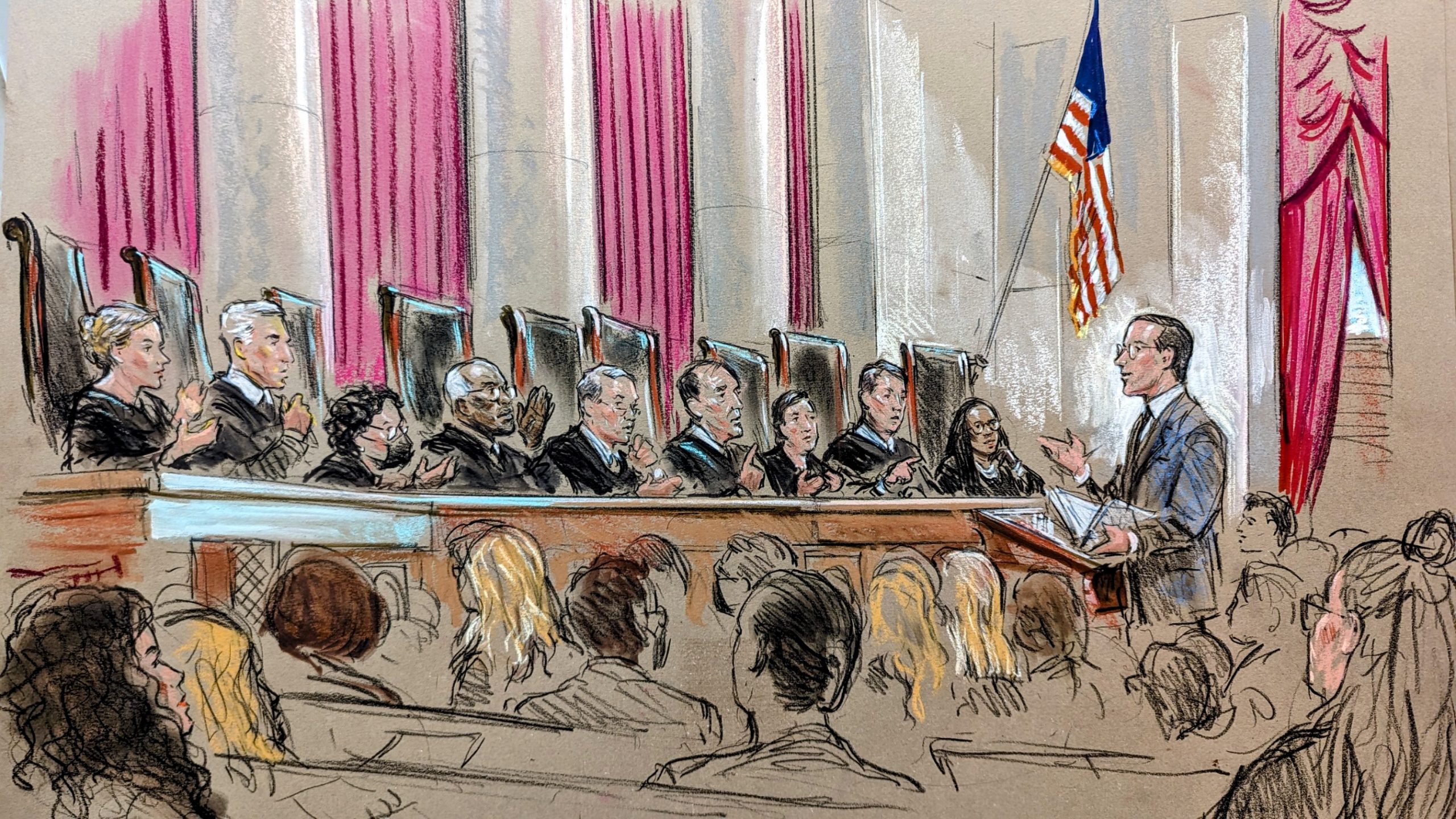
Perhaps one of the most widespread practices that goes (relatively) unnoticed beyond Supreme Court aficionados and obsessives is what I call the “SCOTUS attorney switcheroo.” This is the change in counsel as a case travels from the lower courts to the Supreme Court. Although this may not – on the surface – seem like a very big deal, it has implications not only on the nature of what the court hears but what actually gets decided by the justices.
An elite bar, quietly in control
This phenomenon has deep structural roots. As Richard Lazarus documented in a landmark 2008 article in the Georgetown Law Journal, the past several decades have seen the consolidation of Supreme Court advocacy in the hands of a small group of specialists – former solicitors general, partners at appellate boutiques, and Supreme Court clinic directors – who dominate the court’s docket to an extent not seen since the early 19th century, “when a few extraordinary attorneys” similarly “dominated oral argument before the Court.” That bar has only grown more entrenched since Lazarus’ analysis. The same persons – Paul Clement, Lisa Blatt, Jeffrey Fisher, Noel Francisco, Seth Waxman, Neal Katyal, Gregory Garre, Adam Unikowsky – appear repeatedly, arriving at the Supreme Court stage in cases that were argued in the lower courts by someone else entirely.
Chief Justice John Roberts, the same year he joined the court, penned an article looking at the tradeoff between traditional appellate counsel and Supreme Court elite practitioners, assessing the tradeoffs at the heart of this decision. Roberts did not conclude that there is a one size fits all answer to this dilemma. Not only is it case specific, but is also quite contextual – based on the needs of the case itself.
And the stakes of who argues matter. Michael Nelson and Lee Epstein, writing in the Journal of Law and Courts, demonstrated that experienced Supreme Court attorneys are significantly and consistently more likely to win their cases and capture the votes of individual justices, even when controlling for the underlying merits. Veteran advocates know the court’s interpretive preferences, anticipate the questions from the bench, and frame the issues at the level of generality the justices find most approachable. Similarly, Aaron-Andrew Bruhl’s analysis in the Florida Law Review of decades of party briefs found that elite litigators responded more quickly than non-elites to the court’s substantive shifts, adapting their interpretive toolkit earlier and more comprehensively. All of this is to say: The picture that emerges from the academic literature is one in which advocacy at the Supreme Court is a specialized art — and one that the attorneys who litigate in the circuits may not be equipped to practice.
What the data says
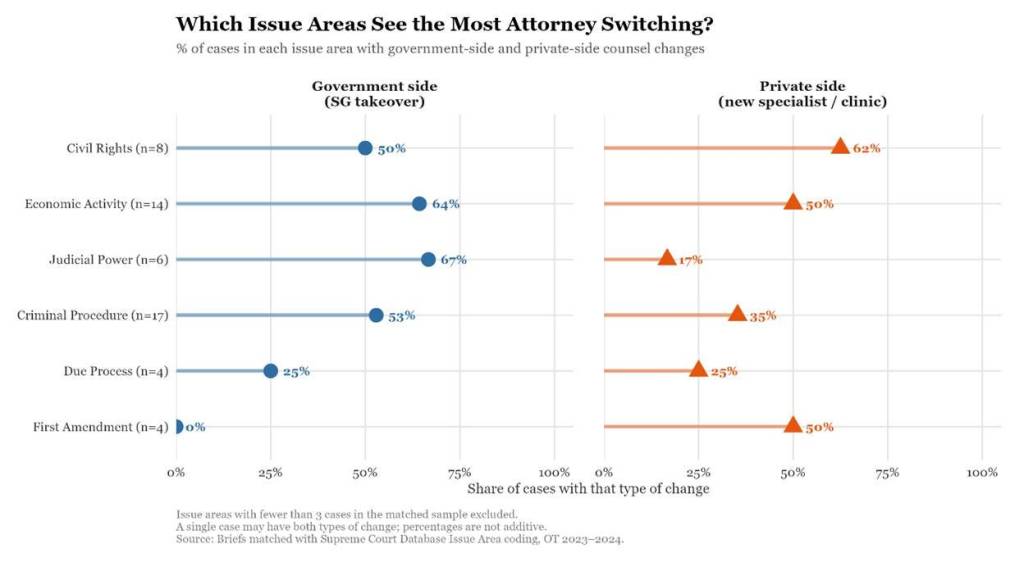
To dig a little deeper into this phenomenon, I examined 71 cases drawn from the 2023-24 term – cross-referenced against the Supreme Court Database. This confirmed that attorney rosters changed in the substantial majority of cases as they traveled from the circuit courts to the Supreme Court. In 56 of those 71 cases, or 79%, at least one meaningful attorney change occurred: a new counsel of record, a Supreme Court specialist coming in, or a clinic (a program typically run by law schools or non-profits) supplanting lower-court counsel.
The personnel shift is pervasive. And it is not random. In particular, the data reveal certain patterns: The switch depends heavily on what kind of case it is and on which elite players are waiting in the wings.
The issue area
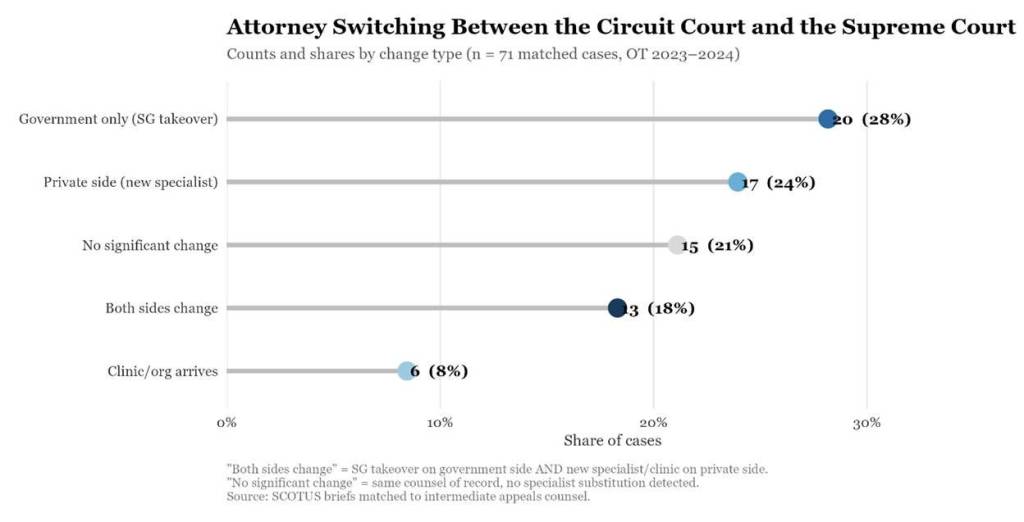
It tuns out that not all areas of law attract the same level of reshuffling. Economic activity cases (14 in the dataset) have a 64% takeover by the solicitor general from DOJ line attorneys or counsel at an agency, reflecting the solicitor general’s institutional interest in guiding administrative and regulatory doctrine. It is the same with judicial power cases, which deal with and shape the authority of Article III courts.
Consider Loper Bright Enterprises v. Raimondo, in which the justices struck down the Chevron doctrine, which counseled courts to defer to federal agencies’ interpretation of an ambiguous statute. That case exemplifies the economic activity pattern at its starkest, as well as the power of federal courts. The fishing company whose dispute became the vehicle for one of the most consequential administrative law decisions in decades was represented at the Supreme Court by Paul Clement, the former solicitor general who had argued before the court more than 100 times. The litigation below had been handled by one team, but at the Supreme Court, Clement’s name as counsel of record signaled to everyone watching that this was no longer a dispute about federal fishery regulations. Rather, it was a referendum on the administrative state itself. The government’s response – with Solicitor General Elizabeth Prelogar as counsel of record – matched the level of that threat.
Interestingly, First Amendment cases present almost the mirror image: there was zero solicitor general involvement in the sample. There was, however, a 50% private-side specialist rate. This reflects the arrival of advocacy organizations and Supreme Court clinics, which effectively function as a specialized bar in the public-interest sphere. In Acheson Hotels v. Laufer, for example, which dealt with whether a plaintiff has a right to sue under the American with Disabilities Act, the plaintiff was represented by Thomas Bacon in the U.S. Court of Appeals for the 1st Circuit and on the cert-stage brief in opposition. By the merits stage, however, the Institute for Constitutional Advocacy and Protection at Georgetown Law had come in, bringing the kind of Supreme Court-focused advocacy infrastructure that a solo plaintiff’s attorney in an ADA standing case would not ordinarily have access to. This was par for the course.
Who argued below
The identity of the circuit-level attorney also matters enormously in predicting whether a substitution will occur.
When the attorney below was already a member of the Supreme Court bar – a repeat player who had previously argued or briefed cases before the justices – the continuity rate is significantly higher. Adam Unikowsky appeared as counsel of record in multiple cases in the dataset, having been recruited at the circuit stage in part because of his established Supreme Court practice. Lloyd Miller, a veteran Native American law practitioner with Supreme Court experience, also remained as counsel of record for the San Carlos Apache Tribe from the U.S. Court of Appeals for the 9th Circuit through the merits brief in Becerra v. San Carlos Apache Tribe, which dealt with healthcare funding for tribes. These are advocates who can do both: they know the record and the client, and they know the court.
But when the attorney below was a regional litigator, a solo practitioner, or a specialist in a field far from Supreme Court practice, substitution is close to inevitable — at least at the merits stage if not before. In Wilkinson v. Garland, an immigration case from the U.S. Court of Appeals for the 3rd Circuit, Rhonda Gelfman, a solo practitioner, represented the petitioner below. At the Supreme Court, she remained on the brief, but Jaime Santos – an experienced Supreme Court practitioner – became counsel of record with Goodwin Procter providing the organizational infrastructure. In Pulsifer v. United States, a criminal sentencing case, the defense attorney before the lower court, J. Robert Black, remained listed, but the renowned Supreme Court team of the law firm Skadden was brought in at the cert and merits stages to handle the briefing and argument.
This pattern — the solo or regional attorney retained nominally but displaced substantively — appears in case after case.
The accountability gap
The attorney who handled the initial appeal and became deeply intertwined in the matter is thus frequently not the attorney who will shape the precedent that comes out the other end.
Stepping back, this makes a great deal of sense. The Supreme Court is a specialized institution with specialized demands. Advocates who appear before it regularly understand its rhythms, its current doctrinal preoccupations, and the particular dynamics of the current bench in a way that a circuit-level specialist may not.
The question then is not whether specialization is valuable – it plainly is – but whether the concentration of that specialization in the hands of a small, overwhelmingly elite bar has other costs. On the one hand, sophisticated institutional litigants – the government, major corporations, well-funded advocacy organizations – are represented at the Supreme Court by advocates who have been there before and will be there again. This sends both a signal of “quality” to the justices and ensures for lawyers uniquely attuned to the court’s expectations and practices. At the same time, this means for some parties – especially individual litigants, criminal defendants, immigrants, and small businesses – their cases are taken over by someone they have never met, and which the attorney who knows the most about the actual facts is, by the time the merits brief is filed, increasingly not the main attorney at the highest court.
And this has consequences. As Aaron Tang has argued, attorney identity is not merely a stylistic variable in Supreme Court litigation — it is a substantive one, shaping the framing of issues, the choice of grounds, and the level of doctrinal ambition that any given case carries into the building. The case the circuit decided and the case the Supreme Court decides may be nominally the same dispute, but they are often analytically distinct, and the change in advocates is both a symptom and a cause of that transformation.
The SCOTUS attorney switcheroo, documented in the data and theorized in the academic literature, is a quiet story beneath the blockbusters. It is now a structural feature of how the modern Supreme Court bar works – and, for better or worse, it is shaping American law.
Posted in Empirical SCOTUS, Recurring Columns
Cases: Pulsifer v. United States, Acheson Hotels, LLC v. Laufer, Loper Bright Enterprises v. Raimondo, Wilkinson v. Garland, Becerra v. San Carlos Apache Tribe