Court appears skeptical of right to jury trial in FCC proceedings

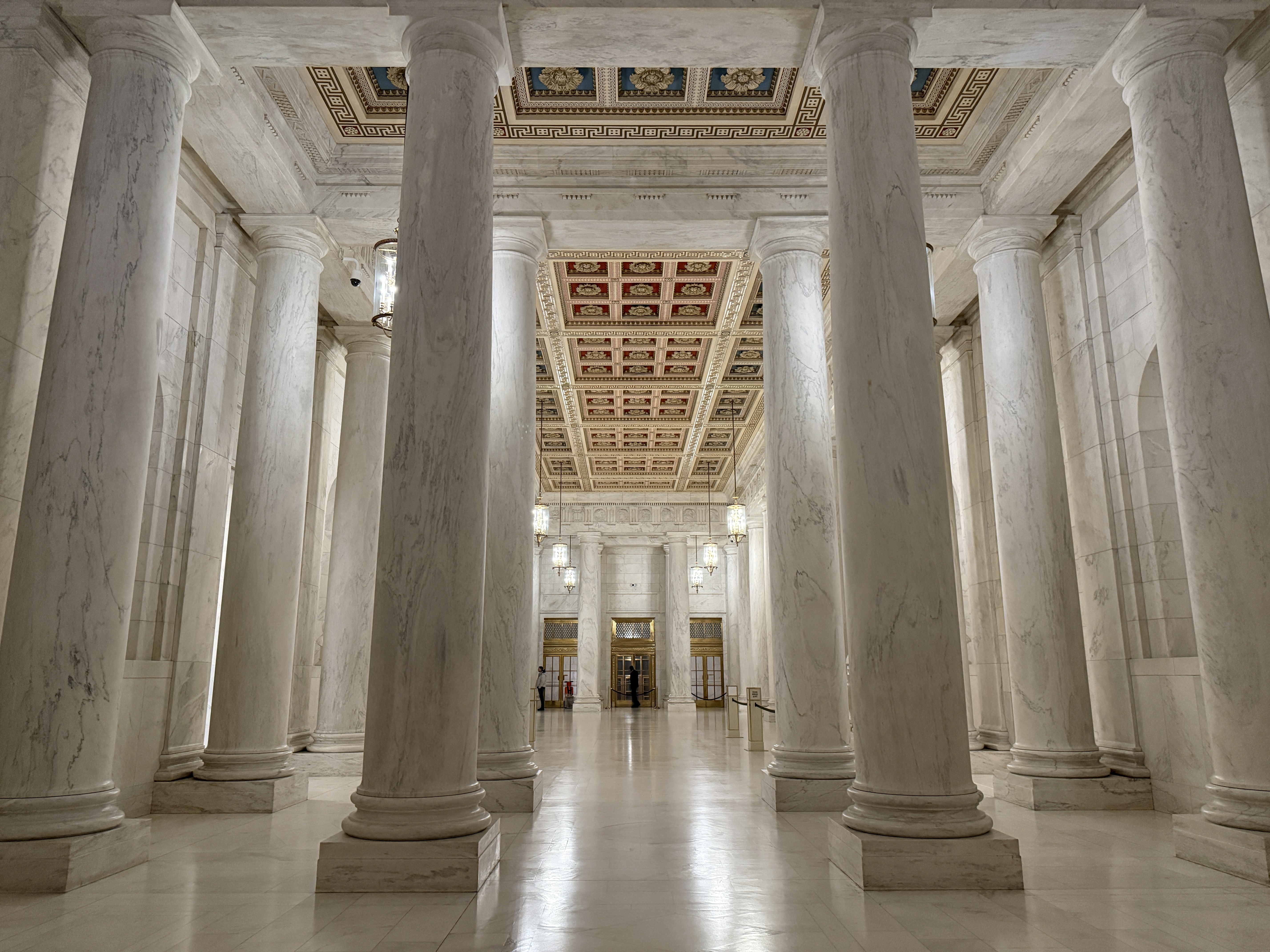
The Supreme Court on Tuesday heard oral arguments in a challenge by telecommunications carriers AT&T and Verizon to the constitutionality of fines that the Federal Communications Commission imposed against them for violations of federal communications laws. AT&T and Verizon contend that the imposition of the penalties, which total more than $100 million, violated their Seventh Amendment right to a jury trial. During nearly 80 minutes of argument, some justices were sympathetic to the companies’ plight, but they also appeared receptive to the FCC’s argument that the orders notifying the companies of the penalties are not binding until the Department of Justice brings a lawsuit to enforce them – at which point a jury trial is available.
Two years ago, the court ruled in SEC v. Jarkesy that the Securities and Exchange Commission’s imposition of fines in its administrative proceedings as a penalty for securities fraud violated the Seventh Amendment, which guarantees a right to a jury trial in “suits at common law” – that is, lawsuits seeking legal remedies, such as money, rather than a remedy (known as equitable relief) that orders a defendant to do something or to stop doing something – in which $20 or more is at stake.
The dispute before the court on Tuesday, FCC v. AT&T, stems from a pair of in-house proceedings in which the agency concluded that AT&T and Verizon had violated a provision of the Telecommunications Act of 1996 that requires telecommunications carriers to protect confidential customer data – here, information about customers’ locations. AT&T and Verizon received notices from the FCC advising them that the agency believed they had violated the law and assessing penalties – $57 million for AT&T and $46.9 million for Verizon. They had the chance to file written responses to the notices, but they did not have a hearing or a trial before the agency issued an order, known as a “forfeiture order,” directing them to pay the penalties within 30 days.
Under the Communications Act, when a carrier receives a forfeiture order, it has two choices. First, it can pay the fine and then seek review in a federal appeals court, which will apply a fairly deferential standard. Second, it can refuse to pay the fine; if it does so, the Department of Justice has five years in which to file a lawsuit in a federal district court to enforce the order and collect the fine. In such a proceeding, the carrier would be entitled to a jury trial.
Both companies opted to go to federal court, where they argued that imposing the fine in an in-house proceeding violated their Seventh Amendment right to a jury trial. The U.S. Court of Appeals for the 5th Circuit agreed with AT&T and threw out the fine. Judge Stuart Kyle Duncan wrote that, “in this process, which was completely in-house, the Commission acted as prosecutor, jury, and judge.”
The U.S. Court of Appeals for the 2nd Circuit upheld the fine assessed against Verizon. Writing for that court, Judge Alison Nathan said that “[n]othing about the Commission’s proceedings … transgressed the Seventh Amendment’s jury trial guarantee.”
Representing the carriers, Jeffrey Wall emphasized that the FCC had imposed more than $100 million in civil penalties on the carriers without giving them any way to obtain a jury trial. That, he said, is a “straightforward violation” of the Seventh Amendment. Although the government characterizes the forfeiture orders as merely an “invitation[] to pay,” he said, the language in the federal statute allowing the government to “assess[] and impose[] penalties” is “not voluntary language.” Indeed, he noted, the government itself treats the orders as binding, requiring the recipients to pay the penalties “by a particular date.”
Wall also contended that the forfeiture orders violated a principle known as the unconstitutional conditions doctrine – the idea that the government cannot use coercion to get people to give up their constitutional rights. Here, he said, the government uses the forfeiture orders because “they know that legitimate parties pay 100% of the time,” because they do not want to wait to see whether the government ultimately brings an enforcement action due to the negative implications of having an outstanding unpaid penalty. It’s “hard to imagine a clearer case of penalizing the exercise of a fundamental constitutional right,” Wall concluded.
By contrast, Vivek Suri, the assistant to the U.S. solicitor general who argued on behalf of the FCC, stressed that the forfeiture orders issued by the FCC are not binding. Unlike in Jarkesy, he noted, where the SEC had its own tools to recover penalties that it had assessed, the FCC can only collect the penalties by filing an enforcement suit, “where you do get a jury trial.” Moreover, he continued, in those enforcement suits for the FCC, the jury trial determines “whether you violated the law in the first place.” And interest on the penalties only accrues after the jury trial, he told the justices, because the penalty is not owed until then.
Several justices seemed to agree with the government’s suggestion that the forfeiture orders are nonbinding and, therefore, the Seventh Amendment is not implicated. Chief Justice John Roberts wondered aloud whether the orders merely created a “PR problem” because they indicated that the carriers “did something bad.” “In terms of the substantive legal issue,” Roberts suggested, “you are not obligated to pay until you get a jury.”
Wall resisted that characterization, telling Roberts that there is a difference between owing a penalty and when you have to pay it. But Roberts pushed back, comparing the penalties in the forfeiture orders to parking tickets. If you don’t pay those, he observed, you get a legal proceeding.
Both Justices Amy Coney Barrett and Ketanji Brown Jackson echoed Roberts’ thinking. Barrett asked Wall whether, if a forfeiture order is not binding, it can violate the Seventh Amendment. And Jackson queried whether, if the forfeiture order is “just a statutory prerequisite for the DOJ to bring … its lawsuit, then don’t you lose?” “I don’t understand the Seventh Amendment to be involved,” she told Wall, “because, when DOJ brings its lawsuit, you will have a jury trial.”
Wall emphasized that the forfeiture orders “have huge consequences” for the carriers, which were “branded an egregious lawbreaker.” The government can’t now simply “slap a non-binding label” on the forfeiture orders, he said, particularly when carriers have consistently paid them for the last half-century.
The potential consequences for the carriers of a forfeiture order, even if labeled “nonbinding” by the government, did appear to be a concern for several of the court’s more conservative justices, such as Justice Neil Gorsuch, who pressed Suri about what repercussions, if any, the orders or the failure to pay the penalties assessed in the orders could have for the carriers. Suri assured the justices that the only legal consequences for a failure to pay the penalty would be an enforcement action by the DOJ. Facts in a penalty order, Suri said, do not carry “any special weight” in future proceedings. Instead, he told the justices, “if the same fact happens to be relevant again, it can be tried again” – a response that seemed to mollify them.
In his rebuttal, Wall warned that construing the forfeiture orders as nonbinding but allowing the government to use the facts would create a “domino problem”: “We couldn’t get a jury in the first instance, so we had to pay or hold out and not get a jury. Now you’re going to use it again in this order, and we won’t be able to get a jury there either. If you disagree with us again, we’ll have to sit and wait,” Wall said. He urged the Supreme Court to “avoid all” of the potential problems by holding that the scheme violates the Seventh Amendment. “But, at a minimum,” he concluded, “these orders shouldn’t be worth anything more than the paper they’re printed on, and we ought to get our money back.”
A decision in the case is expected by late June or early July.
Posted in Court News, Featured, Merits Cases
Cases: Federal Communications Commission v. AT&T, Inc., Verizon Communications Inc. v. Federal Communications Commission