
Skip to content
Newsletter

SCOTUStoday for Wednesday, March 18

Kelsey Dallas's Headshot
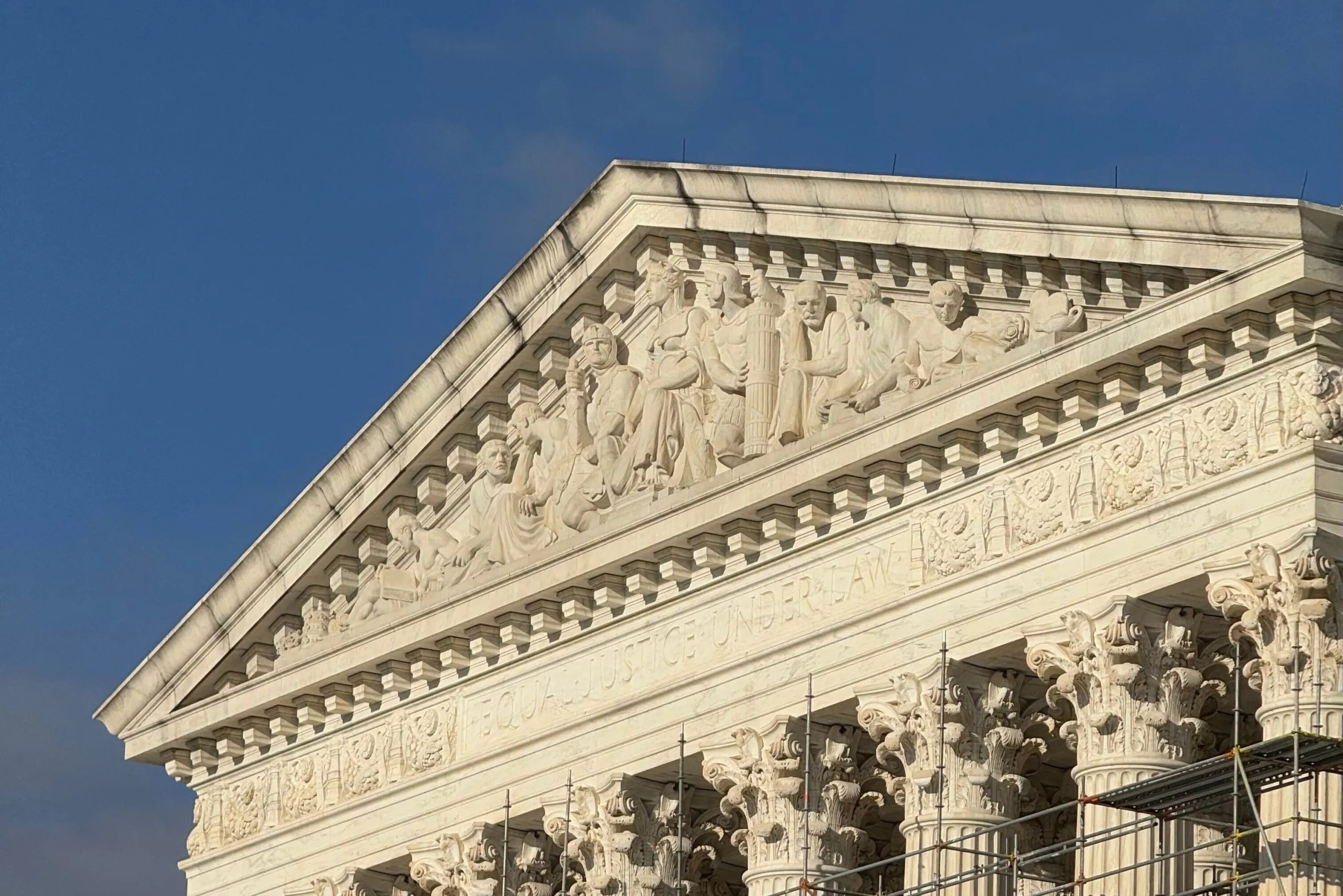
Carved details along top of Supreme Court building are pictured
(Katie Barlow)

Should the White House look more like the Supreme Court Building? The chairman of the Commission of Fine Arts, Rodney Mims Cook, Jr., has suggested swapping the White House’s “graceful Ionic columns” for “more ornate” Corinthian columns, the style of columns used for the Supreme Court, according to The Washington Post. “Corinthian is the highest order” of column, Cook said.

At the Court

The court has indicated that it may announce opinions on Friday at 10 a.m. EDT. We will be live blogging that morning beginning at 9:30.

Also on Friday, the justices will meet in a private conference to discuss cases and vote on petitions for review. Orders from that conference are expected on Monday at 9:30 a.m. EDT.

The court will next hear arguments on Monday, the first day of its March sitting.

Morning Reads

Chief Justice John Roberts warns personal attacks on judges have 'got to stop'

Lawrence Hurley, NBC News

During an appearance on Tuesday at Rice University in Houston, Chief Justice John Roberts spoke about criticism of the court and of individual judges and justices. Without naming President Donald Trump, who has repeatedly criticized the Supreme Court in recent weeks, Roberts explained “that critiques of the substance of Supreme Court rulings are part of the job but that some more pointed comments have gone too far,” according to NBC News. “The problem sometimes is that the criticism can move from a focus on legal analysis to personalities. And you see from all over, I mean, not just any one political perspective on it, that it’s more directed in a personal way, and that, frankly, can be actually quite dangerous,” Roberts said.

What's at stake in Springfield if SCOTUS lets Trump deport Haitians?

Danae King, Columbus Dispatch

Springfield, Ohio, was thrust into the national spotlight during the 2024 presidential election when then-candidate Donald Trump warned about the city’s Haitian immigrants. Now, a group of residents has filed a brief urging the Supreme Court to protect those Haitian immigrants as the justices consider the Trump administration’s effort to remove their protected immigration status, according to the Columbus Dispatch. “The amicus brief says millions of dollars in tax revenue are at stake if Haitians are made to leave Springfield,” as well as community diversity and economic growth.

RFK Jr's vaccine agenda stymied by Boston judge who has handed Trump setbacks

Nate Raymond, Reuters

On Monday, U.S. District Judge Brian Murphy blocked Health and Human Services Secretary Robert F. Kennedy Jr.’s effort to change U.S. vaccine rules. It was Murphy’s latest ruling against the Trump administration, which has also been before him in immigration, funding, and energy policy cases, according to Reuters. “Cases with national significance have been piling up on the dockets of Massachusetts-based judges like Murphy, as Trump opponents strategically funnel litigation into the federal court in Boston now dominated by the judicial appointees of Democratic presidents.” Last year, the Supreme Court lifted Murphy’s injunction in an immigration case, “clearing the way for the deportation of several men to South Sudan.”

Alabama Supreme Court rules that police can require people to provide identification

Ralph Chapoco, Alabama Reflector

On Friday, the Alabama Supreme Court “ruled that state law enforcement may arrest people who do not provide identification if they are not satisfied with the answers they provide about their identities,” according to the Alabama Reflector. “The crux of the case is a person’s Fourth Amendment right against unreasonable searches and seizures. The U.S. Supreme Court has ruled that the Constitution allows law enforcement to stop and detain someone to investigate” if the person is suspected of a crime, but that these stops, known as Terry stops, “must be temporary, not last ‘longer than necessary’ and be done in the least intrusive way.” According to the Alabama Supreme Court’s ruling, “the suspect bears the burden to completely identify himself or herself during a valid Terry stop.”

Arkansas school districts blocked from displaying Ten Commandments

BrieAnna J. Frank, USA Today

On Monday, U.S. District Judge Timothy Brooks “blocked several Arkansas school districts from implementing a state law requiring public schools to display the Ten Commandments,” holding that “[t]he displays would violate students’ and parents’ First Amendment rights,” according to USA Today. In his ruling, Brooks quoted “a landmark 1962 U.S. Supreme Court opinion over prayer in public schools,” Engel v. Vitale, writing that Arkansas “may have lost sight of the fact that ‘a union of government and religion tends to destroy government and to degrade religion.’”

A ‘Defender General’?

Michael A. Fragoso, National Review

In a column for the National Review, Michael A. Fragoso reflected on the Judicial Conference’s recent decision to create an office that “coordinate[s] criminal defense strategy at the Supreme Court,” explaining why he believes “there are a number of problems with this.” Among other potential issues, it may involve using funding without statutory authorization and that was approved for a different purpose. “Republican appropriators should proceed with caution,” Fragoso wrote.

On Site

From the SCOTUSblog Team

The remaining questions after the Supreme Court’s tariffs ruling

Last month, the Supreme Court ruled that the International Emergency Economic Powers Act did not give President Donald Trump the authority to impose sweeping tariffs. Although the decision was a landmark one, it left a variety of questions open – some of which Amy explored in her latest analysis.

Supreme Court is showing in Washington, D.C.
From the SCOTUSblog Team

The Supreme Court of Canada

For SCOTUSblog’s series on different supreme courts around the world, Zachary Shemtob spoke with Adam Dodek, a professor of constitutional law at the University of Ottawa, about the Supreme Court of Canada.

The Supreme Court of Canada.
Contributor Corner

The biggest names on the briefs

In his Empirical SCOTUS column, Adam Feldman analyzed the authorities that advocates turn to in their Supreme Court briefs in an effort to determine which authorities are cited the most often and what that might tell us about how Supreme Court advocacy works today.

Pulsifer v. US

Podcasts

Advisory Opinions

Judge Gets Vulgar in Transgender Spa Case

Sarah Isgur and David French dive into two opinions from the U.S. Court of Appeals for the 9th Circuit: one involving anti-discrimination law in Washington and another related to a first-grade girl being punished for giving her classmate a drawing inspired by what her teacher read in class.

SCOTUS Quote

JUSTICE SCALIA: “What are – what are you quoting from? I’m –”

JUSTICE BREYER: “I’m quoting from regulations which are 54 U.S.C. – I don’t know. I’ll – I’ll have to show you later, because I’m quoting –”

(Laughter.)

JUSTICE BREYER: “We’re going to get into numbers, and I – I just thought this case is too complicated to ask anything, but you’ve tempted me.”

Sturgeon v. Frost (2016)

Recommended Citation: Kelsey Dallas, SCOTUStoday for Wednesday, March 18, SCOTUSblog (Mar. 18, 2026, 9:00 AM), https://www.scotusblog.com/2026/03/scotustoday-for-wednesday-march-18/