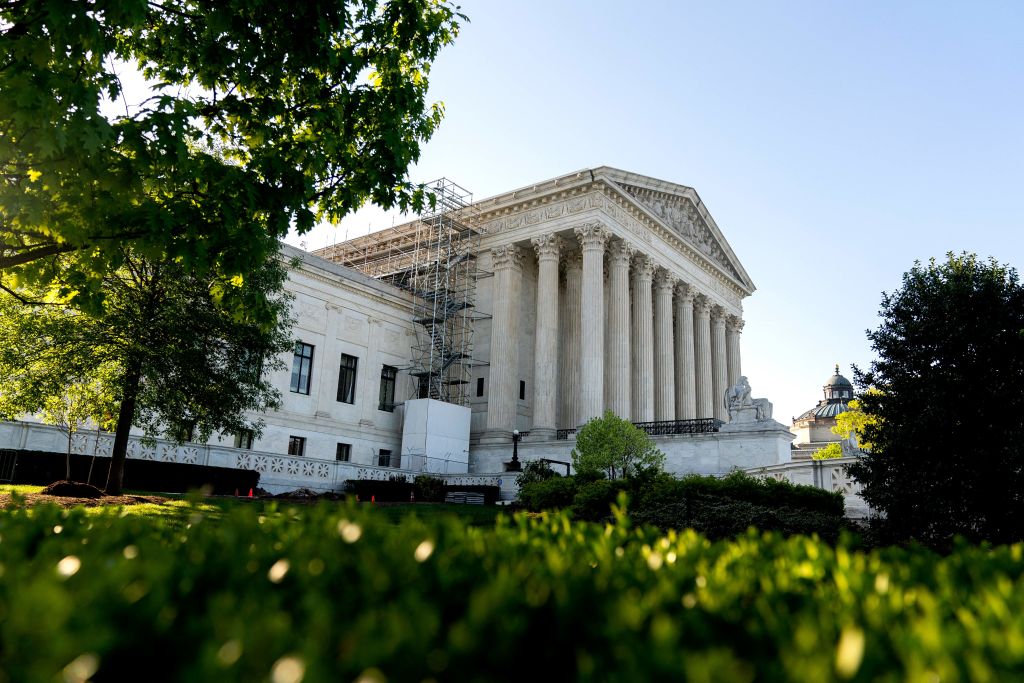
Announcement of opinions for Tuesday, February 24
We will be live blogging as the court releases opinions in one or more argued cases from the current term.
Click here for a list of FAQs about opinion announcements. Note: A login is not required to participate in the chat.
Court grapples with disputes over efforts to recover losses from Cuban confiscations
Birthright citizenship: under the flag
How and why the conservative justices differed on tariffs
SCOTUStoday for Tuesday, February 24
More news
Watching tariffs come down
Today is the first time the court is taking the bench since its nearly four-week mid-winter recess. It is a day for bar admissions and possible opinions before the February sitting starts in earnest on Monday.
The tariff case is hanging in the air. Solicitor General D. John Sauer, who argued for the president’s policies, is here, with two assistants from his office. Neal Katyal, who argued for the challengers in the companion case of Trump v. V.O.S. Selections, is also in the bar section.
Two groups are here for admission to the Supreme Court Bar, one from Washburn University Law School and the other the Metropolitan Black Bar Association, of New York City. They don’t know in advance that they will get to witness such a historic day.
A breakdown of the court’s tariff decision
Empirical SCOTUS is a recurring series by Adam Feldman that looks at Supreme Court data, primarily in the form of opinions and oral arguments, to provide insights into the justices’ decision making and what we can expect from the court in the future.
“We decide whether the International Emergency Economic Powers Act (IEEPA) authorizes the President to impose tariffs.”
That is the first sentence of Chief Justice John Roberts’ opinion for the court in Learning Resources, Inc. v. Trump, decided today, Feb. 20, 2026. The case arose from a challenge to broad tariffs that the executive branch imposed pursuant to IEEPA’s grant of authority to “regulate . . . importation.” The court’s decision on whether the president had the power to do so was unambiguous:
Continue ReadingThe President asserts the extraordinary power to unilaterally impose tariffs of unlimited amount, duration, and scope. In light of the breadth, history, and constitutional context of that asserted authority, he must identify clear congressional authorization to exercise it. IEEPA’s grant of authority to “regulate . . . importation” falls short. IEEPA contains no reference to tariffs or duties. The Government points to no statute in which Congress used the word “regulate” to authorize taxation. And until now no President has read IEEPA to confer such power. We claim no special competence in matters of economics or foreign affairs. We claim only, as we must, the limited role assigned to us by Article III of the Constitution. Fulfilling that role, we hold that IEEPA does not authorize the President to impose tariffs.
Announcement of opinions for Friday, February 20
On Friday, Feb. 20, we were live as the court released its opinion in Learning Resources, Inc. v. Trump, the tariffs case.
Click here for a list of FAQs about opinion announcements. Note: A login is not required to participate in the chat.
Continue ReadingJustices to consider constitutionality of tax foreclosure sales
The argument next week in Pung v Isabella County asks the court to consider the constitutionality of the longstanding practice of tax foreclosures sales. This is one of those cases that would be tremendously important if it came out one way and will probably sink without a trace if it comes out the other. My guess, unless the justices want to call into question the basic architecture of foreclosure sales in every jurisdiction in the country, is that they’re not going to accept Pung’s challenges to this process.
Continue ReadingDemocrats ask Supreme Court not to disrupt New York redistricting dispute
Two separate groups of New York voters and elected officials on Thursday afternoon urged the Supreme Court to leave in place a ruling by a state trial judge in Manhattan that would bar the state from using its existing congressional map in the 2026 elections. Instead, the ruling by Justice Jeffrey Pearlman of the New York Supreme Court – which is a trial court in that state – would require New York to redraw the map on the ground that it diluted the votes of Blacks and Latinos in the only New York City congressional district represented by a Republican. The voters called the request to intervene a “brazen defiance of” the Supreme Court’s rules, while a group of state officials added that granting the request would require the court to improperly intrude on state interests.
Continue Reading