What oral arguments and opinion authorships can actually tell us

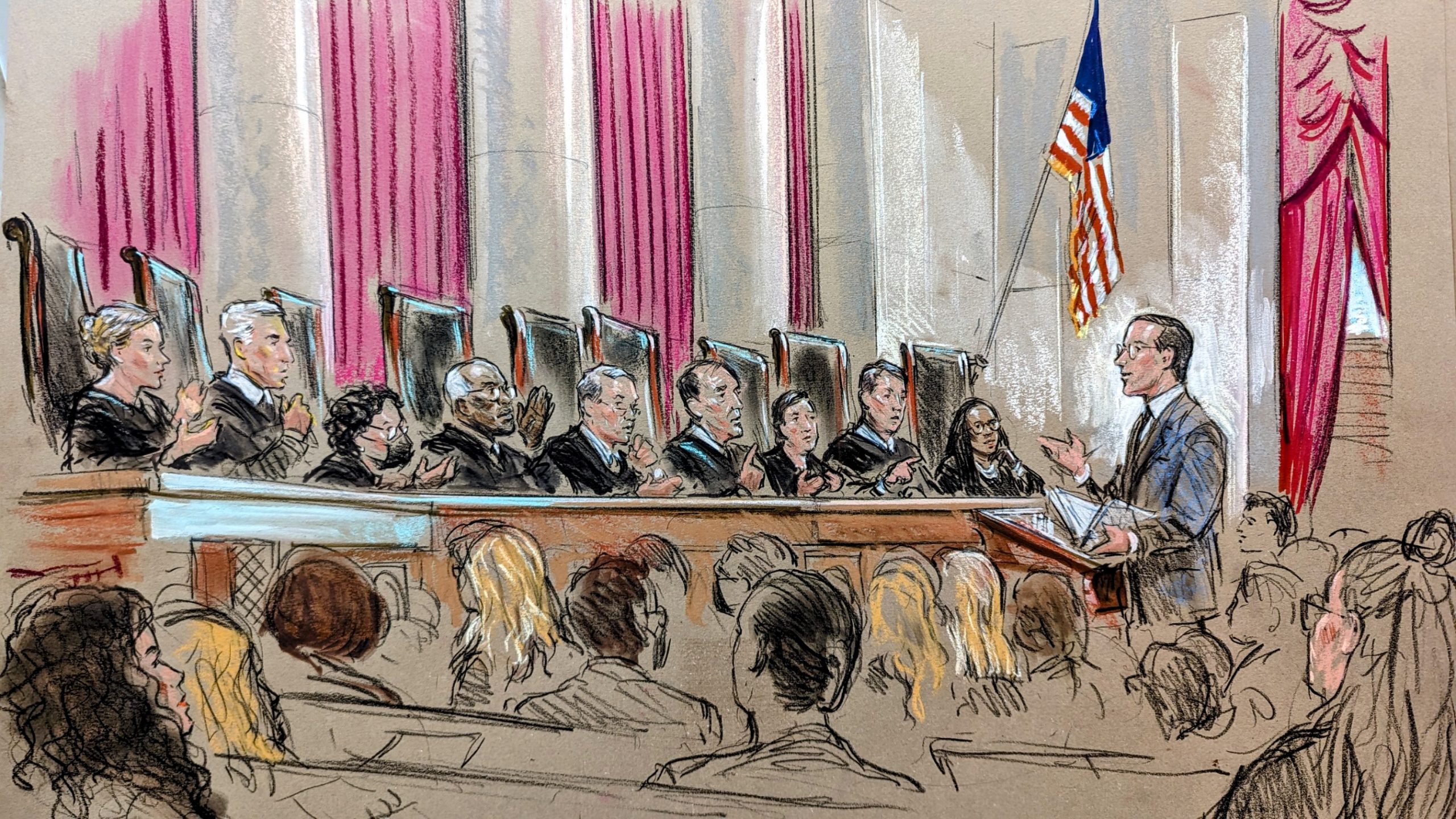
Empirical SCOTUS is a recurring series by Adam Feldman that looks at Supreme Court data, primarily in the form of opinions and oral arguments, to provide insights into the justices’ decision making and what we can expect from the court in the future.
In Case v. Montana, which dealt with the conditions in which police officers may enter a home without a warrant to render emergency aid, Justice Neil Gorsuch arrived at oral argument with a specific legal theory already in hand. He pressed counsel on whether a private citizen historically could enter another person’s property to prevent serious harm. Gorsuch conveyed that law enforcement – regarding their ability to enter one’s property in an emergency situation – should have no fewer rights than a private citizen would. At the same time, he insisted that any emergency-entry is bounded – it authorizes a limited entry for law enforcement to deal with that emergency, not a general license to search the premises. When his separate concurrence appeared, it tracked those questions almost exactly: the Fourth Amendment’s emergency-aid exception for police to enter one’s home, he wrote, is grounded in the common law of necessity and the historic privilege of private citizens to enter property to avert serious physical harm.
That alignment between argument and opinion is not incidental. Across the 2025-26 term’s argued cases through the March sitting, the oral-argument transcripts reveal two distinct types of opinions. For majority opinions, the clearest signal of an opinion’s author is early conversational centrality – which justice dominated oral argument in its opening phase. For concurrences and dissents, the stronger signal is linguistic: the specific framing that a justice advanced. This suggests the justices at oral argument are doing something more than “advocacy theater” or simply advocating a position. Rather, during oral argument, they are actually engaging in a visible stage of the opinion-writing process.
For majority opinions, timing matters more than volume
The conventional assumption – that the justice who dominates the whole argument is most likely to write – turns out to be weaker than a subtler alternative. The better predictor of majority authorship is not how much a justice speaks overall, but how active the justice is in the argument’s first 25 exchanges. Interestingly, justices who are most present in that early window end up being the majority author at a substantially higher rate than those who are merely the most voluminous speakers across the whole argument.
The distinction has an intuitive explanation. Early in the argument, the justices are still establishing what the case is actually about – which doctrinal frame will govern, which facts are legally relevant, which party has the harder question. A justice who is especially active in that formative phase may be doing more than asking questions. They may be taking ownership of the legal problem. On the other hand, the justice who talks most across the full argument may simply be an engaged questioner. Those are different things.
One complication is worth flagging. Because the post-Covid setup in which the justices speak is based on seniority, the earliest exchanges are not a pure measure of initiative – it also reflects the institutional seating sequence. The data bears this out: a justice’s order of first entry is statistically associated with authorship, but when used alone to pick a specific author it performs poorly (the author lands in the top three on this measure in only seven of 15 cases). The early-share measure is more useful precisely because it captures sustained presence in the opening exchange rather than just the accident of when a justice first gets called upon.
The case-level record illustrates where this is sharpest. Justice Sonia Sotomayor’s majorities in Galette v. New Jersey Transit Corp., Bowe v. United States, and Hain Celestial Group v. Palmquist each followed her early presence at oral argument. In five others – Berk v. Choy (Justice Amy Coney Barrett), Villarreal v. Texas (Justice Ketanji Brown Jackson), Bost v. Illinois State Board of Elections (Chief Justice John Roberts), GEO Group v. Menocal (Justice Elena Kagan), and Urias-Orellana v. Bondi (Justice Ketanji Brown Jackson) – the eventual author ranked second in this regard.
The counterexamples are equally instructive. In USPS v. Konan, Justice Clarence Thomas authored the majority but ranked seventh on total exchange and ninth on word share – perhaps not surprising for the famously taciturn justice. Chief Justice John Roberts – who also speaks relatively infrequently – authored Learning Resources v. Trump, the tariffs case, while ranking sixth on exchanges and eighth on word share. Neither justice looked dominant by volume. Both thus make more sense under an early-centrality account than under a total talkativeness account.
Raw speaking volume still matters – but differently for different justices
Volume is not irrelevant. Majority authors do tend to occupy more of the court’s speaking space than their colleagues in a given case (exchange share and word share each place the eventual author in the top three such justices roughly 47% of the time). But the relationship between volume and authorship is complicated by the fact that the justices have very different speaking styles, and authorship does not show up the same way across all of them.
Jackson was the most talkative justice by a considerable margin, averaging nearly 18% of justices’ turns and nearly 23% of justices’ words. Gorsuch is also highly active at argument. Thomas, by contrast, averages around 4% of exchanges and 3% of words – a gap that makes raw-volume comparisons across justices almost meaningless as an authorship signal. Thomas entering a conversation at all is thus a different data point than Jackson doing so.
For justices who are already actively engaged at argument, this means that authorship tends to appear as a relative increase over their own baseline – more present, earlier, than in the cases they do not write. For justices like Thomas, whose baseline is quiet, entering early in the seniority sequence in a case may suggest the issues in place are doctrinally in his wheelhouse.
One justice-level anomaly is sharp enough to deserve its own note. Kagan wins the longest-average-exchange metric in eight of 15 cases – more than any other justice by a wide margin – but authors only three majority opinions in the dataset. This indicates that at argument, more than any other justice, Kagan is often working through a problem aloud, or laying out a doctrinal landscape, in a way that does not translate into the early conversational centrality that tends to result in a majority opinion.
Majority authors range broadly; separate authors drill down
One of the cleaner findings in the data concerns not how much a justice speaks, but how that speaking is distributed across the two sides of the argument. The model for majority authorship shows that concentrating disproportionate attention on the first advocate – the petitioner – is actually a negative predictor of writing the majority opinion. The practical implication is that justices who are posturing, consciously or not, for the majority opinion tend to engage both advocates. They need the full record to write for the court.
When the outcome measure shifts from majority authorship to any-opinion authorship – including concurrences and dissents – things flip. Concentrating on the first advocate identifies an opinion author in six of 15 cases at the top rank, up from two of 15 for majority authorship alone. And in each of those six, the winning justice was not the majority author. The justices flagged by this measure – Gorsuch in Bowe, Alito in Villarreal and GEO Group, Barrett in Bost – are in every instance a separate writer. The pattern has an intuitive logic which has already been shown to be significant in the political science literature: a justice who has already decided which side’s argument is deficient may spend the argument pressing that side harder.
Concurrences and dissents leave a different kind of trace
When the question shifts from who wrote the majority to who wrote any opinion, the metrics that perform best change: sustained word volume and linguistic presence across the full argument become more predictive than early conversational centrality. This, again, makes sense on its face. Separate writers may not be concerned with framing a common path. They are staking out a position of their own, and they begin doing so at argument.
Majority opinions are coalition products, shaped by assignment, circulation, and the need to hold five votes. Individual voice gets sanded down in the process. Separate opinions preserve individual voice in a way that majority opinions cannot. They do not need other justices’ buy-ins. The Gorsuch concurrence in Case v. Montana is a clear illustration of why. His argument questions were not just topically related to his concurrence. They were structurally identical. He organized the oral exchange around the common-law necessity privilege; he organized the concurrence around the same principle. No other justice joined him in this, so there was no need to moderate his voice and cater to any judicial coalition.
What the data can and cannot establish
The most important qualification is that this analysis does not directly account for justices’ ideologies or voting coalitions. Some of the early oral-argument dominance by a majority author likely reflects him or her being positioned near the center of the likely coalition – justices who know, or suspect, where the majority is heading and are already working to define it. A second limit is the sample size. Fifteen decided argued cases is a meaningful start, but it is not a basis for strong claims. The separate-opinion similarity results are drawn from a subset of that already modest universe.
What the data does establish is simpler and, for court watchers, more immediately useful. Oral argument is not mere performance. The transcript contains information about who is taking ownership of a case – information that begins to appear before any opinion is assigned, circulated, or announced. For majority opinions, that ownership tends to look like early conversational presence and broad engagement across both sides of the argument. For separate writings, it tends to look like the persistence of a justice’s individual area of focus from the bench into the opinion.
Oral argument, on this account, is not just performance, but the earliest indication of which justice will own the case.
Posted in Empirical SCOTUS, Featured, Recurring Columns
Cases: Case v. Montana