Skip to content
Newsletter

SCOTUStoday for Monday, April 6

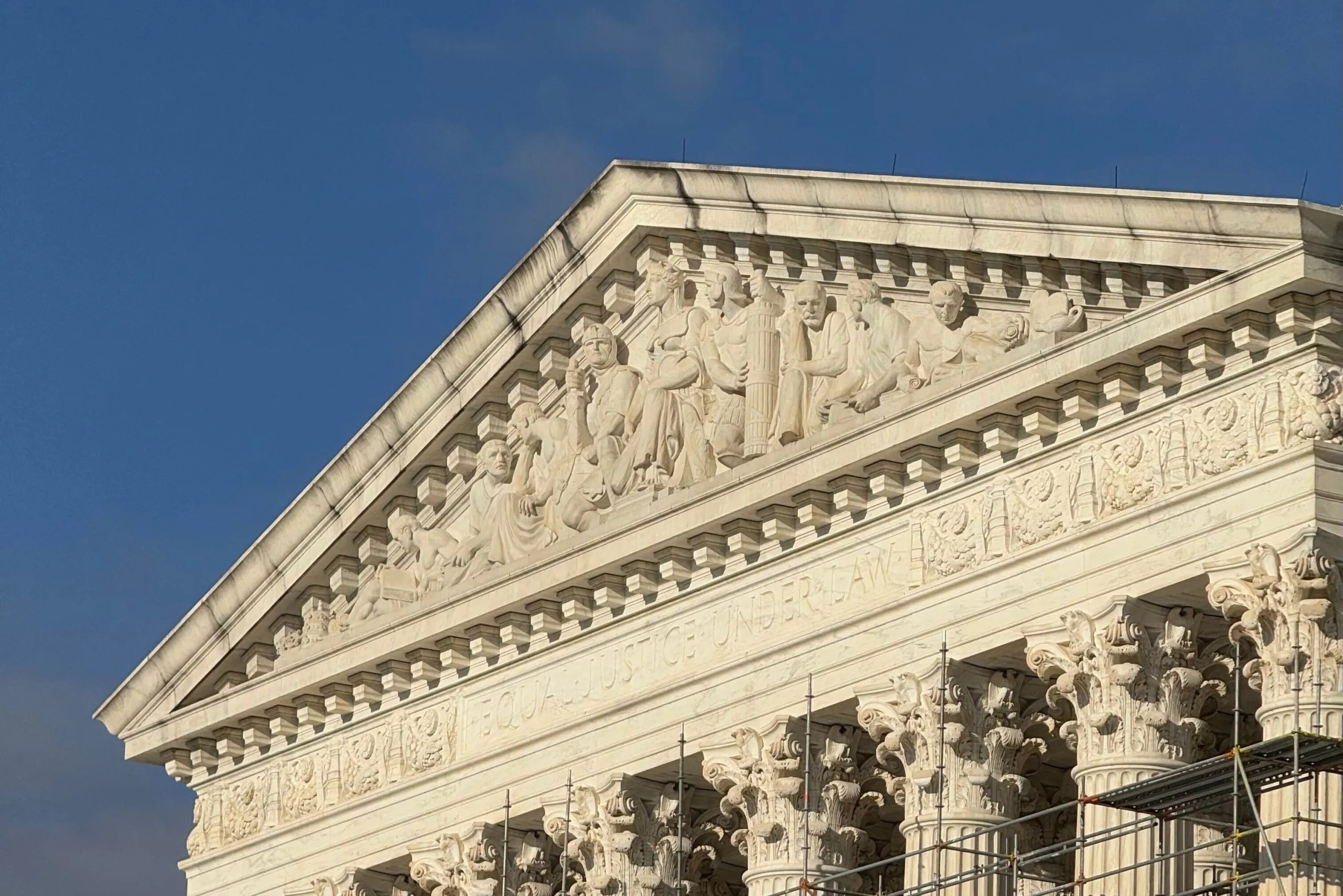
Carved details along top of Supreme Court building are pictured
(Katie Barlow)

On this day in 1938, the Supreme Court heard argument in United States v. Carolene Products, on a law that prohibited interstate shipping of filled milk, an alternative to traditional dairy milk. Anastasia Boden wrote about the court’s eventual ruling in a column for SCOTUSblog in February, highlighting a footnote in then-Justice Harlan Fiske Stone’s majority opinion that has had profound effects on constitutional law.

At the Court

On Thursday, the justices met in a private conference to discuss cases and vote on petitions for review. Orders from that conference are expected this morning at 9:30 a.m. EDT.

On Friday, the court confirmed a report that Justice Samuel Alito was briefly hospitalized on March 20. For more on the court’s statement, see the On Site section below.

The court will next hear arguments on Monday, April 20, the first day of its April sitting.

Morning Reads

Trump files emergency appeal to keep building White House ballroom

Dan Diamond and Jonathan Edwards, The Washington Post

On Friday, the Trump administration asked the U.S. Court of Appeals for the District of Columbia Circuit to block “a federal judge’s order to halt the construction of President Donald Trump’s White House ballroom, arguing in an emergency motion that pausing the $400 million project would raise national security risks,” according to The Washington Post. “‘Time is of the essence!’ Justice Department lawyers wrote, saying that the planned 90,000-square-foot addition to the White House is being designed to defend against ‘hostile attacks via drones, ballistic missiles, bullets, biohazards’ and other potential threats to the president.” The administration noted that “it would seek emergency relief from the Supreme Court if necessary.”

Pam Bondi Wanted a Graceful Exit. But Trump Wanted Her Gone.

Glenn Thrush and Tyler Pager, The New York Times

In its story on when and why Trump parted ways with former Attorney General Pam Bondi, The New York Times revealed that Trump and Bondi’s conversation about her departure took place during their Wednesday trip together to the Supreme Court. “Bondi, downcast but determined, joined Mr. Trump for a glum crosstown drive to the Supreme Court, where they watched arguments in the birthright citizenship case. In the car, Mr. Trump told her it was time for a change at the top of the Justice Department.” The president then announced her firing in a Thursday morning social media post.

Trump administration can't make colleges provide race-related data, judge rules

Nate Raymond, Reuters

U.S. District Judge F. Dennis Saylor IV on Friday ruled that “[t]he Trump administration cannot force public universities in 17 U.S. states to turn over sweeping amounts of data so it can examine whether they have ceased considering race as an admissions factor,” issuing a preliminary injunction in a lawsuit “over a new data reporting requirement the Department of Education adopted in a survey used to gather information from colleges,” according to Reuters. The Department of Education is seeking “seven years of admissions data on the race and sex of students to track compliance with the Supreme Court’s 2023 ruling ending affirmative action in higher education.” In Friday’s ruling, Saylor noted that “the Education Department had the statutory authority to seek such data but he said the ‘rushed and chaotic manner’ by which it adopted the new requirements led it to not properly engage with universities about problems they foresaw,” such as needing more time to ensure accuracy.

What to know about the battle over lawsuits alleging that Roundup weedkiller can cause cancer

David A. Lieb, Associated Press

Later this month, the Supreme Court will hear argument in a case on whether the company behind Roundup weedkiller can be sued under state laws by individuals who developed cancer while using Roundup. The company, Bayer, contends that it is protected from such lawsuits by federal law, which did not require labels with cancer warnings. Bayer has the support of the federal government in the case, but it’s not acting as if it will definitely win, according to the Associated Press. Instead, Bayer is pursuing a $7.25 billion settlement deal “intended to resolve most of the pending and future failure-to-warn claims involving Roundup” and working with state legislatures to bar the filing of such lawsuits in the future.

Nationwide Injunctions, a Crucial Check on Presidential Power, Are Not Dead Yet

Damon Root, Reason

In a column for Reason, Damon Root contended that the Supreme Court’s ruling last June limiting judges’ use of universal, or nationwide, injunctions, has not brought as much change to the legal system as some predicted it would. “[Y]ou may think that President Donald Trump is now free to implement his national agenda of immigration crackdowns without facing any more interference from pesky lower court judges, who have enjoined such presidential policies in the past,” Root wrote. But “the Supreme Court left the courthouse doors wide open for federal judges to block the president’s actions nationwide through other comparable legal mechanisms, such as national class-action lawsuits.”

On Site

From the SCOTUSblog Team

Supreme Court issues statement that Justice Alito was hospitalized approximately two weeks ago

Justice Samuel Alito was hospitalized on March 20 “[o]ut of an abundance of caution” and at the recommendation of his security detail, the Supreme Court’s Public Information Officer said in a statement released to reporters on Friday afternoon. The statement noted that “he returned home that night, as previously planned … and he returned to work the following Monday for oral argument.”

Associate Justice Samuel Alito sits during a group photo of the Justices at the Supreme Court in Washington, DC on April 23, 2021.
From the SCOTUSblog Team

The inscrutable Chief Justice John Roberts

Chief Justice John Roberts rarely speaks in public, and when he does so, he seems to studiously avoid saying anything particularly memorable. But when viewed in full, his public statements form a narrow but consistent philosophy.

RobertsJuly1
Contributor Corner

What oral argument told us in the birthright citizenship case

In his Empirical SCOTUS column, Adam Feldman closely analyzed the transcript from the April 1 oral argument in the birthright citizenship case, exploring who drove the debate, what it centered on, and what this tells us about a possible outcome.

Pulsifer v. US

SCOTUS Quote

JUSTICE SCALIA: “ … I didn’t understand Justice Breyer’s question where he said the amiable bank robber says, would you please step … Would you please step over here?”

JUSTICE BREYER: “Yeah, I’m walking into a bank robbery where they have about –”

JUSTICE SCALIA: “Step over there or I’ll blow your head off is what he says.”

MR. FLETCHER: “Yes, and I imagine a request –“

JUSTICE BREYER: “My – my example was meant to encompass a polite, but armed, bank robber.”

Whitfield v. United States  (2014)

Recommended Citation: Kelsey Dallas and Nora Collins, SCOTUStoday for Monday, April 6, SCOTUSblog (Apr. 6, 2026, 9:00 AM), https://www.scotusblog.com/2026/04/scotustoday-for-monday-april-6/