Court seems sympathetic to death-row inmate’s attempt to challenge racial discrimination in jury selection

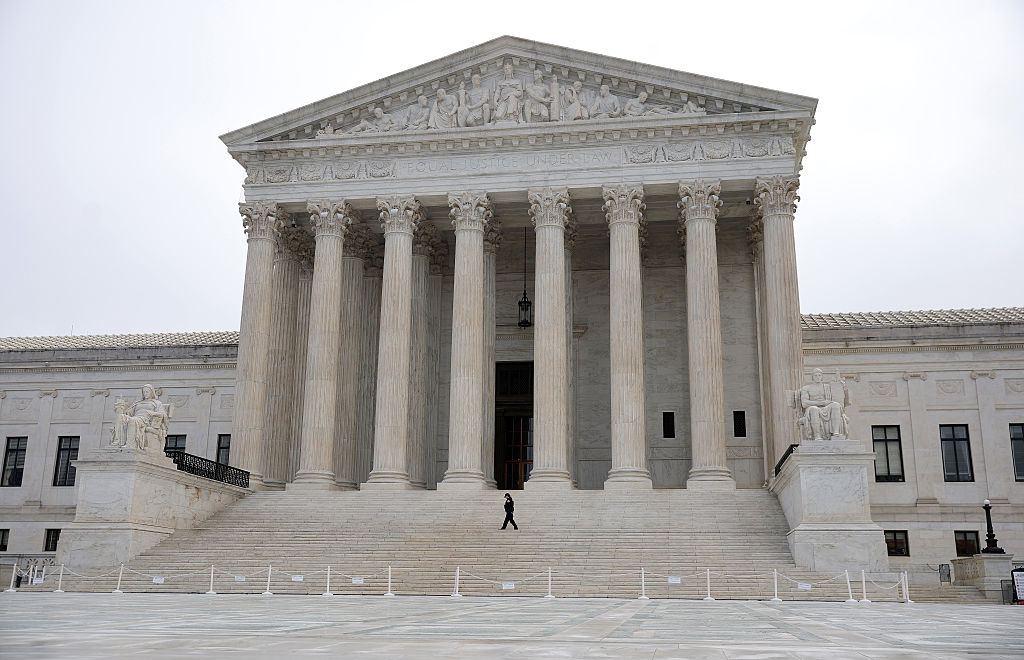
The Supreme Court on Tuesday seemed sympathetic to a Mississippi man who argues that a district attorney violated the Constitution’s ban on racial discrimination in jury selection. Terry Pitchford is on death row for his role in the 2004 robbery and murder of Reuben Britt, who owned a store in Grenada County, Mississippi. At his trial, prosecutor Doug Evans eliminated four potential jurors, all of whom were Black, over the objections of Pitchford’s lawyers.
The question before the justices on Tuesday was not whether Evans’ conduct violated the Supreme Court’s 1986 decision in Batson v. Kentucky, holding that the use of peremptory challenges (that is, challenges for any reason) to remove potential jurors based on race violates the Constitution. Instead, the justices and lawyers debated another issue: whether a ruling by the Mississippi Supreme Court upholding Pitchford’s conviction and sentence on the ground that he had waived his right to make a Batson challenge was not simply wrong, but an “objectively unreasonable” application of Supreme Court precedent. After nearly two hours of oral arguments in Pitchford v. Cain, a majority of the justices appeared to agree with Pitchford that it was.
Justice Brett Kavanaugh, who is often a key vote in closely divided cases, repeatedly signaled support for the ruling by Senior U.S. District Judge Michael Mills, the federal judge who agreed with Pitchford that (among other things) he had not waived his right to make the Batson challenge. Kavanaugh twice noted that Mills was “a very experienced district judge” who had also been a former Mississippi Supreme Court justice. “He knows what he’s doing,” Kavanaugh emphasized.
This was not the first time that a case in which Evans was involved has come before the Supreme Court. In 2019, his preemptive strike of a Black juror during jury selection prompted the Supreme Court – in an opinion penned by Kavanaugh – to throw out the conviction of another inmate, Curtis Flowers.
At Pitchford’s trial, his lawyers objected to Evans’ strikes of the four Black jurors, but the state trial judge (who had also presided over Flowers’ case) rejected their challenges. The jury that ultimately convicted Pitchford had only one Black juror, even though the county in which the trial occurred is 40% Black.
On appeal, the Mississippi Supreme Court upheld Pitchford’s conviction and sentence. It held that because Pitchford had not offered any arguments to the trial court to counter the race-neutral explanations that the prosecutor had offered for his strikes of the four potential Black jurors (such as that one potential juror was late to court and another had a relative who committed “similar offenses” to Pitchford), he had waived his right to make his Batson claim.
Pitchford then went to a federal district court in Mississippi to seek post-conviction relief. He initially found more success, as Mills agreed with Pitchford that the juror strikes violated Batson. But the U.S. Court of Appeals for the 5th Circuit reversed. Even if Pitchford had not waived his right to make his Batson claim, that court ruled, he still had no right to relief under the Antiterrorism and Effective Death Penalty Act, the federal law governing post-conviction claims, because he could not show (as AEDPA requires) that the state supreme court’s decision was “an ‘objectively unreasonable’ application of a Supreme Court ‘holding[].’”
Representing Pitchford on Tuesday, lawyer Joseph Perkovich told the Supreme Court that “[t]he trial court’s own rectified failings in this prosecution, also riddled with other misconduct, yielded a jury selected with discriminatory taint, which in turn condemned an 18-year-old [Pitchford] whose accomplice, according to the state’s case, killed the shopkeeper in this botched robbery.”
Scott Stewart, Mississippi’s solicitor general, emphasized that Pitchford’s case was different from Flowers’ case and “requires a very different result.” Stewart contended that Pitchford had changed his arguments during the course of the litigation. Moreover, he contended, the Supreme Court has held that the lower courts can adopt rules governing the preservation of Batson claims and when such claims have been waived.
A major point of contention at Tuesday’s oral argument was whether, as the Mississippi Supreme Court had held, Pitchford had waived his right to make his Batson claim because his trial lawyer, Allison Steiner, had not rebutted the prosecutor’s race-neutral explanations for his strikes.
Justice Clarence Thomas first raised this issue, asking Perkovich whether Steiner had “offer[ed] an argument or evidence that the reasons offered by the prosecutor” for striking the jurors were pretextual.” Perkovich asserted that she had satisfactorily done so. Thomas later observed that Steiner had filed a document with the court “indicating that she did not raise these objections.”
Chief Justice John Roberts suggested that the language that Steiner used at trial – indicating that “[a]t some point, the defense is going to want to reserve both its Batson objection and straight Fourteenth Amendment racial discrimination” – may have caused “some confusion.”
Justice Ketanji Brown Jackson had a different reading of the same language. In her view, Steiner’s use of the phrase “at some point” could be “an indication that she was preparing or prepared to make the showing and she was asking the court for the opportunity to do so.”
Kavanaugh also seemed satisfied that Steiner had done everything that she needed to do. He told Stewart that Steiner was “trying to make the objections right there, and” the state trial judge “says you already made them and there’s no Batson violation.”
Justice Samuel Alito disagreed. He was sharply critical of Steiner, calling her “the most timid and reticent defense counsel that I have encountered. Any competent defense attorney that I knew would have spoken up” regarding a Batson challenge, he said.
Perkovich pushed back, countering that there was “a two-person conversation” and “the reasonable expectation is that defense was going to be heard,” but the “third step” – determining whether Pitchford had refuted the prosecution’s race-neutral explanations for its strikes of the Black jurors – “just did not happen.”
Alito reiterated that Steiner had had “every opportunity” to rebut the prosecution’s race-neutral claims, but he also acknowledged that “the judge didn’t handle this the way it should have been handled” by having her make her argument.
Justice Elena Kagan declined to second-guess what Steiner should have done to make her objections clearer. “The question is whether she’s waived her objection. And three times, she’s told by the court that the objection has been preserved.”
Toward the end of Stewart’s time at the lectern, Kavanaugh asked a question that – although not actually relevant to the question before the court – seemed to further signal his position. Explaining that “the reason this matters is this is a death penalty case, right, and” Pitchford “was 17 when he committed the crime, and … he was not the shooter, correct?”
Stewart confirmed that he was not.
Two other promising signs for Pitchford came in questions from Justice Neil Gorsuch and then from Jackson. Gorsuch asked Stewart what should happen next if the Supreme Court were to agree with Mills that the state supreme court’s ruling on the waiver issue was unreasonable. And although Stewart suggested that the case should return to the Mississippi Supreme Court for it to “undertake whatever analysis this Court holds to be lacking,” Justice Amy Coney Barrett later contended that the federal courts, rather than the state courts, should determine whether there was a Batson violation.
Jackson viewed the case as a fairly simple one. Why, she asked Perkovich, couldn’t the court write “a very short opinion” in which it said “something like Pitchford’s trial counsel made a Batson objection and reraised it multiple times. Each time, the trial judge reassured her that it was preserved. Nevertheless, [the] Mississippi Supreme Court said it was waived. That’s unreasonable. The end. What would be wrong with that?”
Perkovich responded, “Not anything I can think of.” And although his answer drew laughter, Jackson’s proposed solution could prove to be the outcome in a very serious case.
A decision is expected by late June or early July.
Posted in Court News, Merits Cases
Cases: Pitchford v. Cain