
Skip to content
Newsletter

SCOTUStoday for Thursday, April 2

Kelsey Dallas's Headshot
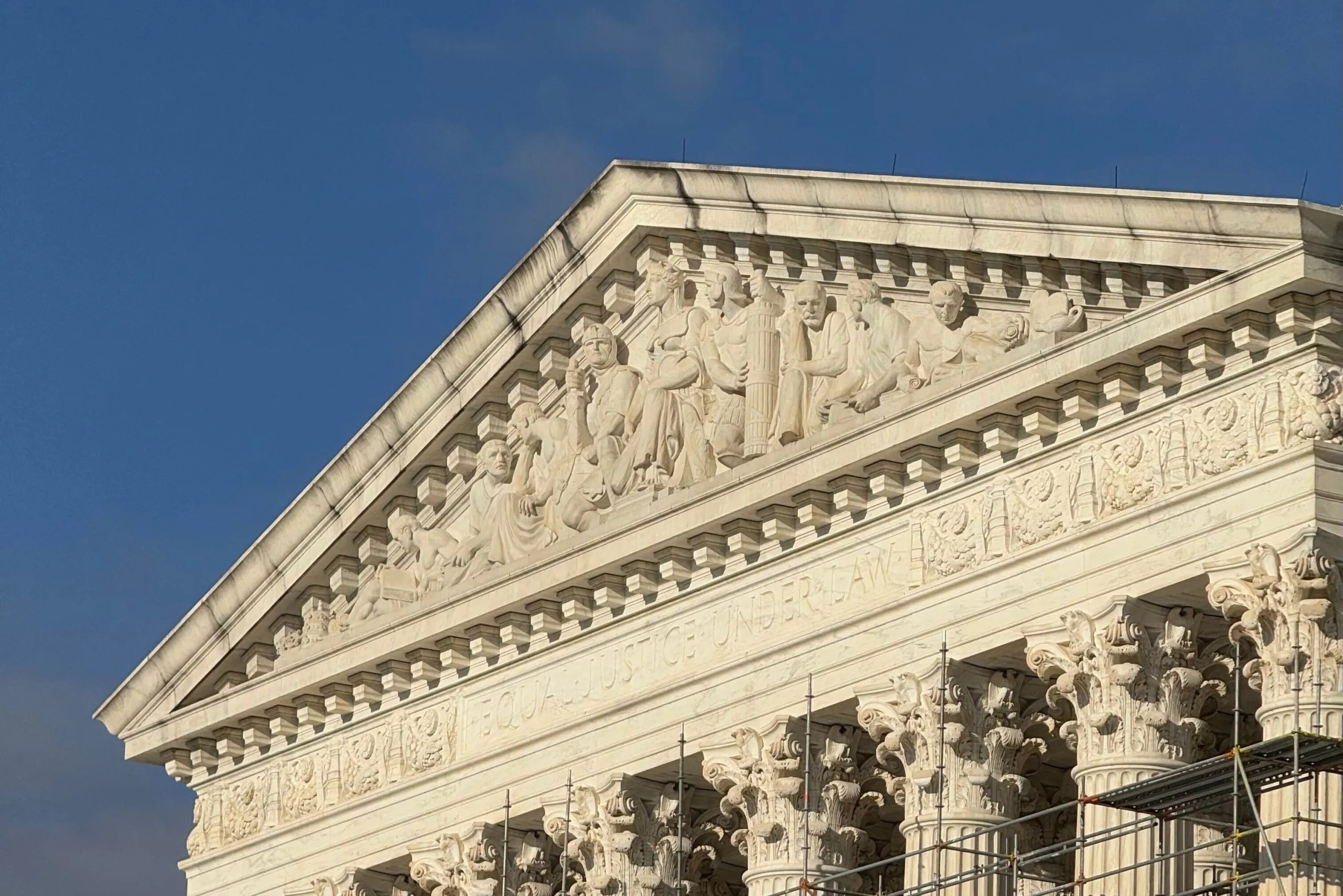
Carved details along top of Supreme Court building are pictured
(Katie Barlow)

It was a historic day at the Supreme Court on Wednesday, as President Donald Trump became the first sitting president to attend oral argument. Today’s newsletter has all you need to know about his appearance and the argument in general.

At the Court

Yesterday, the court heard argument in Trump v. Barbara, the birthright citizenship case. We live blogged during the argument, and the Advisory Opinions podcast went live after it concluded. For more on Wednesday’s argument, see Amy’s argument analysis in the On Site section below.

Today, the justices will meet in a private conference to discuss cases and vote on petitions for review. Orders from today’s conference are expected on Monday at 9:30 a.m. EDT.

Morning Reads

Trump Attends Supreme Court Oral Arguments, Then Leaves an Hour In

Ann E. Marimow, Zolan Kanno-Youngs, and Miriam Jordan, The New York Times

President Donald Trump on Wednesday became “the first sitting president to attend oral arguments at the high court … listening as the justices across the ideological spectrum questioned his efforts to strictly limit birthright citizenship,” according to The New York Times. “Many other presidents, including John Quincy Adams, Abraham Lincoln and Richard Nixon, have made appearances in the courtroom. But they all did so as lawyers arguing cases, before or after serving in the White House, according to Clare Cushman, a historian with the Supreme Court Historical Society.” The Times reported that “[m]any people outside the court expressed strong opposition to the president’s presence,” describing attendance as a “strong-arming tactic.”

Trump rails against birthright citizenship after attending Supreme Court arguments

Peter Charalambous, Meghan Mistry, and Michelle Stoddart, ABC News

After spending about 90 minutes in the courtroom on Wednesday, Trump left midway through the argument to return to the White House. Soon after departing, the president posted on Truth Social about birthright citizenship. “We are the only Country in the World STUPID enough to allow ‘Birthright’ Citizenship!,” Trump wrote.

How the Supreme Court ruling could reshape conversion therapy bans

BrieAnna J. Frank, USA Today

After the Supreme Court on Tuesday sided with a therapist challenging Colorado’s ban on conversion therapy on free speech grounds, states across the country with similar laws on the books are considering next steps. Brett Nolan, senior attorney at the Institute for Free Speech, told USA Today that much “depends on the language of other states’ laws as it relates to speech-based conversion therapy,” since one of the key issues raised in the ruling was that Colorado’s law “censors speech based on viewpoint” by, for example, barring therapy conversations that discourage same-sex attraction but allowing conversations that support it. Ronnie London, general counsel at the Foundation for Individual Rights and Expression, said the decision “doesn’t call into question bans on conversion therapy methods that are not speech-based, such as electric shocks and the use of nausea-inducing chemicals.”

Colorado tried to silence me for helping gender-confused kids. The Supreme Court just ruled 8-1 in my favor

Kaley Chiles, Fox News

In a column for Fox News, Kaley Chiles, the licensed counselor who challenged Colorado’s conversion therapy ban, reflected on the significance of the Supreme Court’s 8-1 ruling in her favor. “It’s reassuring to have the court protect freedom of speech,” Chiles wrote. “While Colorado officials may honestly think that a boy can become a girl, our country was founded on the right to engage in healthy debate – even when the government disagrees with us.”

The Dissenter’s Dilemma and Trump v. CASA

Richard Re, Divided Argument

In a post for Divided Argument, SCOTUSblog contributor Richard Re reflected on the “dissenter’s dilemma” – that is, the idea that a justice in dissent must work to “fuel outrage over a decision’s potential reach” while simultaneously working to “minimize” its impacts. It’s not an easy balance to strike, and, according to Re, it often leads dissenters “to engage in doomsaying” that doesn’t materialize. Re offered the example of Trump v. CASA, in which the court addressed the universal injunctions putting Trump’s executive order on birthright citizenship on hold nationwide. Dissenters warned that the court’s decision limiting such injunctions might enable the order to take effect, but, in fact, lower court judges kept it on hold in class-action litigation. “One might remember this example when considering other assertions in dissenting opinions,” Re wrote.

On Site

Argument Analysis

Supreme Court appears likely to side against Trump on birthright citizenship

On Jan. 20, 2025, President Donald Trump signed an executive order that would end birthright citizenship – the guarantee of U.S. citizenship to virtually everyone born in this country. Trump’s order has never gone into effect; since then, every federal court that has considered a challenge to the order has struck it down. After just over two hours of oral arguments on Wednesday, before an audience that included (at least for part of the morning) Trump himself, a majority of the Supreme Court seemed likely to do the same.

WASHINGTON, DC - APRIL 01: A general view of the U.S. Supreme Court ahead of U.S. President Donald Trump's expected arrival on April 01, 2026 in Washington, DC. The Supreme Court is hearing oral arguments in Trump v. Barbara to determine if President Trump's executive order ending birthright citizenship is constitutional. According to historians and the Court, this is the first time a sitting president has attended oral arguments at the nation's highest court.
View from the Court

Trump attends birthright citizenship argument

In his View from the Court column, Mark Walsh described what it was like in the courtroom as Trump made history as the first sitting president to attend oral argument. He noted that the president was joined by Attorney General Pam Bondi, Secretary of Commerce Howard Lutnick, and White House Counsel David Warrington.

TOPSHOT - The motorcade carrying US President Donald Trump departs the Supreme Court after President Trump attended oral arguments, in Washington, DC on April 1, 2026. President Donald Trump watched the US Supreme Court hear a landmark case weighing the constitutionality of his contentious bid to end birthright citizenship, an extraordinary and possibly unprecedented move for the nation's highest office.
Argument Analysis

Justices seem dubious of government’s argument in criminal venue case

The Supreme Court on Monday considered whether federal prosecutors can try a defendant not only in the district where the offense occurs, but also where the crime’s “contemplated effects” are felt. During the roughly 80-minute argument in Abouammo v. United States, the justices seemed to suggest that the answer was no.

The Supreme Court Building is pictured on March 25, 2026.

Podcasts

Advisory Opinions

Birthright Citizenship Oral Arguments

Sarah Isgur is joined by David French, Amanda Tyler, Akhil Amar, and Amy Howe to react to the oral arguments in the birthright citizenship case.

SCOTUS Quote

CHIEF JUSTICE ROBERTS: “Well, [birth tourism] certainly wasn’t a problem in the 19th century.”

GENERAL SAUER: “No, but, of course, we’re – we’re in a new world now, as Justice Alito pointed out to, where 8 billion people are one plane ride away from having a – a child who’s a U.S. citizen.”

CHIEF JUSTICE ROBERTS: “Well, it’s a new world. It’s the same Constitution.”

Trump v. Barbara  (2026)

Recommended Citation: Kelsey Dallas, SCOTUStoday for Thursday, April 2, SCOTUSblog (Apr. 2, 2026, 9:02 AM), https://www.scotusblog.com/2026/04/scotustoday-for-thursday-april-2/