Court appears likely to side with Trump administration on rights of asylum seekers

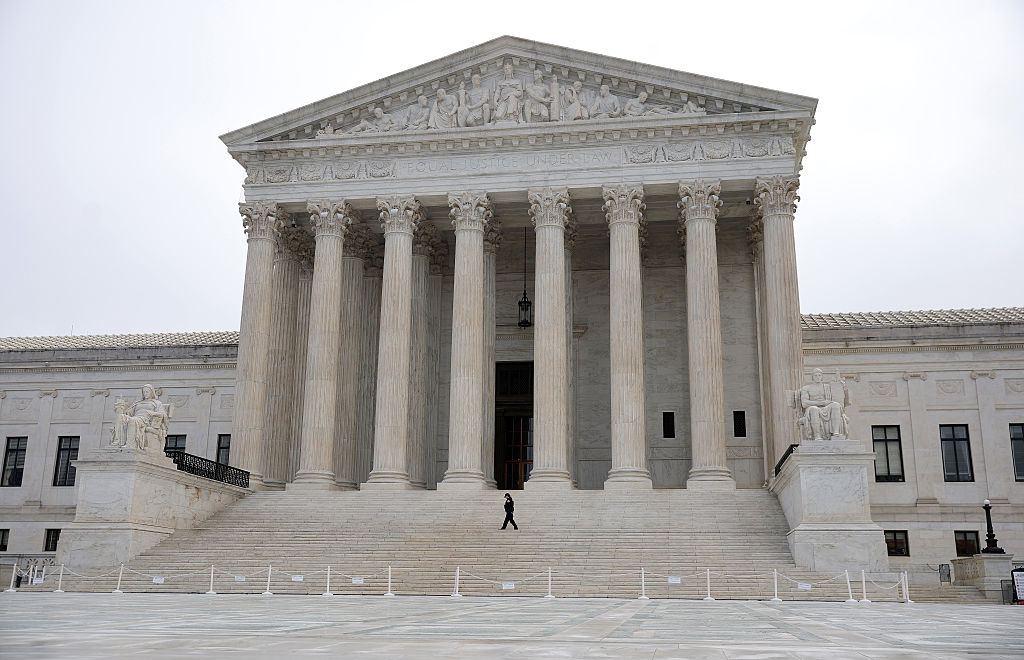
The Supreme Court on Tuesday appeared likely to uphold the federal government’s policy of systematically turning back asylum seekers before they can reach the U.S. border with Mexico. During roughly 80 minutes of oral arguments in Noem v. Al Otro Lado, a majority of justices seemed to agree with the Trump administration that the policy does not violate a federal law allowing noncitizens to apply for asylum when they “arrive[] in the United States.”
Under U.S. law, noncitizens can apply for asylum – a form of legal protection for people who fear persecution or harm in their own countries – either when they are “physically present in the United States” or when they “arrive[] in the United States.” Noncitizens who arrive at a port of entry, an officially designated site to enter the country, such as an airport or a land crossing, and indicate that they want to seek asylum are inspected and processed. That is, they are screened by border officials and then channeled into the asylum system, which may include either an interview with an asylum officer or proceedings in immigration court.
The policy at the center of the dispute – known as “metering” – was adopted almost 10 years ago in response to a surge in the number of Haitian immigrants seeking asylum in San Ysidro, a port of entry outside San Diego. To implement it, officials from the Customs and Border Patrol agency stood along the U.S.-Mexico border and turned back noncitizens without valid travel documents, including asylum seekers, before they could enter the United States. In 2017, the government extended that policy to all ports of entry across the U.S. border with Mexico, and it was formalized in a memorandum in 2018.
Al Otro Lado, Inc., an immigrant rights group, and 13 asylum seekers went to federal court in southern California to challenge the policy. A majority of the U.S. Court of Appeals for the 9th Circuit agreed with them that, for purposes of applying for asylum, noncitizens who were turned away from ports of entry before they could cross the border had “arrived in” the United States.
After the court of appeals turned down the federal government’s request to reconsider the case, the Trump administration went to the Supreme Court, which agreed last fall to weigh in.
Representing the Trump administration at Tuesday’s oral argument, Assistant to the U.S. Solicitor General Vivek Suri told the justices that, under the challengers’ reading of the law at the center of the case, the phrase “arrives in the United States” would mean “stopped outside the United States.” Such an interpretation, he argued, “defies the statutory text. You can’t arrive in the United States while you’re still standing in Mexico.” Moreover, Suri continued, the government’s position is supported by the Supreme Court’s 1993 decision in Sale v. Haitian Centers Council, holding that the United Nations Convention Relating to the Status of Refugees and federal immigration law do not apply to noncitizens outside the United States – there, to Haitian refugees on the high seas attempting to reach the United States. If Congress wanted to deviate from the “territorial approach” outlined in Sale when it enacted the “arrives in” language three years later, Suri stressed, “it would have said so. It didn’t.”
Representing the challengers, Kelsi Corkran countered that in the Refugee Act of 1980, Congress created a legislative scheme to track the United States’ obligations under international treaties to avoid sending refugees back to countries where they would be persecuted. Those obligations, she said, extend to noncitizens arriving at the U.S. border to seek asylum. The government’s interpretation of the law at the center of the case, she contended, “isolates the word ‘in’ at the expense of making the rest of the statute nonsensical.” Moreover, she added, for more than three decades, U.S. government regulations have acknowledged that noncitizens attempting to enter the country are entitled to be inspected and processed.
Justice Clarence Thomas asked both lawyers about international law and its bearing on the dispute before the court on Tuesday. Suri reiterated that, as the court made clear in Sale, the U.N. Convention did not apply outside the United States. But even if it did apply, he continued, what the convention bars is “returning someone to a foreign country,” which the metering policy doesn’t do.
Justice Sonia Sotomayor was skeptical that the government’s interpretation did not run afoul of the United States’ obligations under international treaties. The court’s decision in Sale, she told Suri, “very clearly says that U.S. asylum … protections apply to those who reside in or have arrived at the border of the United States.”
Like Sotomayor, Justice Ketanji Brown Jackson was sympathetic to the challengers. She focused on what she characterized as the “practical implications” of the government’s reading, and in particular on what she saw as a disparate impact that Congress could not have intended. Under the government’s interpretation, she noted, someone who “wants to do everything by the book” in seeking asylum but is turned away when she approaches the border would not have her request considered at all, but “someone who manages to enter the United States unlawfully … and requests asylum gets their application entertained[.] That doesn’t seem to me to make any sense,” Jackson concluded.
Justice Brett Kavanaugh was less sympathetic to this point. He suggested that the potentially inequitable effects of a ruling for the Trump administration should not factor into the court’s thinking at all. Instead, he told Corkran, “the only issue before us is trying to figure out what ‘arrives in’ means.”
Jackson raised another issue: whether the court should reach the merits of the dispute at all, when the government rescinded the policy more than four years ago. If the government doesn’t have a “concrete plan” to reinstate it, she queried, how do the justices even have the authority to review the lower court’s decision?
Suri responded that the question of whether the dispute is moot – that is, no longer a live controversy – “turns on whether the Court can grant any effectual relief whatsoever to the prevailing party.” And in this case, he said, some of the orders that the district court issued are still in effect, including “a class-wide declaration saying we can never engage in metering at the southern border.”
Jackson’s efforts to have the case tossed out based on the idea that the policy is no longer in effect did not seem to get any real traction with her colleagues. Justice Amy Coney Barrett, for example, later told Suri that when she “asked if the administration intended to reinstate the metering policy,” she “didn’t intend to suggest that it was formally moot.”
Justice Elena Kagan focused on the text of the statute, telling Suri that under the government’s interpretation it has a “massive superfluity … problem”: if the phrase “arrives in the United States” means that the noncitizen must be in the United States, but another phrase in the same law indicates that it applies to noncitizens who are “physically present in the United States,” then the “statute ends up saying, essentially,” Kagan suggested, “any alien who is in the United States or who is in the United States.”
Justice Samuel Alito took a different approach to the text, questioning whether the challengers’ interpretation was consistent with its language. If the challengers compared a noncitizen’s arrival in the United States to “knocking at the door,” he told Corkran, “[d]o you think someone who comes to the front door of a house and knocks at the door has arrived ‘in’ the house? The person may have arrived ‘at’ the house.”
Several of the court’s conservative justices also questioned how the challengers’ interpretation would work from a logistical and spatial perspective. As Barrett put it, if the phrase “arrives in the United States” does not involve actually crossing the border into the United States, “what is the magic thing or the dispositive thing that we’re looking for where we say, ah, now that person … arrives in the United States?”
Corkran responded that someone “arrives in the United States … when they are at the threshold of the port’s entrance about to step over.” But when the metering policy is in effect, she said, “that process of arriving is interrupted by the border officer physically blocking them from completing the arrival such that the person never arrived.”
Justice Neil Gorsuch pressed Corkran, asking her to explain why someone in a line to enter the port wouldn’t fall under the “arrives in” language. “I mean,” he said, “if the whole point is to make sure that people who are attempting to get into the country have the opportunity to file asylum claims and they’ve made it all the way, why does it matter who’s second in line?”
Chief Justice John Roberts also grappled with the line issue, asking Corkran whether it matters “how many people are processing the arrivals” at the port of entry or “how quickly the line’s going to move.” “I mean,” he said, “it strikes me as a very factual question.”
A decision in the case is expected by late June or early July.
Posted in Court News, Featured, Merits Cases
Cases: Noem v. Al Otro Lado