Temporary Protected Status and the Supreme Court: an explainer

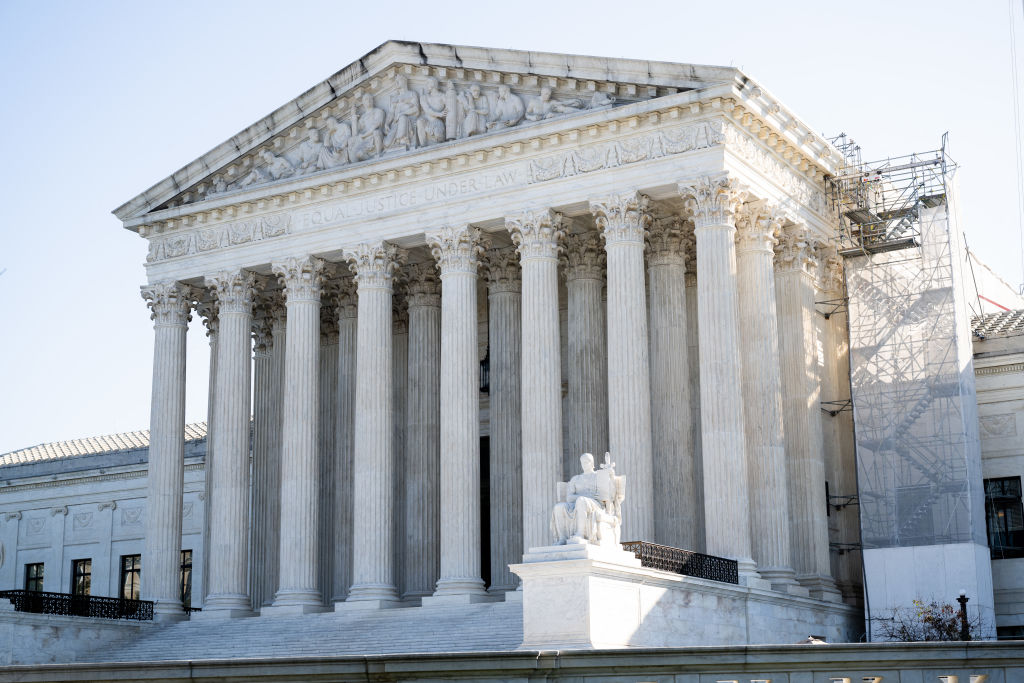
The Supreme Court announced last week that it will hear argument in late April on the Trump administration’s effort to remove protected immigration status from Syrian and Haitian nationals. Its eventual ruling is expected to bring clarity not just to these two cases, but also to several other lawsuits filed in response to the administration’s changes to the Temporary Protected Status program, which enables certain non-citizens to temporarily live and work legally in the United States.
As in the birthright citizenship case, the Supreme Court’s decision could hold significant consequences for immigration policy. Here’s a brief overview of the Temporary Protected Status program, what’s at stake in the related disputes, and what the court has said in the past year about the administration’s authority to revoke protected immigration status.
What is the Temporary Protected Status program?
The Temporary Protected Status, or TPS, program was established in 1990 through Title III of the Immigration Act. When it was passed, the act empowered the attorney general – in consultation “with appropriate agencies of the Government” – to designate countries as unsafe to return to, whether because of war, natural disaster, or other “extraordinary and temporary conditions.” Soon after the Department of Homeland Security was created in 2002, this authority transferred to the DHS secretary.
When the DHS secretary designates a country for TPS, nationals of that country living in the U.S. can apply for temporary protection from deportation and temporary authorization to work. Individuals who receive these protections are often described as having been “granted TPS” or having “received TPS.”
A country’s TPS designation lasts six, 12, or 18 months, at which point the DHS secretary reconsiders conditions on the ground and potentially extends the designation (which can be done indefinitely). A TPS holder’s protection from deportation and work authorization ends when their home country’s TPS designation ends.
How many people benefit from the TPS program?
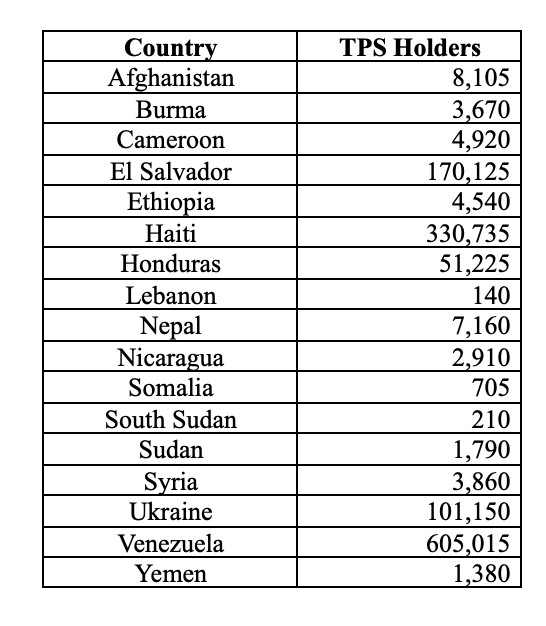
As of March 2025, there were nearly 1.3 million people from 17 countries living and working in the U.S. with TPS protections, according to Congress. The breakdown by country is as follows:
How has the TPS program changed under the Trump administration?
Over the past year, as the Trump administration overhauled the immigration system more broadly, former DHS Secretary Kristi Noem worked to scale back the TPS program. Specifically, Noem announced her intent to terminate TPS status for 13 countries, including Haiti, Syria, Venezuela, and Afghanistan.
In these announcements, Noem and other DHS leaders explained their belief that conditions on the ground in these countries no longer meet the threshold for TPS and emphasized that TPS designations are meant to be “temporary.” “The administration is returning TPS to its original temporary intent,” Noem said in May 2025 when announcing the end of Afghanistan’s protected status.
How have TPS holders responded to the Trump administration’s moves to terminate such designations?
Noem’s effort to terminate TPS designations sparked multiple legal battles. TPS holders who stood to lose their protected status sued to block the terminations, contending that Noem had rushed through the decision-making process in an effort to justify preordained outcomes and that her termination decisions were motivated, at least in part, by animus toward certain racial and ethnic groups. The Trump administration countered that immigration law bars courts from even reviewing a secretary’s decision to terminate TPS status; but in any event, it argued, Noem followed all required steps.
According to a Bloomberg analysis, most of the federal courts to have considered these lawsuits have issued preliminary rulings in favor of the TPS holders. Although the content of these decisions has varied, judges generally have agreed that that they have the power to review the overall “patterns and practices” of the secretary’s approach to TPS and that the secretary’s approach violated the federal law governing administrative agencies. Some have held that Noem was motivated by “hostility to nonwhite immigrants” rather than changing conditions on the ground in the countries that were previously designated for TPS.
The administration’s website for the Temporary Protected Status program cites the lower-court orders putting Noem’s termination decisions on hold, explaining that “[t]he Department of Homeland Security vehemently disagrees with” them.
What has the Supreme Court said about TPS?
The Syria and Haiti cases are not the first TPS disputes to make it to the Supreme Court’s interim relief docket. Last year, the justices twice addressed the Trump administration’s effort to vacate a pending extension of protected immigration status for around 300,000 of the 605,015 Venezuelan nationals who take part in the TPS program.
The Venezuela case, Noem v. National TPS Alliance, first came to the court in May 2025, after Senior U.S. District Judge Edward Chen in California temporarily barred the Trump administration from ending Venezuelans’ participation in the TPS program, and the U.S. Court of Appeals for the 9th Circuit declined to stay that order. The administration asked the justices to clear the way for the removal of these protections.
On May 19, the Supreme Court granted the administration’s request without explaining its decision. Justice Ketanji Brown Jackson indicated that she would have denied the stay request, but she did not write a dissenting opinion.
In September, Chen issued his final decision in the case and again sided with the Venezuelan TPS holders. He noted that the Supreme Court’s order in the case “did not provide any specific rationale” and contended that it “did not bar this Court from adjudicating the case on the merits and entering a final judgment issuing relief.”
The federal government asked the 9th Circuit to put Chen’s ruling on hold while it appealed, but the appellate court declined to do so. As a result, the government again asked the Supreme Court to allow it to proceed with removing protected status from the Venezuelan nationals.
On Oct. 3, 2025, the court granted the Trump administration’s request. As in May, the order was short and unsigned. The court noted that “[a]lthough the posture of the case has changed, the parties’ legal arguments and relative harms generally have not. The same result that we reached in May is appropriate here.”
Justices Sonia Sotomayor and Elena Kagan noted that they would have denied the application, but they did not explain why. Jackson wrote a dissenting opinion, in which she rejected the idea that the administration had shown an “urgent” need for the Supreme Court’s intervention. “Only if the Government demonstrates such a time-sensitive need should we even consider vetoing the lower courts’ unanimous judgment about the most equitable interim status. The Government has made no such showing,” Jackson wrote.
In January, the 9th Circuit affirmed Chen’s final ruling, but the Supreme Court’s second decision in favor of the Trump administration remains in effect – the court wrote it would stay in place until the justices address a petition for review in the case. Ahilan Arulanantham, a UCLA law professor who also represents the Venezuelan TPS holders, told SCOTUSblog in February that hundreds and potentially thousands of Venezuelan nationals have been deported from the U.S. since the Supreme Court ruled against them, adding that these deportees likely won’t be able to return even if the justices eventually rule in their favor.
Did the Supreme Court’s Venezuela decisions affect other TPS cases?
It appears that the Supreme Court’s orders on TPS protections for Venezuelan nationals have had a limited impact on other TPS disputes. According to the Bloomberg analysis, TPS holders have received favorable rulings in at least nine cases since the justices issued their first Venezuela order in May.
The judges in these cases have acknowledged that the Supreme Court sided with the Trump administration, but they have emphasized that the court’s brief orders left room for lower courts to rule differently. For example, in response to the Trump administration’s claim in the Haiti case that the Supreme Court’s Venezuela orders made it clear that the district court could not review Noem’s termination of Haiti’s TPS designation, Judge Ana Reyes wrote that applying the Supreme Court’s Venezuela orders would have required “divination,” because the “orders never discuss jurisdiction.” And in the Syria case, the U.S. Court of Appeals for the 2nd Circuit emphasized that the Venezuela dispute involved “a different country, with different factual circumstances, and different grounds for resolution by the district court.”
How did the Syria and Haiti cases come to the Supreme Court?
U.S. Solicitor General D. John Sauer took a different view on the Supreme Court’s Venezuela orders when he brought the Syria and Haiti disputes to the court’s interim relief docket. Sauer implied that the decisions should have prevented future orders barring TPS changes and noted that, despite this, lower-court judges have “persisted with … halting TPS terminations based on variations of the same reasoning … that this Court already twice rejected.”
Sauer urged the justices to take up the Syria and Haiti cases for argument before the relevant federal appeals courts had a chance to weigh in on the merits. He presented them as an opportunity to clear up the confusion surrounding whether courts can block a DHS secretary’s TPS decisions. In the absence of a Supreme Court ruling, Sauer wrote, “lower courts will continue to impermissibly bypass an unambiguous judicial-review bar and displace the Secretary’s judgment on matters committed to her unreviewable discretion by law; continue … to substitute their own judgment for the Secretary’s; and continue to impede the termination of temporary protection that the Secretary has deemed contrary to the national interest, tying those decisions up in protracted litigation with no end in sight.”
On Monday, March 16, the justices agreed to consider the Syria and Haiti disputes on the merits. Oral argument will take place at the end of April, and a decision is expected by early July.
Posted in Court Analysis, Featured, Merits Cases
Cases: Noem v. National TPS Alliance, Noem v. Doe, Trump v. Miot