
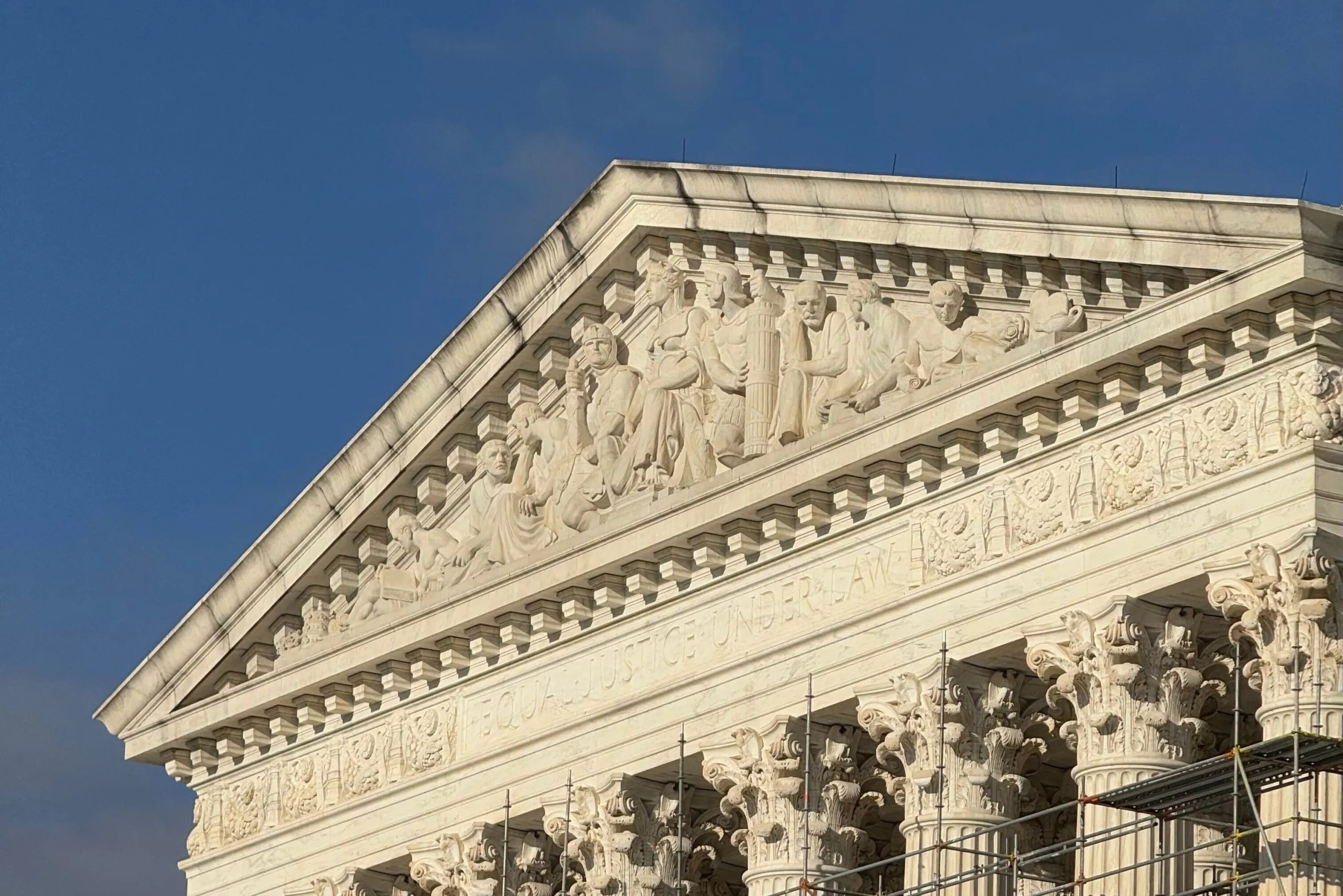


As you may have heard by now, the Supreme Court is apparently experiencing a crisis of confidence. An NBC News poll fielded in late February and early March showed that confidence in the Supreme Court is at its lowest point since the outlet started polling on the topic in 2000. Just 22% of registered voters today say they have a “great deal” (7%) or “quite a bit” (15%) of confidence in the Supreme Court – compared to 52% when the NBC polling began.
Republicans are part of this downward trend, even though the court has had a 6-3 conservative majority since 2020. As recently as 2024, more than half (53%) of registered Republicans had a “great deal” or “quite a bit” of confidence in the Supreme Court. Today, that figure stands at 35%. (Only 9% of Democrats “had a great deal or quite a bit of confidence in the court.”)
So what is driving the change? Unpopular rulings? President Donald Trump’s complaints?
Those factors likely play a role, but the best explanation may also be the simplest: The Supreme Court is caught up in a broader drop in confidence in institutions. In other words, the trend line may have little to do with the Supreme Court’s own actions, as Sarah Isgur and David French noted during their conversation about the NBC News poll on the Advisory Opinions podcast. “There are very few institutions that have not had this downward trend,” French said.
Indeed, Gallup polling shows that Americans’ trust in most institutions – from houses of worship to media organizations to Congress – is plummeting. For example, in 2002, 58% of Americans had a “great deal” or “quite a lot” of confidence in the presidency. In 2025, just 30% said the same. Over the same time period, confidence in Congress fell from 29% to 10%.
John Inazu of Washington University in St. Louis and Asma Uddin of Michigan State University addressed this broader crisis of trust during their March 16 panel on religion, trust, and the Supreme Court at the Faith Angle Forum in Miami, reflecting on whether and how the justices should respond. There are no easy answers, Inazu said, noting that we’re “going to be in for a long, long stretch of weakened institutions.”
However, Inazu and Uddin did both offer suggestions for the justices. Perhaps counterintuitively, Inazu urged them to avoid treating their written opinions as an opportunity to win public support. When they do so, they end up sounding “more like pundits and less like judges,” Inazu said. But it is good for the justices to embrace chances to connect with the public in other settings, Uddin contended, sharing her sense that it “helps people to believe in the court when the justices are out in public talking about their work.”
The justices weren’t at the Faith Angle Forum, but they may have arrived at Uddin’s conclusion independently. In recent weeks, several justices, including Chief Justice John Roberts, have spoken on college campuses and at legal events about how the court does its work, trying to correct common misconceptions.