Court rules criminal defendants may be prohibited from discussing ongoing testimony with counsel during an overnight recess

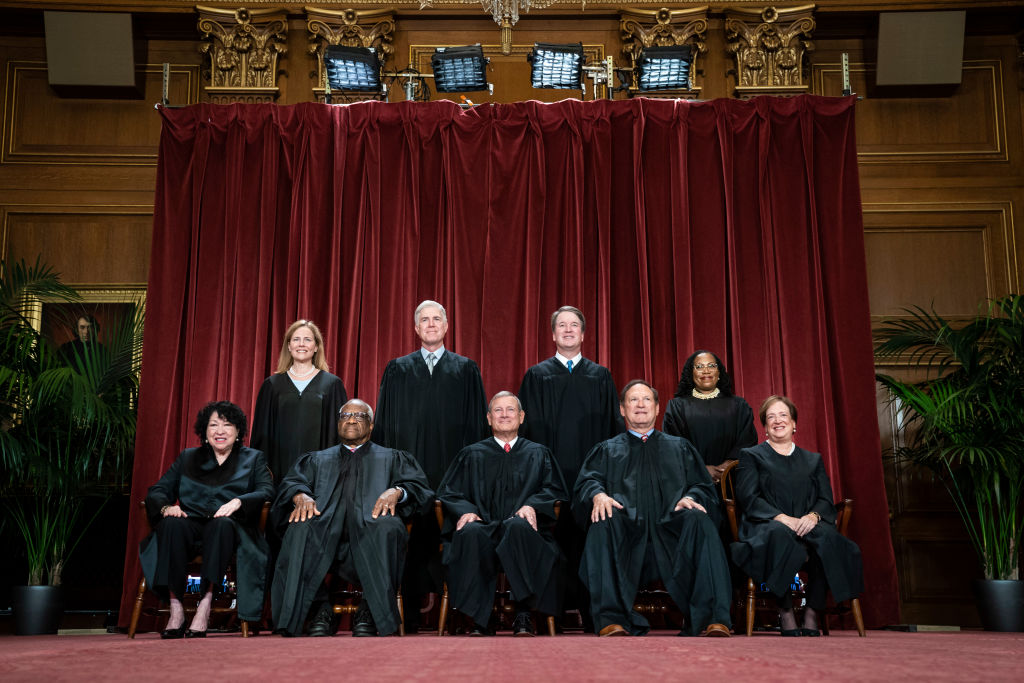
When a trial court recesses a criminal trial during a defendant’s testimony, the court may order the defendant and his lawyer not to discuss that testimony during the break except when it is incidental to discussions of trial strategy or whether to accept a plea bargain, the Supreme Court ruled on Wednesday. The vote to affirm the lower court judgment in Villarreal v. Texas was unanimous, with Justice Ketanji Brown Jackson writing for the court. Justices Clarence Thomas and Neil Gorsuch did not join the court’s opinion.
At trial for the murder of his boyfriend, Aaron Villarreal took the stand in his own defense. After about an hour, the trial judge called a recess for the rest of the day. The judge ordered Villarreal’s lawyer not to discuss his client’s testimony with him overnight. In particular, the judge prohibited the lawyer from “managing” (or “coaching”) his client’s future testimony. Villarreal was convicted of murder. On appeal, he argued that the order not to discuss his testimony violated his Sixth Amendment right to effective assistance of counsel. The Texas appeals courts affirmed his conviction, saying the trial court’s order had been appropriate.
On Wednesday, the Supreme Court agreed with the Texas courts. In agreeing, Jackson’s opinion for the court listed types of attorney-client discussion that a trial court may not prohibit. “No less than before or after his testimony, a defendant’s access to advice about trial strategy remains essential to the collaborative enterprise that is criminal defense,” Jackson stated. Moreover, the flow of information goes both ways, she continued, such that the lawyer is always free to obtain factual information from the client on which trial strategy may hinge.
Furthermore, a court may not prohibit a client from getting lawyerly advice about whether to take a guilty plea, even if the explanation for why to take the plea requires some discussion of the impact that the client’s ongoing testimony has on prospects for acquittal or a hung jury. According to the court, “The Sixth Amendment does not abide a take-my-word-for-it vision of the attorney-client relationship.”
The court interpreted the trial court’s order in this case as prohibiting only discussions of the client’s ongoing testimony “for its own sake,” and not when the discussion is incidental to some legitimate topic such as trial strategy or whether to take a plea. In doing so, Jackson portrayed the court’s decision as striking a balance between the dual roles that a criminal defendant occupies when testifying in his own defense. A defendant is entitled to “the advice of counsel unrestricted by judicial interference,” she wrote at the opinion’s outset. Once that defendant takes the stand, however, he or she assumes the burden of a “witness’s responsibility to offer sworn testimony uninfluenced by a lawyer’s midstream tinkering.”
In adopting this balancing approach, the court eschewed a more categorical approach. At oral argument, Villarreal’s lawyer had insisted that a nuanced line between legitimate and illegitimate discussions of the client’s testimony was unworkable in practice. Claiming support from several federal circuit courts of appeals, Villarreal’s lawyer argued that the court should adopt a bright-line rule allowing defendants and their lawyers to discuss anything overnight, so as not to chill legitimate discussions about trial strategy.
The court was unpersuaded by the “chilling effect” argument. Pointing out that the federal circuit opinions cited by Villarreal came in cases that involved absolute prohibitions on overnight discussions between lawyer and client, Jackson distinguished the limited order in Villarreal’s case. “The same concern is not present with an order prohibiting only discussion of ‘nothing but the testimony,’” she wrote. “Consultation about the testimony itself – practicing it, debriefing it, and the like – is a recognized, distinct tool in every lawyer’s preparatory arsenal. We trust that lawyers ordered to sheathe that tool overnight will have no difficulty doing so.”
Concurring in the court’s opinion, Justice Samuel Alito wrote a separate opinion expressing concern that unscrupulous defense lawyers might use the court’s opinion to disguise management of future testimony as advice about trial strategy or whether to take a plea. As examples of legitimate discussion, Alito offered, “[c]ounsel could say, ‘Let’s discuss what plea terms you are willing to agree to,’ or ‘We should seek a deal because there is a strong chance the jury will find you guilty.’” But it would not be legitimate to say, “We will really need to secure some sort of deal unless, when you return to the stand tomorrow, you stop scowling, looking down, and making nervous gestures with your fingers.” That would be impermissible “coaching,” wrote Alito, and unprotected by the court’s decision.
Jackson’s opinion for the court appeared to agree with this language in Alito’s concurrence. In footnote 5, the court acknowledged that “[t]he line between discussion of testimony for its own sake and discussion of testimony incidental to other topics may not always be razor sharp. We trust that defense counsel will not evade the spirit of qualified conferral orders by couching discussion of testimony qua testimony in strategic terms.” Then, agreeing with the line Alito drew in his concurrence, the court gave a concrete example of such a pretext: “For instance, unprotected discussion does not become protected simply by way of a preface explaining that a defendant’s ‘chances of acquittal will improve’ if he adjusts his testimony.” Although such a statement may touch on trial strategy, it “seeks to shape future testimony in light of past testimony and thus is unprotected.”
Thomas and Gorsuch, however, did not approve of the court or Alito offering concrete examples of what lawyerly advice would and would not cross the line. “I cannot join the Court’s opinion because it opines on hypothetical situations not before the Court and needlessly expands our precedents,” wrote Thomas.
Posted in Court News, Merits Cases
Cases: Villarreal v. Texas