Birthright citizenship: under the flag
Brothers in Law is a recurring series by brothers Akhil and Vikram Amar, with special emphasis on measuring what the Supreme Court says against what the Constitution itself says. For more content from Akhil and Vikram, please see Akhil’s free weekly podcast, “Amarica’s Constitution,” Vikram’s regular columns on Justia, and Akhil’s new book, Born Equal: Remaking America’s Constitution, 1840-1920.
What determines whether a baby born on American soil is a constitutional birthright citizen? Is it the domicile of that baby’s parents? Their allegiance? Their law-abidingness?
No, no, and no. Constitutional birthright citizenship in fact has virtually nothing to do with the baby’s parents, and instead has everything to do with a simple, concrete fact: Was the baby born under the flag?
When a baby is born, if American soil lies below and an American flag flies above, that baby is a birthright citizen, as Reconstruction Republicans across the land understood. This originalist rule is clear and clean: look down, and then look up.
Under the flag
This column is the first in a new series on birthright citizenship and Trump v. Barbara, the case in which the Supreme Court will determine the legality of President Donald Trump’s order seeking to end birthright citizenship. We believe Trump’s order is egregiously unconstitutional, and we’ve now said so to the justices, in an amicus brief filed earlier today by Akhil, with Vik as counsel of record and Sam as lead assistant.
In this series-inaugurating column, we focus on the three words the 14th Amendment’s framers and ratifiers repeated countless times and that best capture the essence of the citizenship clause: under the flag.
“All persons born or naturalized in the United States, and subject to the jurisdiction thereof, are citizens of the United States,” the 14th Amendment’s first sentence promises. No one doubts that babies born on American soil are born “in the United States.”
And the refining jurisdictional clause essentially means that a baby must be born “under the flag.” This principle, which Akhil first presented in a 2005 book, cleanly explains both the scope and the limits of birthright citizenship. Certain enclaves, even though located on American soil, fall under different flags: foreign embassies, foreign public vessels, foreign-army-occupied territories, and tribal land. These enclaves thus lie outside constitutional birthright citizenship’s full guarantee (as we will discuss in a future column, and as a key 1898 precedent also recognized).
But all children born under the American flag are born American citizens. In 1868, this rule embraced the children of slaves, the children of Confederates, and the children of “Gypsies.” It undoubtedly blankets the children of illegal immigrants today.
The originalist evidence
Between 1866 and 1868, from the Atlantic to the Pacific, Reconstruction Republicans proclaimed over and over again that all born under the flag would be birthright citizens.
Leading these architects of the 14th Amendment, which the 39th Congress sent to the states for ratification in June 1866, were once and future vice presidents, Hannibal Hamlin and Schuyler Colfax.
In October 1866, Hamlin – Abraham Lincoln’s first vice president – addressed an “overflowing” crowd at the Cooper Institute in New York City. “[T]he constitution shall be so amended that every man born under that flag shall be an American citizen,” Hamlin declared. One week earlier, in Philadelphia, he had glossed the 14th Amendment the same way: “every child born under our flag shall be an American citizen.” (Recall that Lincoln himself had delivered a famous address at the Cooper Institute in 1860.)
For the 14th Amendment’s framers and ratifiers, “under” was synonymous with “subject to,” and “the flag” was a helpfully concrete stand-in for the more abstract word “jurisdiction.” Theirs was not only a verbal culture, but a visual one, and fittingly, a great American flag adorned the very scene of Hamlin’s Manhattan speech. “The hall of Cooper Institute,” a widely circulating newspaper reported, “was appropriately embellished with a profusion of ‘Stars and Stripes,’ the pillars adjoining the stage being encased in the star-spangled bine, and the ample folds of a large flag flowing gracefully from the speaker’s stand to the floor beneath.”
In August 1866, Schuyler Colfax – the sitting Speaker of the House and future vice president to Ulysses S. Grant – likewise invoked the flag before an Indianapolis audience of “five to seven thousand”:

[The 14th Amendment] declares that every person – every man, every woman, every child, born under our flag, or naturalized under our laws, shall have a birthright in this land of ours. High or low, rich or humble, learned or unlearned, distinguished or obscure, white or black, born in a palatial residence or born in the humblest cabin in the land, this great Government says “the ægis of protection is thrown over you; you can look up to this flag and your country, and say they are yours.” [Applause.]
Notice how Colfax’s phrasing (“born under our flag, or naturalized under our laws”) parallels the constitutional text itself (“born or naturalized in the United States, and subject to the jurisdiction thereof”). In the original understanding, “born under the flag” was functionally equivalent to “born . . . subject to the jurisdiction thereof.” Colfax used the same parallel construction – “born under our flag or naturalized in our Courts” – in the peroration of a July 2, 1866, public letter, read aloud at a South Bend convention and widely reprinted in newspapers across the land.
Other prominent Americans echoed Hamlin and Colfax. The 14th Amendment secures “[t]he immunities of citizenship . . . for every one born under our flag,” General Granville Moody, one of only 58 brevet generals commissioned by Lincoln, informed some 25,000 Union veterans at a September 1866 Pittsburgh convention.
The flag was a constitutional touchstone for 1860s Americans precisely because it was sacred, palpable, and emblematic of sovereignty. Indeed, Moody had opened his oration by naming the “two objects which always stir my soul’s susceptibilities to their profoundest depths”: first, “[t]he cross of the Son of God,” and second, “the Flag of my Country.” He then recited a verse from a founding-era poem, Joseph Rodman Drake’s The American Flag:
Forever float that standard sheet;
Where breathes the foe that stands before us;
With freedom’s soil beneath our feet;
And freedom’s banner floating o’er us.
It is therefore unsurprising that Reconstruction Republicans glossed “jurisdiction” by looking up to the flag, as Representative James M. Ashley did in November 1866, addressing an “overflowing” hall in Jackson, Michigan: “We hold that this is a government free and equal; . . . that every citizen born under its flag owes it an allegiance, and that he cannot withdraw from that allegiance unless he takes up his residence under a foreign flag.”
Ordinary Americans, too, understood the flag as jurisdictional. Consider three unsigned editorials (not remotely exhaustive), each from a different corner of the republic:
- Frankfort, Kentucky (July 1866): “The purpose of the first clause of the Constitutional Amendment is to declare . . . the universality of these rights to all who are born under the flag of the Union or become its adopted citizens . . . .”
- Tiffin, Ohio (August 1866): “Every child born under our flag, . . . becomes, by the very fact of its birth beneath our flag, a citizen of the United States . . . .”
- Sacramento, California (June 1868): “[A]rticle 14 of the National Constitution . . . declares all persons born under the flag citizens of the United States . . . .”
Uncle Sam’s Thanksgiving dinner
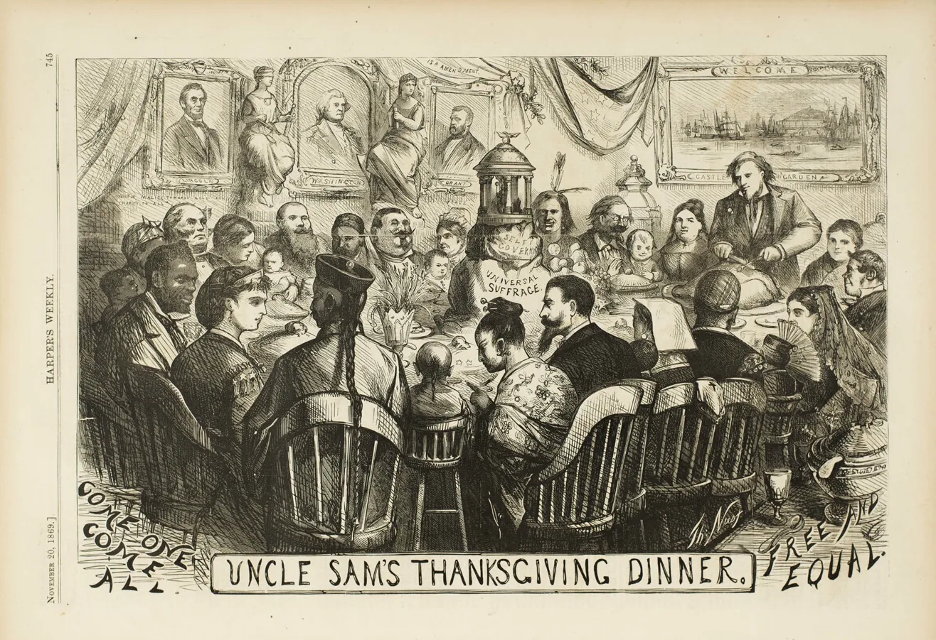
The political cartoon accompanying this column – Thomas Nast’s “Uncle Sam’s Thanksgiving Dinner,” published in the influential Harper’s Weekly in 1869 – captures all this and more in a single remarkable image.
In Nast’s dazzling depiction, men, women, and children – babies! – gather around a Thanksgiving table as Uncle Sam carves a turkey. One family, on the far left, is Black. Nearest the viewer is a Chinese family, with the hair of the father and the son braided in the traditional queue. The scene also includes a Spanish family, marked by a mother holding a fan and sporting a mantilla; Italian and French Catholic families, identified by crucifixes; Irish, German, and British families; an Arab man in a turban; and even an assimilated Native American, with a feather in his hair.
The words “Free and Equal” appear in the lower right, an unmistakable allusion to the recently ratified 14th Amendment. Echoing the Declaration of Independence, over a dozen antislavery state constitutions enshrined “born free and equal” clauses, which in turn furnished the template for the Amendment’s opening sentence.
Notice, too, the paintings on the walls, the art within the art. On the far wall hangs a painting of Castle Garden – that era’s Ellis Island, the landing point for immigrants yearning to be free. On the closer wall hang portraits of Lincoln, father of the Second Founding; Washington, father of the Founding; and Grant, Washingtonian commander-turned-president.
Let us now focus on the seven children arrayed around the table, some old enough to sit in their own chairs, others so young they must be held in their parents’ arms. Each child was born to a different set of parents. Some may descend from enslavers, others from the enslaved; some from native-born citizens, others from strangers in a new land; some from the Mayflower, others from Castle Garden.
But what all the little ones have in common are the stars and stripes draped above them, spanning both walls. All thus feast at Uncle Sam’s table, “Free and Equal” citizens – for when they drew their first breath, they did so on American soil, with freedom’s flag floating over their cradle.
Posted in Brothers in Law, Recurring Columns
Cases: Trump v. Barbara (Birthright Citizenship)