A guide to some of the briefs in support of ending birthright citizenship

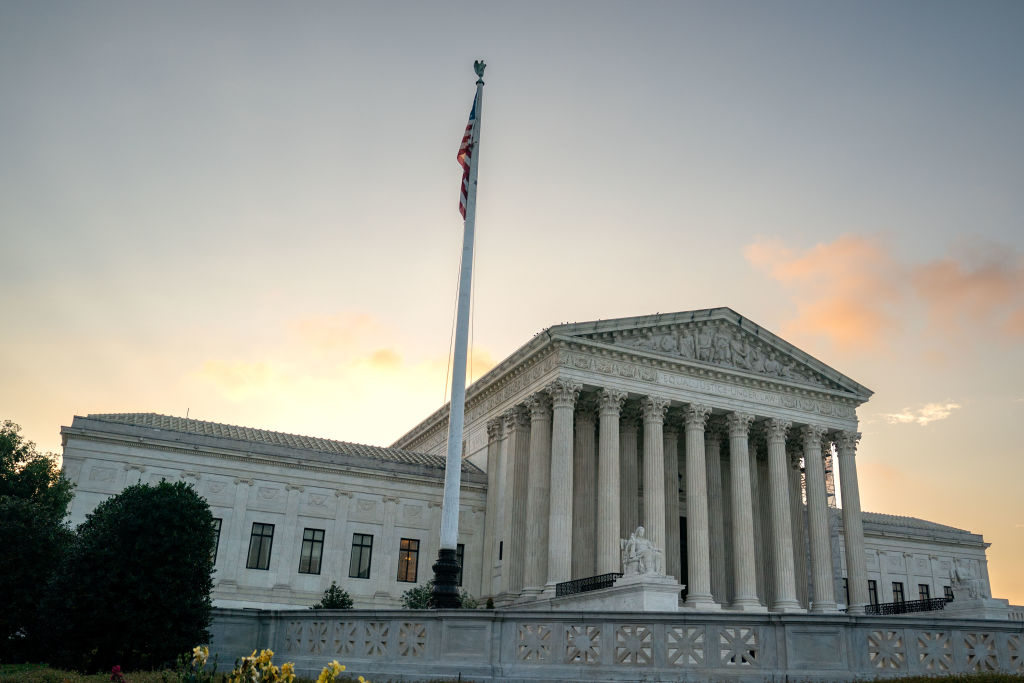
The Supreme Court will hear oral arguments on April 1 in the challenge to President Donald Trump’s executive order seeking to end the guarantee of citizenship to virtually everyone born in the United States. Like another high-profile case argued earlier this term, involving the challenge to Trump’s tariffs, the dispute has thus far garnered a large number of amicus or “friend of the court” briefs – 18 in support of the Trump administration and one that, although theoretically in support of neither side, tends to favor the administration.
I highlight some of the arguments made in the briefs supporting the Trump administration below. When the “friend of the court” briefs supporting the challengers are all filed later this month, I will discuss those in a separate story.
Several briefs focus on echoing or adding to the Trump administration’s arguments on the text of the Constitution.
The 14th Amendment provides that “[a]ll persons born … in the United States, and subject to the jurisdiction thereof, are citizens of the United States and of the State wherein they reside.” The Trump administration’s argument centers on the idea that to obtain citizenship at birth, you must be “subject to the jurisdiction of the United States,” which in turn means that you must be “completely subject” to this country’s “political jurisdiction,” “owing it ‘direct and immediate allegiance.’” The children of noncitizens who live only temporarily in the United States, the federal government contends, “owe primary allegiance to their parents’ home countries, not the United States” and therefore are not covered by the 14th Amendment’s citizenship clause.
Law professor Ilan Wurman offers a closer look at the rule in place in early English and U.S. history. He contends that, contrary to conventional wisdom, birthright citizenship was not universally available but was instead only available to the children of “parents under the sovereign’s protection. In exchange for that protection,” he writes, “the parents owed the sovereign allegiance” – a rule that “is unlikely to have applied” to the children of undocumented immigrants, whose parents would not have been under the sovereign’s protection. And “the leading drafters of the Civil Rights Act and the Fourteenth Amendment,” he says, “appear to have presumed temporary visitors would be excluded” from birthright citizenship because they were not subject to the “complete jurisdiction” of the United States.
Another law professor, Richard Epstein, points to the laws that governed the naturalization of U.S. citizens around the time of the adoption of the 14th Amendment to support the argument that the phrase “subject to the jurisdiction” of the United States does not apply to the children of undocumented immigrants. Under those laws, Epstein contends, someone who wanted to become a naturalized U.S. citizen “had to take an oath renouncing all loyalties to any foreign sovereign”; the children of a naturalized citizen would only then become U.S. citizens as well. “Because ‘subject to the jurisdiction thereof’ excludes individuals born owing allegiance to a foreign country,” Epstein asserts, “the phrase excludes children born to illegal immigrants. Even the most precocious newborn babies cannot renounce foreign ties. Only their parents can. And illegal aliens, by definition, have not done so,” Epstein concludes.
Epstein adds that the Supreme Court’s 1898 decision in the case of Wong Kim Ark, holding that the U.S.-born son of Chinese parents was a U.S. citizen, was “wrongly decided.” “People of Asian heritage” he observes, “had never been allowed to become naturalized citizens, and in fact did not gain that right for years” after the court’s ruling. “It is simply not plausible,” he writes, “that Americans, when they ratified the Fourteenth Amendment, believed they were conferring automatic citizenship on the native-born children of individuals who, because of their race, were ineligible to apply for citizenship.”
Former U.S. Attorney General Edwin Meese argues that Trump’s executive order limiting birthright citizenship is consistent with both legal scholarship and the practice of the executive branch in the wake of the ratification of the 14th Amendment. In support of this, he cites two cases in which the U.S. government concluded that children who were born in the United States to parents who did not have permanent residency in this country were not U.S. citizens.
The Claremont Institute’s Center for Constitutional Jurisprudence, which describes itself as the “public interest law arm of the Claremont Institute, whose stated mission is to restore the principles of the American founding to their rightful and preeminent authority in our national life,” echoes Meese’s arguments. This organization states in its brief that “Thomas Cooley, perhaps the most prominent constitutional treatise writer of the era,” wrote in 1880 that the phrase “subject to the jurisdiction thereof” did not include “any qualified or partial jurisdiction, such as may consist with allegiance to some other government.” Moreover, the group adds, the adoption of the Indian Citizenship Act in 1924, which made clear that all Native Americans born in the United States are U.S. citizens, “demonstrates that Congress did not believe the Fourteenth Amendment had automatically conferred citizenship upon all Native Americans born within the United States after 1868, or that Wong Kim Ark had done so, either.”
Two briefs discuss the possible national security implications of the court’s ruling.
Joshua Steinman, who served on the staff of the White House National Security Council during the first Trump administration and now is the CEO of a cybersecurity firm, urges the justices to consider national security concerns “when interpreting the Constitution.” He argues that Trump’s executive order limiting birthright citizenship “not only removes an incentive for illegal immigration,” but it also “removes birthright citizenship as an attractive alternative for American adversaries seeking to easily cultivate intelligence assets.” Specifically, he suggests, foreign intelligence services could “send an expecting mother to the United States, receive mother and baby on return, indoctrinate and train the child, and then send the individual back to the United States to engage in espionage activity” that – because the individual was a U.S. citizen – would be much more difficult for U.S. intelligence services to detect.
A brief from Sen. Ted Cruz, a Republican from Texas, and other members of Congress decries what he characterizes as the “dire practical consequences” from the so-called “birth tourism” industry – the practice of pregnant women traveling to the United States as tourists to give birth so that their children will have U.S. citizenship. Cruz cites a study suggesting that during the past 15 years, “‘at least 750,000 and possibly as many as 1.5 million’ Chinese nationals have been born as U.S. citizens and are entitled to vote in any U.S. election of their choosing and move freely within our borders.” According to Cruz, if the court decides against Trump’s order, “it will strip from Congress much of its power to prevent hostile nations from manufacturing nominal citizens—persons who bear no allegiance to this country and who may even seek to subvert her interests.”
One brief concentrates on who should benefit from the district court’s decision.
In the case now before the Supreme Court, U.S. District Judge Joseph Laplante barred the Trump administration from enforcing the executive order against a class of babies born after Feb. 20, 2025, (the date the order was originally scheduled to go into effect) who are or would be denied citizenship by Trump’s order.
In a brief supporting neither side, law professor Michael Morley contends that orders like Laplante’s, which apply to a nationwide class, “raise many of the same concerns as the type of universal injunctions” that the Supreme Court barred last year in Trump v. CASA. “Rather than facilitating all-or-nothing litigation before a single district judge in which the rights of potentially millions of people across the nation are at stake,” Morley writes, the Supreme Court “should instead consider potential alternatives,” such as making district court rulings binding throughout the district in which they are issued, allowing others who are similarly situated but not litigants in a case to benefit, or limiting orders that benefit classes to the circuit in which they are issued, rather than making them nationwide.
Posted in Court Analysis, Merits Cases
Cases: Trump v. Barbara (Birthright Citizenship)