Who is driving the conversation at the Supreme Court?

Empirical SCOTUS is a recurring series by Adam Feldman that looks at Supreme Court data, primarily in the form of opinions and oral arguments, to provide insights into the justices’ decision making and what we can expect from the court in the future.
This term, the Supreme Court’s oral argument docket has had a distinctly public-facing quality. Many of the biggest arguments have involved disputes that reach well beyond the parties and into the country’s political life: redistricting in Louisiana v. Callais, presidential tariff authority in Learning Resources v. Trump, presidential removal power and the Federal Reserve in Trump v. Cook, and birthright citizenship in Trump v. Barbara, which was argued on April 1. Even by the standards of the modern Roberts court, that is a striking concentration of cases touching elections, executive power, and the very architecture of government. That docket has naturally drawn attention to outcomes. But it also offers a useful chance to look at something more granular: the nature of oral argument itself. Which advocates are carrying the heaviest load? Which justices are speaking most often? Which cases become justice-dominated exchanges, and which leave more room for uninterrupted advocacy? And what does that tell us about how the law itself is being shaped?
Of advocates and justices
This term’s arguments – which were analyzed through the end of the March sitting on March 4 – suggest a court whose most prominent cases are producing both high advocate speaking totals and heavy judicial engagement. A small number of repeat Supreme Court specialists appear at the center of the biggest arguments. And on the bench, Justice Ketanji Brown Jackson – and her fellow liberals – stand out as the court’s most active questioners.
As for the advocate-side numbers, these make one thing immediately clear: The most speech-heavy arguments are clustering around big cases and elite counsel.
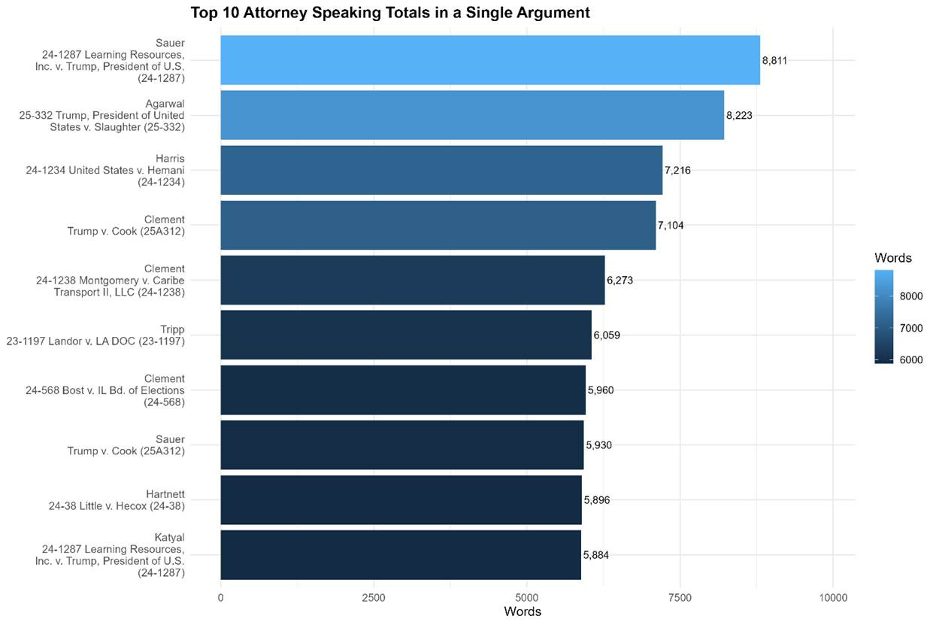
The top single-argument attorney speaking total in the figures (at least up until the birthright citizenship case) belongs to Solicitor General D. John Sauer in Learning Resources, Inc. v. Trump (the tariffs case), at 8,811 words. Just behind him is Amit Agarwal at 8,223 words in Trump v. Slaughter, who was a clerk to Justice Samuel Alito and in that case opposed the administration’s authority to fire a head of the Federal Trade Commission. Next comes Principal Deputy Solicitor General Sarah Harris in United States v. Hemani, a gun rights case, at 7,216 words, and former Solicitor General Paul Clement representing Lisa Cook in Trump v. Cook, at 7,104 words (Clement had three of the top 10 speaking totals in a single argument).
The pattern is suggestive. The lawyers speaking the most in a single argument tend to be the advocates one would expect to find in the Supreme Court’s most charged disputes: experienced specialists, often representing institutional actors (whether the government or parties on the other side), and often arguing cases whose legal framing is broad enough to invite sustained questioning.
As for the justice-side numbers, these show an equally clear, though somewhat more complicated, pattern.
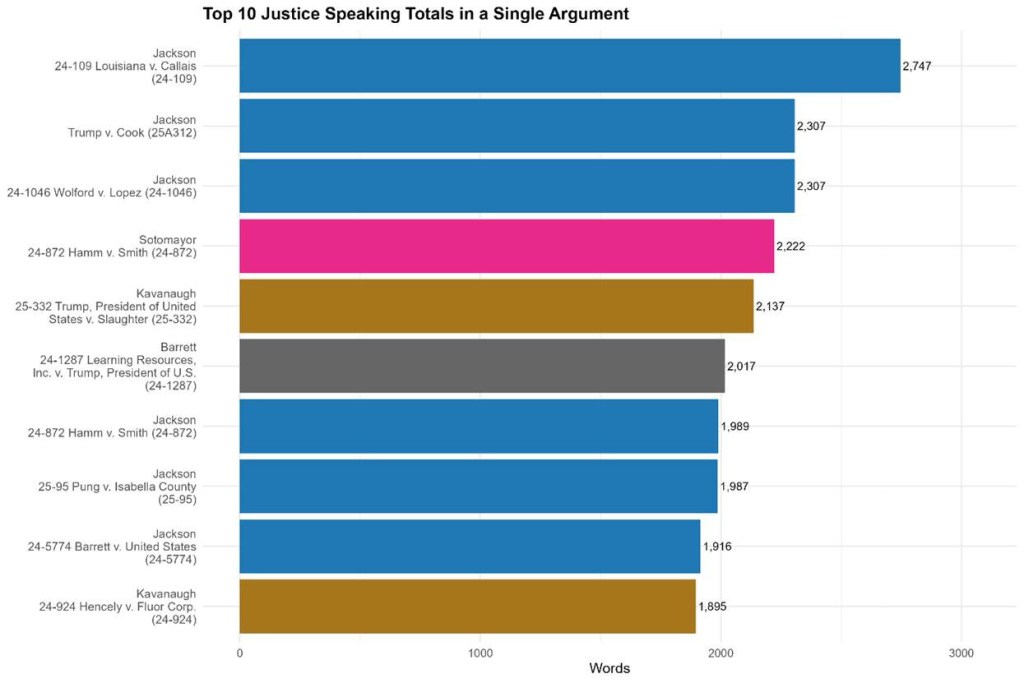
The top single-argument justice speaking total in the chart belongs to Jackson in Louisiana v. Callais, at 2,747 words. Jackson also appears at 2,307 words in Trump v. Cook and Wolford v. Lopez, a gun rights case. Justice Sonia Sotomayor’s 2,222 words in Hamm v. Smith, a death penalty case, takes the fourth-place spot, and Justice Brett Kavanaugh comes in fifth, with 2,137 words in Trump v. Slaughter. In other words, Jackson appears again and again near the top, while other justices have high-volume showings depending on the particular disputes.
This is not particularly surprising. Since she joined the bench, Jackson has regularly been among the justices most inclined to engage quickly and at length. This term’s data appears consistent with that broader pattern. It also fits another observable feature of recent arguments: the liberal justices often account for a substantial share of total questioning – perhaps to voice a potential dissent or try and narrow the contours of a possible majority decision that they may oppose.
The cumulative totals reinforce this broader pattern. Jackson leads the aggregate chart at 53,299 words across cases. She is distantly followed by Sotomayor at 34,967 and Justice Elena Kagan at 30,606. Justices Neil Gorsuch and Kavanaugh sit in the same general range, at 27,880 and 27,657, followed by Alito at 24,541, and Justice Amy Coney Barrett at 23,978. Chief Justice John Roberts and Justice Clarence Thomas trail the group, at 16,538 and 7,278, respectively.
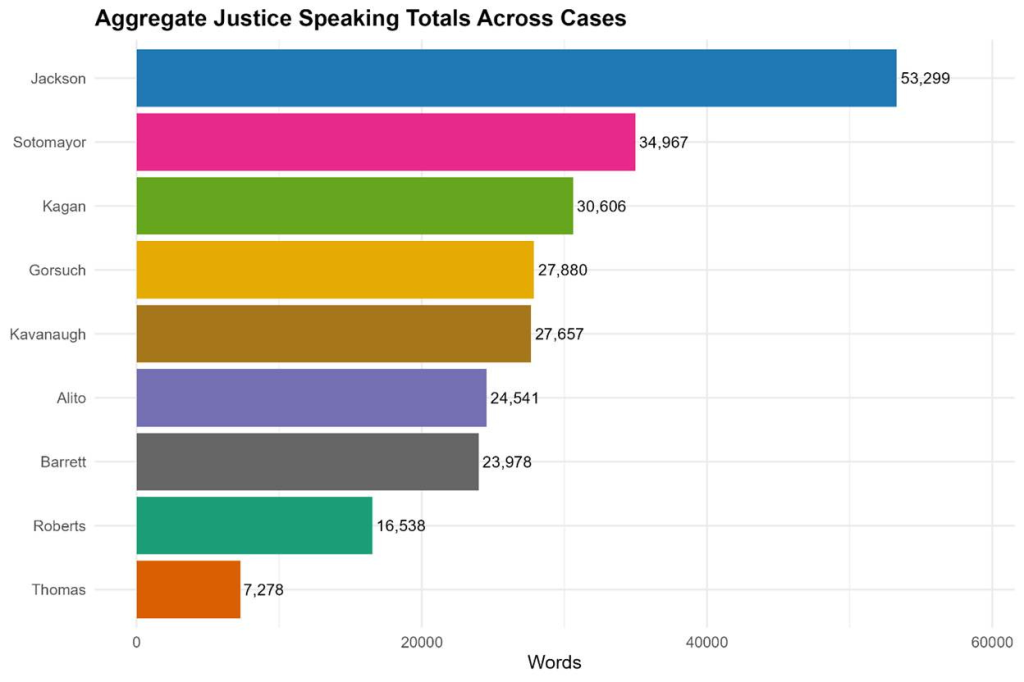
Those totals suggest a bench with fairly uneven speaking habits. Jackson sits in a class of her own. Sotomayor and Kagan form the next tier. Gorsuch and Kavanaugh remain highly active, although not nearly at the same cumulative level as Jackson. Roberts and Thomas are markedly less talkative – this is not new but the gap is still striking.
One way to read this is that the court’s oral arguments now often run through a handful of dominant questioners. Another is that the court’s center of verbal energy has shifted somewhat in recent years, with Jackson’s arrival intensifying a tendency toward active, strategic engagement from the liberal wing. Either way, the data gives this a concrete shape.
Argument structures
If Trump v. Cook offers the best advocate case study, it also offers the best visual example of how an argument is structured.
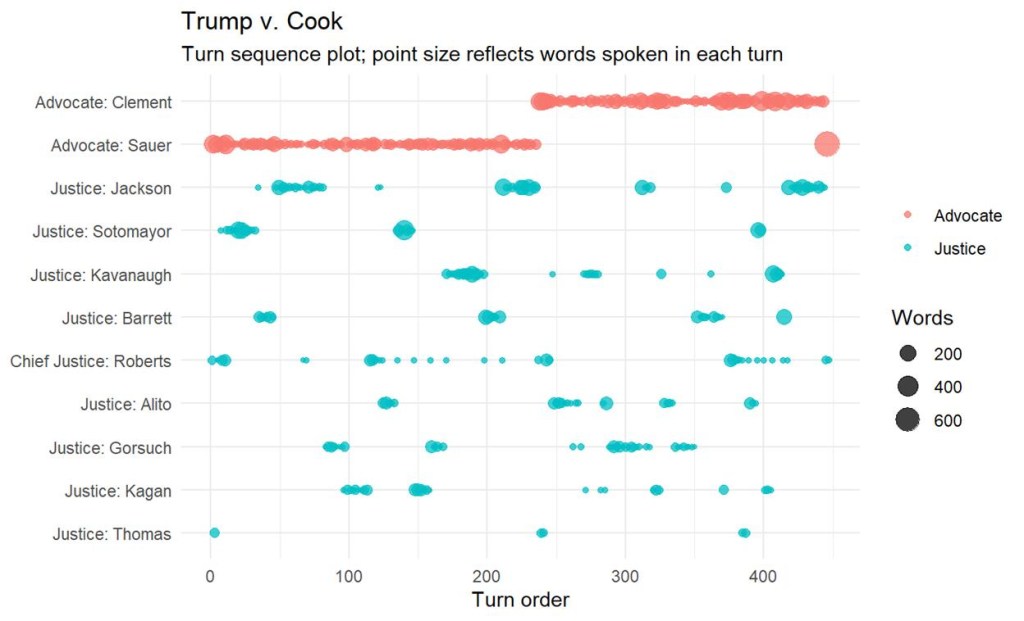
The turn-sequence graph for Trump v. Cook captures a familiar but revealing rhythm. Sauer occupies long stretches early in the argument. Clement appears later in an extended block of advocacy. Between and around them come repeated clusters of judicial questioning, with Jackson visibly active, Sotomayor and Kavanaugh making sustained appearances, and shorter interventions from Roberts, Alito, Gorsuch, Kagan, Thomas, and Barrett.
The plot does not tell a substantive story on its own, but it does show how the argument unfolded in practice. This was not a leisurely presentation interrupted by occasional questions. It was a dense exchange in which the advocates had to navigate bursts of sustained judicial attention, then recover, then do it again. The most experienced Supreme Court lawyers are often valued in part because they can survive that kind of environment while still keeping the legal frame intact.
Some transcript excerpts further make the point.
At one point, Sotomayor pressed Sauer on the historical novelty of the dispute:
JUSTICE SOTOMAYOR: “A hundred and twelve years, and it’s unprecedented that any Federal Reserve officer has ever – has ever been removed. So the unprecedented nature of this case is a – is a part of what the president did, not what Ms. Cook did.”
GENERAL SAUER: “I think that statement has to be qualified by the recognition that there have been situations where governors have been credibly accused or found to have engaged in financial improprieties, and those governors have resigned for financial improprieties that are quite analogous to what is at issue in this particular case.”
That exchange captures one of the defining modes of modern Supreme Court argument: the justice uses institutional history to frame the stakes, and the advocate responds by narrowing the comparison and contesting the historical characterization. Sotomayor’s question invites the court to see the case through the lens of novelty – that the administration is doing something unprecedented. Sauer’s response tries to blunt that by shifting from the exact situation at issue to analogous episodes of financial impropriety and resignation.
Later, Alito pushed Clement with an extreme hypothetical:
JUSTICE ALITO: “All right. I understand your position. How about if, after the person assumes office, videos are disclosed in which the office-holder is expressing deep admiration for Hitler or for the Klan?”
MR. CLEMENT: “I can only imagine –”
JUSTICE ALITO: “That must be –”
MR. CLEMENT: “– where these hypos are going to eventually go, Your Honor, but –”
JUSTICE ALITO: “Well, yeah, because your position leads to –”
MR. CLEMENT: “I’m going to stick with my position.”
JUSTICE ALITO: “Well, you’re – all right.”
MR. CLEMENT: “Of course, I’m going to stick with my position and I’m going to say
that’s an official that would be impeached in a heartbeat …”
This is a different but equally familiar pattern. A justice stress-tests a legal rule with an extreme hypothetical. The advocate acknowledges the force of the move without conceding the principle. Clement’s answer is recognizably that of a seasoned Supreme Court specialist: he does not run from the premise, but he does not let the hypothetical redefine the case either.
The case-level charts also help show how much argument structure varies.
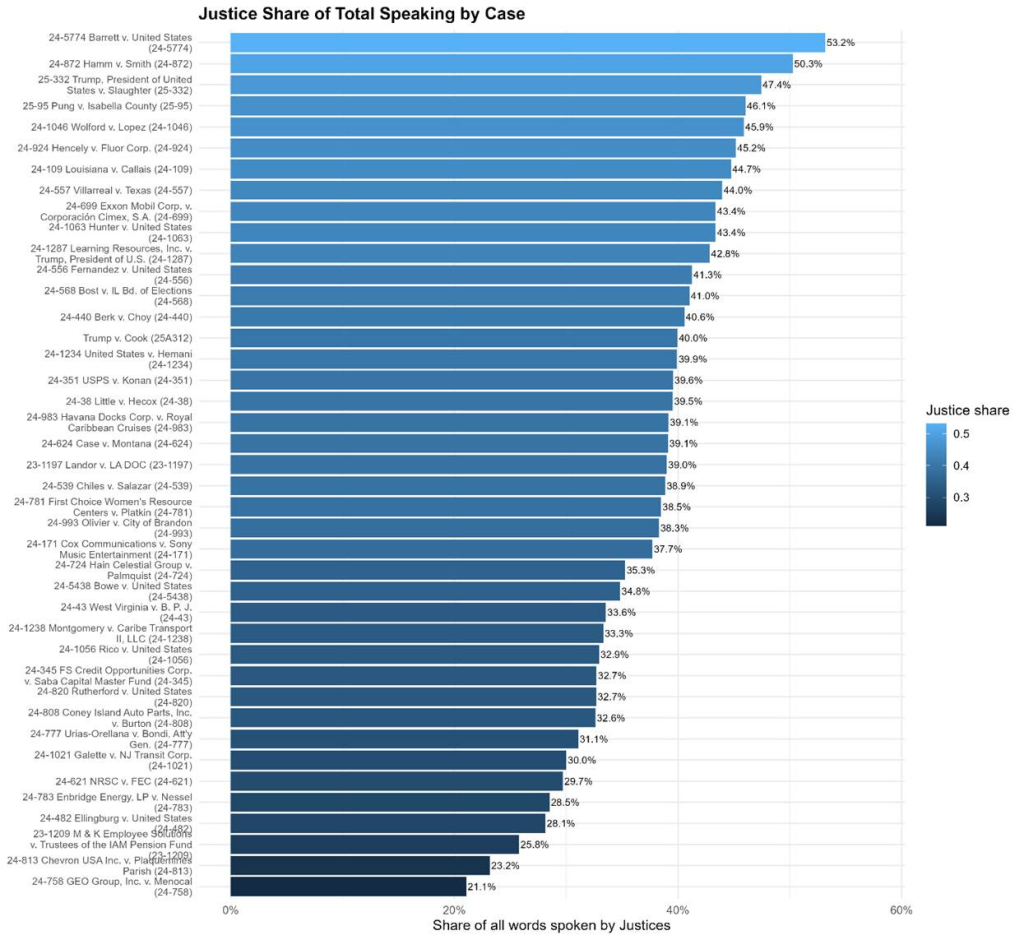
In some arguments, justices account for an unusually large share of the total words spoken. In Barrett v. United States, which dealt with the double jeopardy clause, the justices’ share reaches 53.2% – in other words, they spoke even more than the advocates. In Hamm v. Smith, it is 50.3%. In Trump v. Slaughter, it is 47.4%. Pung v. Isabella County, on the takings clause of the Fifth Amendment, and Wolford v. Lopez, are also near the top. Louisiana v. Callais comes in at 44.7%, and Learning Resources, Inc. v. Trump at 42.8%. Trump v. Cook sits at 40%.
Those are substantial numbers. In practical terms, they suggest that some of the term’s biggest arguments are not simply lawyer presentations punctuated by questions. They are conversations the justices are actively shaping in real time. That can mean sharper testing of doctrinal boundaries, more visible skepticism, or simply a court more inclined to use oral argument as a forum for working through the implications of its own possible rulings and speak to one another through the advocates.
The court’s conversation
Of course, no speaking-time analysis can tell the whole story of oral argument. It does not measure who asked the best question, who changed a colleague’s mind, or which exchange ultimately mattered most at conference. Volume can reflect persistence, skepticism, interest, or the simple contingencies of a particular day. Still, it captures something real. Oral argument is a structured conversation that the justices are not only having with the advocates but with one another, and the distribution of speech helps show who is trying to shape that conversation.
So far this term, the answer is fairly clear. The court’s highest-profile arguments have centered on politically consequential disputes with large institutional stakes. Those arguments are often being handled by elite advocates with the capacity to absorb extended questioning. On the bench, Jackson remains the most consistently forceful verbal presence, with Sotomayor and Kagan also heavily involved, while justices such as Kavanaugh remind observers that the pattern is not one-directional and not ideologically tidy in every case. And while the former may be attempting to shape argument to achieve any victory they can, the latter – given his frequency in the majority – may be projecting the eventual ruling.
That combination – politically charged cases, experienced advocates, and concentrated judicial engagement – has given the term’s oral arguments a distinct feel. The cases may be remembered for what the court eventually decides. But the arguments themselves are already revealing how the justices and the lawyers are grappling with those eventual decisions in real time.
Posted in Empirical SCOTUS, Featured, Recurring Columns
Cases: Trump v. Cook (Independent Agencies), Trump v. Cook