What oral argument told us in the birthright citizenship case

Empirical SCOTUS is a recurring series by Adam Feldman that looks at Supreme Court data, primarily in the form of opinions and oral arguments, to provide insights into the justices’ decision making and what we can expect from the court in the future.
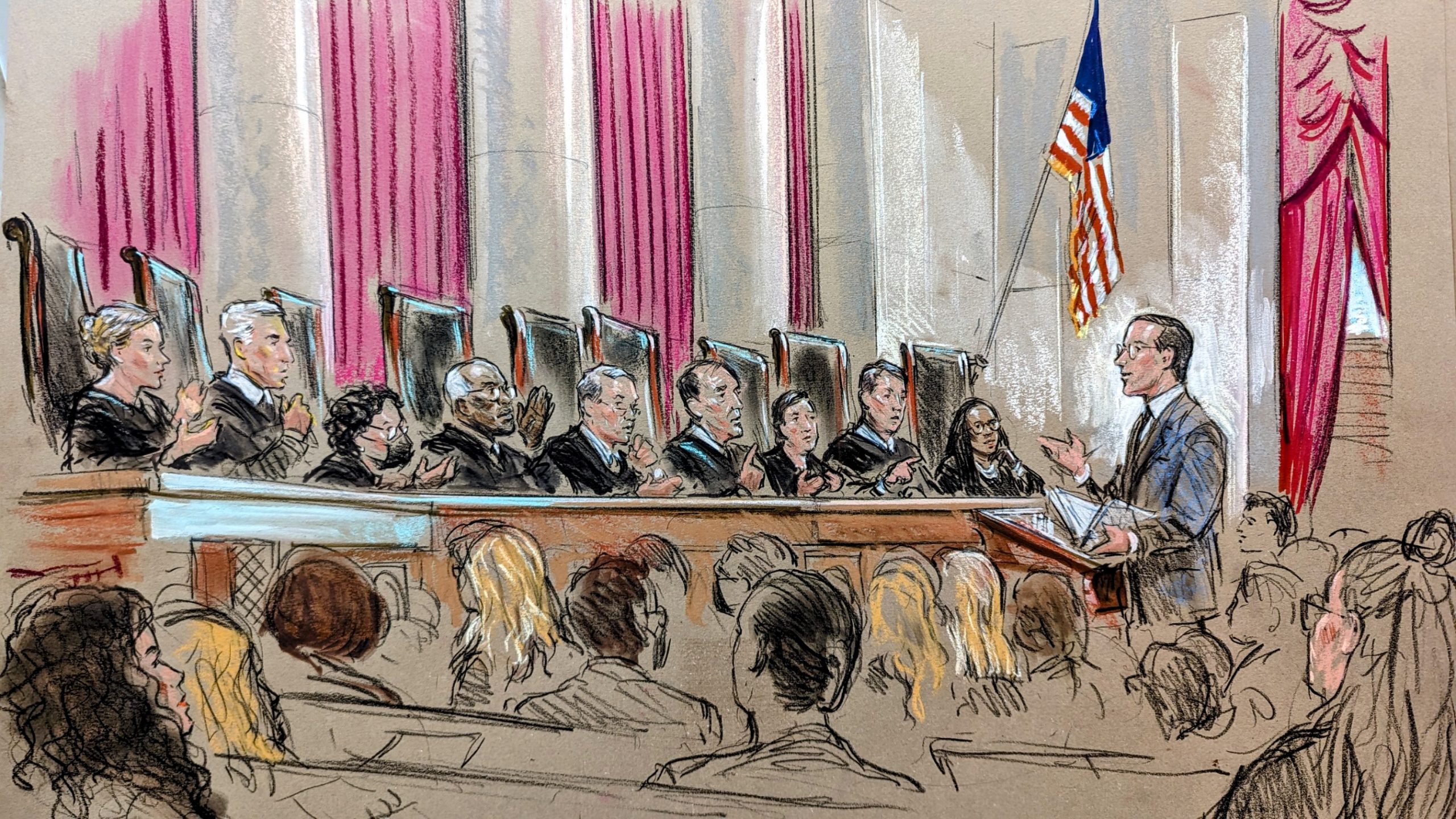
As Amy Howe reported for SCOTUSblog on Wednesday, the Supreme Court heard just over two hours of oral argument on April 1 in Trump v. Barbara, the challenge to President Donald Trump’s executive order ending birthright citizenship for children born in the United States to parents who are undocumented or present in the country on temporary visas. Solicitor General D. John Sauer argued for the government. ACLU National Legal Director Cecillia Wang argued for a class of affected children and families. Trump attended the argument – the first sitting president to do so – and departed shortly after Sauer finished his presentation.
Every lower court to consider the executive order has blocked it. The question before the justices is whether the order complies with the citizenship clause of the 14th Amendment and 8 U.S.C. § 1401(a), which codifies the citizenship clause. The government’s theory turns on the phrase “subject to the jurisdiction thereof” in the citizenship clause and the statute, which Sauer argued should be read to require the parents’ allegiance and domicile (that is, permanent home in or connection with the United States) – concepts he contended would exclude unauthorized immigrants and temporary visa holders from the clause’s reach. Wang pressed the broader reading: that virtually everyone born on U.S. soil is a citizen, with narrow exceptions for children of foreign diplomats and hostile occupying forces.
Now that the dust has (somewhat) settled from oral argument, I closely analyzed the transcript to really understand how the argument unfolded – who drove it, what it centered on, and what it tells us about a possible outcome.
What the transcript reveals
First of all, the advocates got a good deal of words in (Sauer especially) but the bench ultimately controlled the argument.
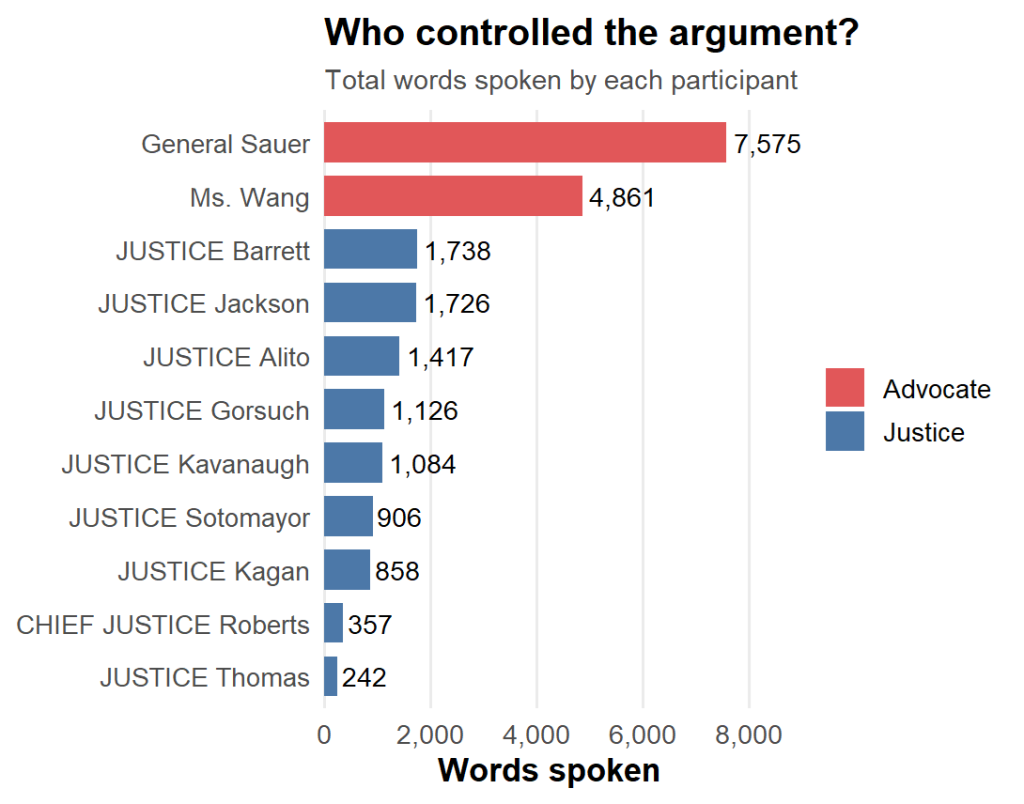
The broadest measure of an oral argument is, obviously, who does the talking. In Trump v. Barbara, the bench spoke a combined 9,454 words – more than either advocate. Sauer spoke 7,575 words across 110 exchanges. Wang spoke 4,861 words across 77 exchanges.
Among individual justices, Justice Amy Coney Barrett led (just barely) in total words (1,738), followed closely by Justices Ketanji Brown Jackson (1,726) and Samuel Alito (1,417). Justice Neil Gorsuch spoke 1,126 words and Justice Brett Kavanaugh 1,084. At the other end were Chief Justice John Roberts at 357 words and Justice Clarence Thomas with just 242 words.
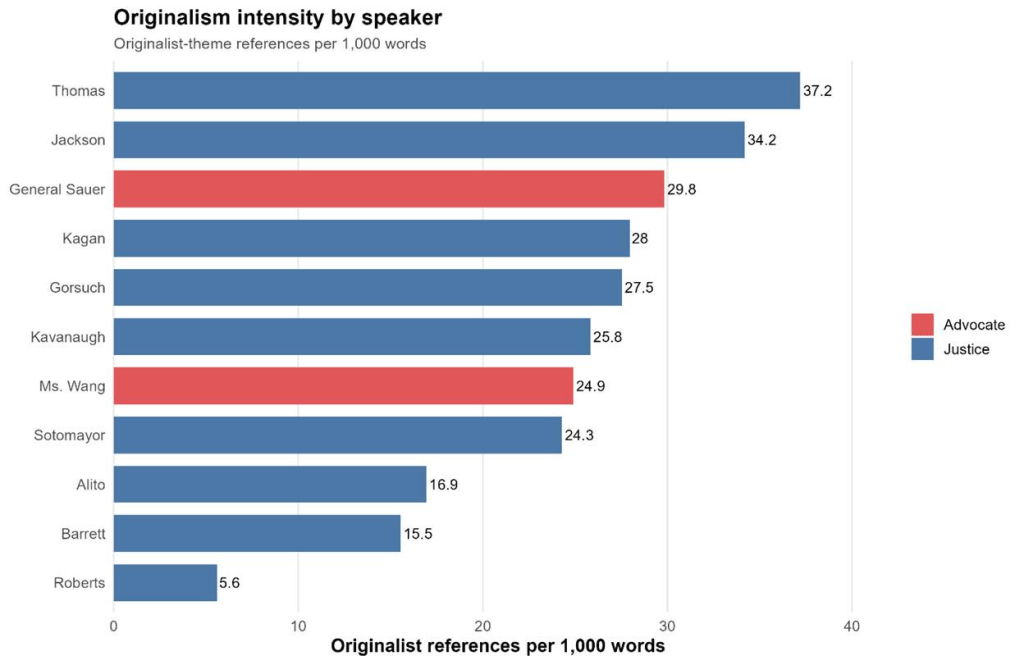
An interesting pattern emerges when we look to what each justice focused on. Oral arguments at the Supreme Court vary widely in this regard. Some are dominated by pragmatic and doctrinal concerns. But this one was dominated by history and originalism.
The originalism-intensity measure – a rate of originalist-theme references per 1,000 words spoken – captures the degree to which each participant framed the argument in historical and originalist terms. Arch-originalist Thomas led at 37.2 references per 1,000 words, with Jackson (who is certainly not a self-described originalist) close behind at 34.2. Of note, the justice least focused on originalism was the chief, who focused on history far less than anyone else.
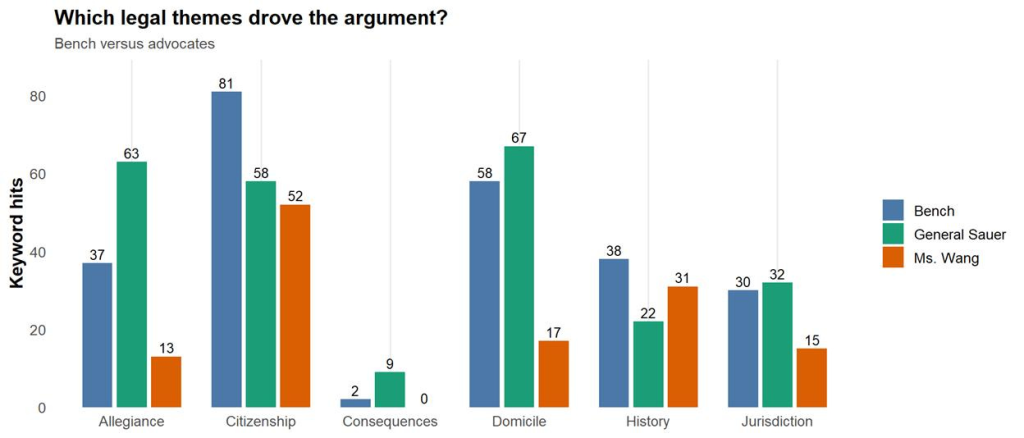
As for specific themes and issues, the argument was organized around a relatively small number of doctrinal questions. “Citizenship” was the most frequently referenced theme across all three speaker groups (the bench, Sauer, and Wang). “Domicile” ranked second overall. “Allegiance” came in third, and “history” and “jurisdiction” filled out the remaining space.
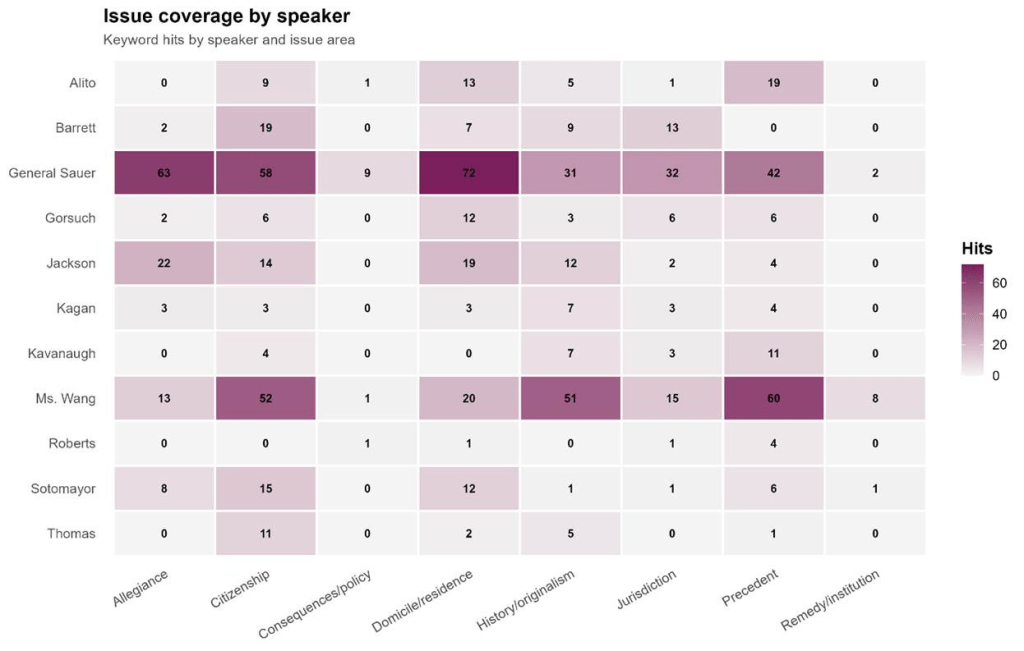
Among the justices, the graph above reveals their individual priorities. For example, Jackson concentrated on allegiance, domicile, citizenship, and history/originalism. Barrett was more attuned to citizenship, jurisdiction, and history/originalism. Alito was focused most on precedent and domicile – consistent with his questioning of Wang on the 1898 case of Wong Kim Ark, the court’s most important precedent on birthright citizenship. Kavanaugh was more diffuse but spoke most often of precedent and history/originalism.
I next studied how much questioning each justice did of each advocate. Gorsuch concentrated heavily on Sauer and much less on Wang. Jackson and Roberts behaved similarly. On the other side, Alito directed most of his questioning to Wang – as did Barrett and Kavanaugh. Justice Sonia Sotomayor and Thomas were more balanced.
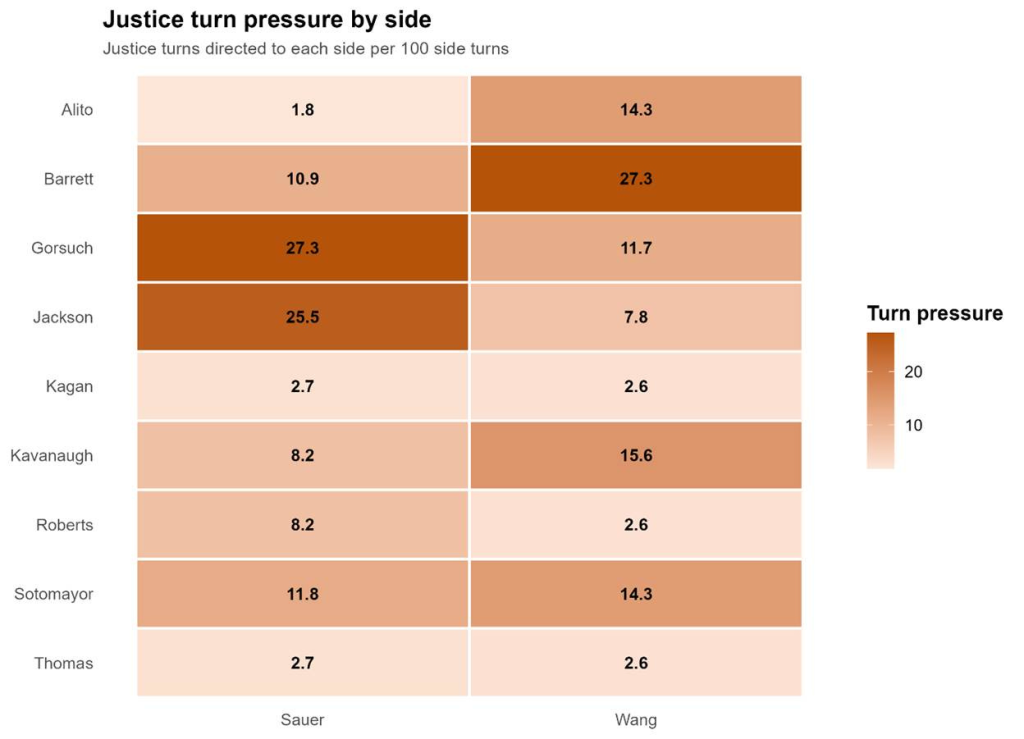
In terms of substance, Gorsuch and Jackson were perhaps the most hostile to Sauer, pressing him on his argument’s internal coherence. Same with the the chief. Overall, Barrett is the hardest justice to place: her questioning skewed heavily toward Wang, but her questions focused on administrability and the nature of Wong Kim Ark rather than sympathy with the government’s core theory. Kavanaugh focused more on Wang’s argument as well, although his questioning about Congress’ decision to reenact the birthright-citizenship language after Wong Kim Ark cut against the government. Alito’s lopsided focus on Wang and Thomas’ originalist framing both track with likely votes for the government.
The pressure data, taken together, are most consistent with a 7-2 or 6-3 outcome favoring the challengers – with Thomas and Alito as the most probable dissents, and Barrett as the swing justice.
What it all might mean
The transcript data from Trump v. Barbara reveal (unsurprisingly) a highly-engaged bench, focused on the history and precedent underpinning the citizenship clause, and a majority more skeptical of the government than the challengers.
Regarding the focus on history, the argument was conducted overwhelmingly in the language of 1868 – when the 14th Amendment was ratified. Every justice who spoke substantively (including the court’s liberal members) engaged with questions of original meaning, historical allegiance, and the scope of the citizenship clause as understood at the time of ratification. Thomas and Jackson – from different interpretive directions – perhaps most anchored the argument in that historical terrain. Sauer built his presentation around it, and Wang engaged it while also centering her argument on precedent such as Wong Kim Ark.
The pressure on advocates was asymmetrical. Gorsuch, Jackson, and Roberts concentrated their questioning on Sauer, testing whether his limiting principles on the citizenship clause – domicile, allegiance, lawful subjection – actually survived the originalist inquiry he invoked. Barrett, Alito, and Kavanaugh concentrated more on Wang, asking whether her broad rule could account for the language and logic of Wong Kim Ark – though (with the exception of Alito) were somewhat less hostile to her than those questioning Sauer. Justices Elena Kagan, Sotomayor, and Thomas were more evenly distributed and, in Thomas’ case, sparing but targeted.
Overall, the justices tested both arguments – and the data suggest they found both sides’ positions vulnerable at specific points, but a majority appeared skeptical of the government’s theory. We should know for sure by late summer, when a decision is expected.
Posted in Empirical SCOTUS, Featured, Recurring Columns
Cases: Trump v. Barbara (Birthright Citizenship)