What really happens on the emergency docket

By now, readers of SCOTUSblog are quite familiar with the Supreme Court’s emergency docket, where parties come to the court seeking emergency orders, oftentimes without full briefing and oral argument. Much of the discourse surrounding this docket centers on its opacity. In 2015, Will Baude pointed out that, unlike with typical cases, we simply do not know how the justices vote on emergency applications. Occasionally, a public dissent or a noted disagreement statement gives us a partial glimpse at the underlying tally. But these are exceptions. Instead, the court usually issues a one-line order and the public is left to guess which justice voted which way.
In February 2026, I had the opportunity to examine Justice John Paul Stevens’ papers at the Library of Congress – including on emergency applications. (Although Stevens retired in 2010, before the emergency docket attracted its current level of public scrutiny, there is no reason to believe this process has changed significantly.) What I found offers the most detailed window into emergency application deliberations I have ever encountered. Stevens’ files contain not only his own memoranda on emergency applications, but the response memos circulated by each of his colleagues, making it possible to reconstruct the full deliberative record across a wide range of such applications.
That record raises serious questions for anyone trying to understand or draw conclusions from the court’s emergency docket.
The case: State of Wisconsin v. Richard A. Moeck
The case of Wisconsin v. Moeck is illustrative.
In Moeck, a criminal defendant had been tried four times on charges including first-degree sexual assault and robbery. After a series of trials, Richard Moeck was convicted at his fourth trial and sentenced to 161 years’ imprisonment, but the Wisconsin courts threw out that conviction, finding that trying him a fourth time violated double jeopardy. The state filed an emergency application for a stay from the Supreme Court while it prepared to petition for certiorari, a formal request asking the Supreme Court to review the lower court decision.
On June 10, 2005, the court issued its order on the emergency application, granting the state of Wisconsin’s application to stay the mandate (the formal certification making a judgment official) of the Wisconsin Supreme Court pending the timely filing and disposition of a petition for certiorari. The stay therefore kept Moeck in custody while the state prepared that request and the court decided whether to accept the case.
The order simply notes that the stay of the lower court’s order freeing Moeck would terminate automatically if cert were denied. No vote count. No dissent. No indication that anything about this case was remotely contested.
Someone looking at the Supreme Court’s public docket would see four entries: the application’s submission on June 2, 2005; a response filed on June 3; the application referred to the court by Stevens on June 10; and the application granted by the court that same day. With no noted dissents, no concurrences to parse, and no vote count disclosed, a newspaper headline about the case might reasonably read something like: “Supreme Court unanimously grants Wisconsin’s request to keep sex offender in jail pending appeal.”
The Stevens’ papers tell a very different story
But let’s back up a bit. When a stay application arrives at the Supreme Court, it initially goes to the circuit justice with jurisdiction over the relevant circuit. As circuit justice for the U.S. Court of Appeals for the 7th Circuit (in which Wisconsin is located), Stevens received the Moeck application. He then had two options: to rule on it himself (which is known as an “in-chambers” opinion) or refer it to the full court. As is typically the case, he chose the latter. Stevens subsequently wrote and circulated a memorandum to his fellow justices laying out the facts of the case, the relevant legal framework, and his recommendation on how they should vote.
In Moeck, Stevens’ memo is several pages long. It walks through Moeck’s four trials in detail, analyzes the Wisconsin Supreme Court’s decisions, and concludes with a recommendation to deny the stay. Denying the stay would have been a win for the criminal defendant: it would have freed Moeck while the state pursued its cert petition.
After Stevens circulated his memo, the other justices responded with their own memoranda, each voting to grant or deny and each, to varying degrees, explaining why.
The vote circulation
Most Supreme Court observers are aware that, in typical cases which are briefed and argued (i.e., non-emergency cases), the judges circulate their views after hearing oral argument, meet in conference to deliberate on the matter, and then exchange memos and opinion drafts.
My review of the Stevens papers reveals that a somewhat similar process occurs for emergency applications. Indeed, the chamber memos circulated among the justices in Moeck offer a rare, granular record of how emergency-application votes actually take shape, justice-by-justice, memo-by-memo, over the course of a few days.
Justice Anthony Kennedy was the first to respond to Stevens’ memo. In a memo dated June 9, 2005 (a day before the others), he wrote that he thought “there may be some substance to the petition for certiorari” and that “the defendant should remain in custody pending our consideration of that petition in the regular course.” Unlike Stevens, he thus voted to grant Wisconsin’s emergency application to keep Moeck in custody.
On June 10, the remaining responses came in. Chief Justice William Rehnquist voted to grant the state’s stay application pending filing and disposition of a cert petition, in a brief memo with no additional reasoning. Justice Sandra Day O’Connor likewise voted to grant pending a decision to grant certiorari.
Justice Clarence Thomas wrote simply, “I vote to deny the application for a stay of the mandate.”
Justice Antonin Scalia: “I vote to deny the stay application.”
Justice Stephen Breyer: “I vote to deny the application for a stay.”
Justice David Souter was more expansive: “Without going beyond John’s [John Paul Stevens’] memo, it strikes me that the conclusion reached by the Supreme Court of Wisconsin is open to serious challenge, but I doubt that I will vote to grant if the State files a petition for cert.” In other words, Souter thought the Wisconsin court may have gotten the law wrong, but doubted the case was significant enough for the Supreme Court to take up. He voted to deny the stay.
Then there is Justice Ruth Bader Ginsburg’s memo. Although she agreed with Stevens that “a grant of certiorari is not in order in this fact-bound case,” she noted that “Tony,” Kennedy’s first name, “thinks cert is a realistic prospect.” “Taking into account the risk of [the defendant’] flight,” she also voted to grant Wisconsin’s emergency application.
That left the tally at four votes to grant and five to deny, with Stevens among those in the denial column based on his initial memo.
Because Stevens had voted to deny the emergency application, he laid out, across several pages, why he believed the Wisconsin court’s decision was a defensible application of federal precedent and that the case was not cert-worthy. But at 11:45 a.m. on June 10, he circulated a final memo to the other justices. “Given the four votes to grant the stay,” he wrote, “and the real risk of flight, I have decided to change my vote.”
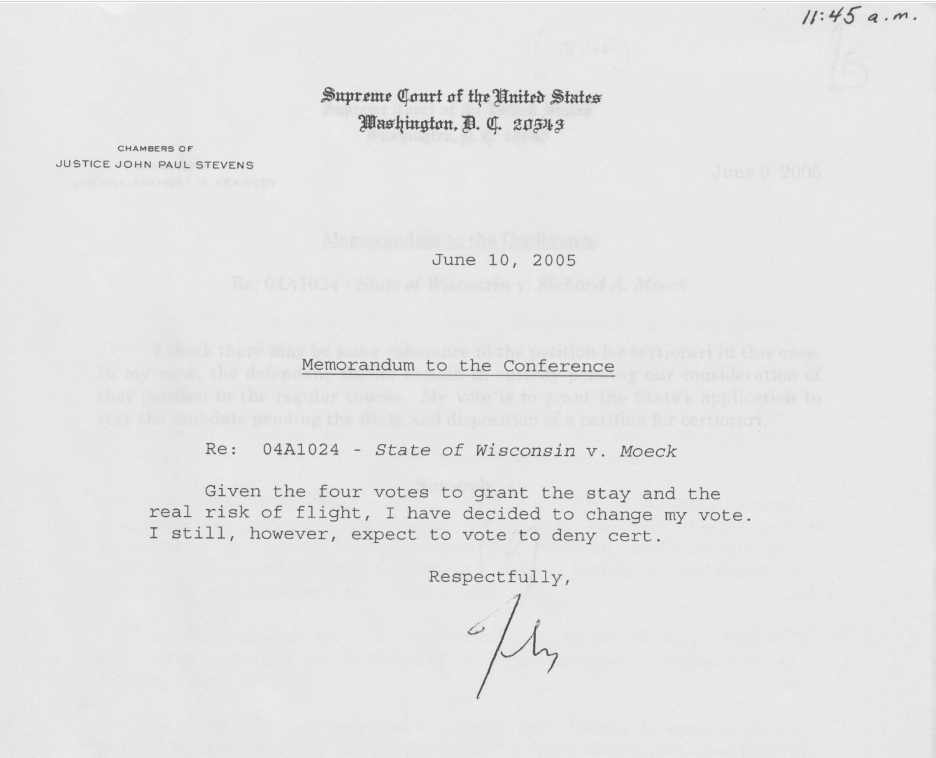
(II:924, John Paul Stevens Papers, Manuscript Division, Library of Congress, Washington, D.C.)
What had been a five to four decision to deny (and allow Moeck to be released) became, in a single memo, a five to four decision to grant (and hold Moeck in custody). But the public order gives no indication that any of this happened: it simply reads as a unanimous ruling.
What the memos reveal
A stay granted pending disposition of a petition for certiorari carries an implicit signal: that the court found the underlying legal question sufficiently worthy of Supreme Court review to preserve the status quo (there, keep Moeck in custody) while it considers whether to take up the case. That is the natural reading of the public order in Moeck.
But, as described above, the memos tell a different story entirely. Of the five justices who voted to grant, only Kennedy expressed any view that the cert petition had merit. Ginsburg explicitly said cert was not in order in a case like this one but voted to grant because of the defendant’s flight risk. Souter expressed doubt he would vote to grant cert. Stevens said outright that he expected to vote to deny cert. And Rehnquist and O’Connor did not address the cert question in their brief memos at all.
Cert was denied on October 31, 2005, and Moeck was released within days. The stay had kept him in custody for five months pending a petition that, as at least three of the five justices in the majority anticipated, was going nowhere.
But no one reading the order – by virtue of the nature of the emergency docket – would have any idea of the rationales behind it.
This is perhaps especially interesting because the vote itself defies any simple ideological story. The five justices who voted to grant Wisconsin’s emergency application, keeping the defendant in custody, were Rehnquist, Kennedy, O’Connor, Ginsburg, and Stevens. The four who voted to deny, which would have freed Moeck, were Thomas, Scalia, Breyer, and Souter. Two of the court’s most conservative members (Thomas and Scalia) voted against the state in a criminal case. Two of its most liberal members (Ginsburg and Stevens) voted to keep a convicted defendant in custody. The deciding vote was cast by the circuit justice who had recommended the opposite outcome.
And then there is Stevens’ vote change, which is perhaps the most striking thing that the memos document. He did not revise his view of the merits. He changed his vote because four colleagues had already voted to grant and because the defendant’s perceived flight risk cut against his legal analysis.
A caution for empirical researchers
Court watchers have increasingly turned to emergency application outcomes as behavioral data, using grants, denials, and the occasional public dissent to study how the justices decide. The Moeck papers should give that enterprise serious pause.
The public record for emergency applications is not a reliable window into how individual justices voted, why they voted that way, or what the underlying tally was. A justice who appears on the “grant” side may have recommended denial. A justice who does not publicly dissent may have voted the other way.
Of course, this is not a criticism of any particular study or legal analysis. It is an observation about the data: public emergency orders are outcomes, not records. Treating them as windows into individual judicial behavior requires assumptions the Moeck papers suggest we cannot safely make.
The bottom line
The public order in Wisconsin v. Moeck is one paragraph long. It tells us a stay was granted. It tells us nothing about a 5-4 vote, a cross-ideological coalition, a circuit justice who recommended denial and then cast the deciding vote to grant, or the explicit flight-risk reasoning that moved him. It tells us nothing about the private cert predictions that shaped at least two other justices’ votes, or the collegial memo-writing process through which all of this unfolded over the course of two days.
Baude was right that we do not know the vote counts on emergency applications. The Stevens’ papers let us see, in one case at least, exactly what that means in practice. And while Moeck is one case, it is not unique. Stevens’ papers contain many more examples like it, and the papers of other justices will eventually tell similar stories.
The debate over the emergency docket has largely focused on outcomes: which cases or for which party the court decides to grant relief. The Stevens’ papers suggest the transparency problem runs deeper than that. We do not just lack explanations for emergency docket decisions. We lack the votes, the reasoning, and sometimes even a reliable idea about what the decision even means.
At the same time, there is something genuinely reassuring in what the Moeck papers reveal: behind the one-line order was a real legal dialogue, justice-by-justice, memo-by-memo, over a few days. In that way, the emergency docket may be more deliberate than its critics assume.
But it is also more hidden than its defenders acknowledge, and the Moeck papers raise questions we need to wrestle with, for several reasons. First, emergency docket orders are cited as precedent in federal courts across the country. They decide whether presidents can fire agency heads, whether election maps stand, and whether people go free or remain in custody. When justices disagree sharply, but the public order reads as unanimous, something is missing. When a majority votes to grant but for entirely different legal reasons, courts citing that order as precedent have no way of knowing which reason commanded a majority.
But this is not just about precedent. On the merits docket, oral argument, opinions, and disclosed votes exist because the public deserves to know not just what the court decided but why. In a democracy, transparency is paramount. Yet the emergency docket has none of that. Whether a justice voted because they thought the executive action was unlawful, or because they thought the harm was irreparable, or because a colleague’s flight risk argument was persuasive, does not appear in the order. This is a serious problem, and especially since the emergency docket is now where some of the court’s most consequential questions land first.
NOTE: This research trip was partly supported through a Faculty Scholarship Award from Bradley University.
Posted in Court Analysis, Emergency appeals and applications, Featured