Uninjured class members, hindsight harmlessness, presidential cronies, and the mistaken use of deadly force

The Relist Watch column examines cert petitions that the Supreme Court has “relisted” for its upcoming conference. A short explanation of relists is available here.
There are 261 petitions and applications teed up for this Friday’s conference. Seventeen are familiar faces making return appearances on the relist stage, joined by four newcomers trying to break into the rotation. The lineup this week includes a RICO class-action that asks how many uninjured plaintiffs are too many, a capital case about whether harmless-error review can rely on evidence the jury never saw, and a qualified-immunity dispute featuring the wrong tear-gas round at the wrong time.
Uninjured class members and statistical proof
In Takeda Pharmaceutical Co. v. Painters and Allied Trades District Council 82 Health Care Fund, Takeda and Eli Lilly seek review of a decision of the U.S. Court of Appeals for the 9th Circuit allowing a nationwide RICO class action to proceed against them based on alleged concealment of the bladder-cancer risks associated with the diabetes drug Actos. The suit is brought not by patients but by third-party payors – insurers and benefit funds – that reimbursed prescriptions. They allege that for more than a decade the companies concealed evidence linking Actos to bladder cancer in order to boost prescriptions, causing TPPs to pay for drugs they otherwise would not have reimbursed.
The district court certified a nationwide class of TPPs under Federal Rule of Civil Procedure 23(b)(3) that reimbursed at least five prescriptions, relying heavily on an econometric model estimating that roughly 57% of prescriptions were “fraudulently induced” – and thus that most class members likely paid for at least one “excess” prescription. A divided panel of the 9th Circuit affirmed certification, reasoning that common proof – including regression analysis and company documents – could establish classwide injury and causation, and that the possibility some class members were uninjured did not defeat predominance (one of the requirements for class certification). Judge Eric Miller dissented, warning that reliance and causation turned on individualized prescribing decisions, making classwide adjudication inappropriate.
The petition argues the 9th Circuit’s permissive approach to Rule 23(b)(3) certification deepens two circuit splits. First, whether Rule 23(b)(3) permits certification of damages classes that include uninjured members without a reliable mechanism to identify and exclude them – an issue the court has twice tried and failed to resolve in Laboratory Corp. of America Holdings v. Davis and Tyson Foods, Inc. v. Bouaphakeo – both Relist Watch graduates. Second, whether plaintiffs can use statistical modeling to prove individualized reliance in fraud class actions. Respondents counter that the case is interlocutory (a premature appeal before a final judgment on the merits) and fact-bound and there’s no real split on the causation issue.
From a Relist Watch perspective, this is catnip: a big-ticket class action, a dissent below, and one of the court’s favorite unresolved questions – how much statistical averaging Rule 23 will tolerate. If the justices are still looking for a clean vehicle after LabCorp’s untimely demise (the court dismissed the petition as improvidently granted), this one may be hard to resist. Of course, “hard to resist” has described several recent cert petitions that ultimately proved very resistible.
Determining prejudice on habeas review: harmless in hindsight?
Whitton v. Dixon asks whether courts evaluating prejudice from constitutional trial error may rely on evidence the jury never saw. Gary Whitton was sentenced to death for a 1990 stabbing in Florida. The prosecution’s case leaned heavily on two jailhouse informants who claimed Whitton confessed. One of them falsely testified that he had never been arrested – a misstatement the U.S. Court of Appeals for the 11th Circuit later agreed violated Giglio v. United States because the government failed to correct it. But the 11th Circuit still denied habeas relief, concluding that the Florida Supreme Court reasonably found the evidence of Whitton’s guilt “overwhelming.” In reaching that conclusion, the court pointed to DNA testing conducted years after trial that allegedly linked blood on Whitton’s boots to the victim – testing never presented to the jury.
Whitton argues that this turns harmless-error review into a hindsight exercise: prejudice must be assessed based on the trial record, not post hoc developments. According to the petition, the U.S. Courts of Appeals for the 2nd, 6th, and 10th Circuits, as well as the North Carolina Supreme Court, have rejected the use of post-verdict evidence when evaluating harmless error. The state counters that the 11th Circuit was merely holding – under the Antiterrorism and Effective Death Penalty Act‘s famously forgiving standard limiting federal courts’ power to grant habeas relief – that the state court’s determination was not unreasonable.
If the justices see a genuine split about harmless-error methodology rather than a fact-bound dispute about AEDPA deference, Whitton may get a closer look; otherwise, the case may depart as quickly as it arrived.
All the president’s men
Stephen K. Bannon, former advisor to President Donald Trump, was convicted of contempt of Congress under 2 U.S.C. § 192 for “willfully” refusing to comply with a subpoena from the January 6, 2021, House Select Committee on the grounds that Trump had invoked executive privilege. The U.S. Court of Appeals for the D.C. Circuit affirmed his conviction, noting in part that circuit precedent required a willful refusal only be “deliberate” and “intentional,” and does not require bad faith or unlawful purpose. It also rejected as forfeited Bannon’s argument that the committee was improperly constituted under its authorizing House resolution, because he had not raised it before the committee.
Judges Neomi Rao, Karen Henderson, and Justin Walker dissented from en banc denial on the mens rea issue, with Rao and Henderson also wanting to reach the composition question. Judge Gregory Katsas issued a decision respecting denial of rehearing en banc. And Judges Bradley Garcia, Cornelia Pillard, Patricia Millett, and Florence Pan concurred in the denial of rehearing en banc. All acknowledged varying degrees of tension between circuit precedent and more recent Supreme Court precedent indicating that “willfulness” requires a showing that the defendant knew his conduct was unlawful.
In his petition, Bannon renews the two questions that spilled so much judicial ink: whether “willfully” in Section 192 requires the government to prove the defendant knew his conduct was unlawful, or merely that his noncompliance was intentional and deliberate; and whether the Select Committee’s apparent failure to comply with its own authorizing resolution (it never had the required 13 members or a ranking minority member) deprived it of the “authority” necessary to issue a valid subpoena under Section 192.
Although the court may be interested in those issues, it is unlikely to reach the merits. In a terse filing signed only by the Trump administration’s Solicitor General, D. John Sauer, the government informed the court that it “has determined in its prosecutorial discretion that dismissal of this criminal case is in the interests of justice,” and requested a GVR (grant, vacate, and remand) so the district court can grant the government’s pending Federal Rule of Criminal Procedure 48(a) motion to dismiss the case with prejudice. Bannon’s team, not surprisingly, agreed, while taking a parting shot at the D.C. Circuit’s “errant interpretation” of Section 192 and noting that the legal questions remain live and threatening to individual liberty.
Given the ever-present risk of contempt-of-Congress prosecutions in D.C., the justices are likely giving this one a careful look.
Qualified immunity and excessive force
The petition in Reinink v. Hart arises from the chaotic protests in Grand Rapids following George Floyd’s death. During a confrontation with protester Sean Hart, Officer Phillip Reinink fired a 40-mm canister launcher saying that he believed it contained a “Muzzle Blast” powdered tear-gas round designed for close-range dispersal. Instead, the launcher discharged a similar-looking Spede-Heat tear-gas projectile, a munition intended to be lobbed into the air rather than fired directly at a person. The projectile struck Hart in the shoulder, injuring him.
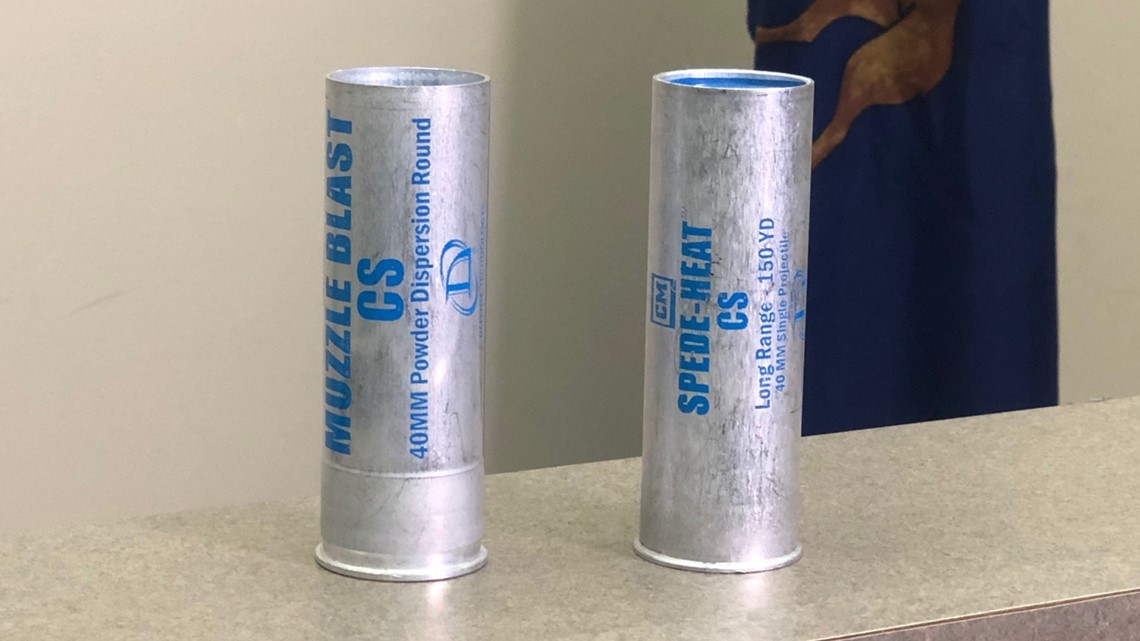
Hart brought an “excessive force” claim against Reinink. The district court granted summary judgment for Reinink, holding that his mistaken deployment of the wrong munition was objectively reasonable under the traditional Graham v. Connor totality-of-the-circumstances framework and that qualified immunity applied. A divided panel of the U.S. Court of Appeals for the 6th Circuit reversed, reasoning that because testimony indicated that firing Spede-Heat directly at a person could constitute deadly force, a jury could find the use of such force unreasonable under the circuit’s test for evaluating its use. Judge Joan Larsen dissented, emphasizing the absence of clearly established law addressing this kind of mistaken deployment.
Reinink’s petition asks the Supreme Court to resolve two questions. First, he urges the justices to clarify how courts should distinguish ordinary force from deadly force in Fourth Amendment cases, proposing a test that considers the weapon’s typical lethality, the officer’s intent, and the actual harm inflicted. Second, he asks the court to address when a reasonable factual mistake about the type of force used entitles an officer to qualified immunity. Respondent Hart counters that the case presents no doctrinal gap: the court recently reaffirmed Graham’s totality-of-the-circumstances objective reasonableness approach in Barnes v. Felix, under which an officer’s intent is irrelevant to the constitutional inquiry. He maintains that the 6th Circuit correctly focused on the nature of the force actually deployed. In reply, Reinink says his case provides a “perfect vessel” to answer important questions about how to handle factual mistakes in use-of-force cases.
The court takes petitions from police officers invoking qualified immunity very seriously, and this case is no exception. Whether this one presents a genuine doctrinal gap or just a fact-specific disagreement remains to be seen – but it has enough moving parts to warrant at least one more look. We should know soon whether this petition is going to get traction.
New Relists
Issues: (1) Whether, in the Fourth Amendment’s reasonableness-of-a-seizure context, a law enforcement officer’s intended level of force is relevant to determining whether an officer’s use of force should be analyzed under a deadly-use-of-force standard or a general use-of-force standard; and (2) whether, in analyzing an excessive force claim brought under 42 U.S.C. § 1983, an officer’s mistaken use of force being higher than what he or she intended entitles the officer to qualified immunity, so long as the mistake is reasonable under the circumstances.
(Relisted after the Mar. 6 conference.)
Bannon v. United States, 25-453
Issues: (1) Whether “willfully” in 2 U.S.C. § 192 – which states that anyone who is “summoned … by the authority of either House of Congress” and “willfully makes default” on the subpoena has committed a crime – requires the government to prove the defendant knew his conduct was unlawful; and (2) whether the proper composition of a congressional committee bears on its “authority” to issue a subpoena for purposes of 2 U.S.C. § 192.
(Relisted after the Mar. 6 conference.)
Takeda Pharmaceutical Co. v. Painters and Allied Trades District Council 82 Health Care Fund, 25-625
Issues: (1) Whether a federal court may certify a class action pursuant to Federal Rule of Civil Procedure 23(b)(3) when some members of the proposed class lack any compensable injury in fact; and (2) whether a federal court may certify a class action pursuant to Federal Rule of Civil Procedure 23(b)(3) when a class relies on representative evidence to try to prove an individualized reliance issue that is a necessary element of each plaintiff’s claim.
(Relisted after the Mar. 6 conference.)
Issues: (1) Whether in determining if a constitutional error had a prejudicial effect on the outcome of a trial a court must consider only that evidence that was presented to the jury at the trial; and (2) whether the prejudice from the Giglio v. United States violation in this case met the standards for relief under Giglio and Brecht v. Abrahamson.
(Relisted after the Mar. 6 conference.)
Returning Relists
Issues: (1) Whether, viewing the facts from the officers’ perspective at the time, the officers acted reasonably under the Fourth Amendment by using bodyweight pressure to restrain a potentially armed and actively resisting individual only until handcuffing could be accomplished; and (2) whether the panel erred in denying qualified immunity where no case clearly established that pre-handcuffing bodyweight pressure violates the Fourth Amendment.
(Relisted after the Sept. 29, Oct. 10, Oct. 17, Nov. 7, Nov. 14, Nov. 21, Dec. 5, Dec. 12, Jan. 9, Jan. 16, Jan. 23, Feb. 20, Feb. 27, and Mar. 6 conferences.)
Bannon v. United States, 25-453
Issue: (1) Whether “willfully” in 2 U.S.C. § 192 – which states that anyone who is “summoned … by the authority of either House of Congress” and “willfully makes default” on the subpoena has committed a crime – requires the government to prove the defendant knew his conduct was unlawful; and (2) whether the proper composition of a congressional committee bears on its “authority” to issue a subpoena for purposes of 2 U.S.C. § 192.
(Relisted after the Mar. 6 conference.)
Foote v. Ludlow School Committee, 25-77
Issue: Whether a public school violates parents’ constitutional rights when, without parental knowledge or consent, the school encourages a student to transition to a new “gender” or participates in that process.
(Relisted after the Nov. 21, Dec. 5, Dec. 12, Jan. 9, Jan. 16, Jan. 23, Feb. 20, Feb. 27, and Mar. 6 conferences.)
Issue: Whether the requirement that a verdict be based only on the evidence presented in the courtroom at trial satisfies 28 U.S.C. § 2254(d)(1)‘s “clearly established” requirement, and if so, whether a jury’s consideration of and reliance on extrinsic evidence as part of a jury experiment violates this rule.
(Relisted after the Dec. 5, Dec. 12, Jan. 9, and Jan. 16 conferences; now being held for consideration of response to Fields’ rehearing petition.)
Issue: Whether Article 64 of the Texas Code of Criminal Procedure, as authoritatively construed by the Texas Court of Criminal Appeals, violates due process by arbitrarily denying prisoners access to postconviction DNA testing, rendering illusory prisoners’ state-created right to prove their innocence through newly discovered evidence.
(Relisted after the Dec. 5, Dec. 12, Jan. 9, Jan. 16, Jan. 23, Feb. 20, Feb. 27, and Mar. 6 conferences.)
Gator’s Custom Guns, Inc. v. Washington, 25-153
Issue: Whether ammunition feeding devices with the capacity to hold more than ten rounds are “Arms” presumptively entitled to constitutional protection under the plain text of the Second Amendment.
(Relisted after the Dec. 5, Dec. 12, Jan. 9, Jan. 16, Jan. 23, Feb. 20, Feb. 27, and Mar. 6 conferences.)
Issue: (1) Whether a ban on the possession of exceedingly common ammunition feeding devices violates the Second Amendment; and (2) whether a law dispossessing citizens, without compensation, of property that they lawfully acquired and long possessed without incident violates the takings clause.
(Relisted after the Dec. 5, Dec. 12, Jan. 9, Jan. 16, Jan. 23, Feb. 20, Feb. 27, and Mar. 6 conferences.)
Viramontes v. Cook County, 25-238
Issue: Whether the Second and Fourteenth Amendments guarantee the right to possess AR-15 platform and similar semiautomatic rifles.
(Relisted after the Dec. 5, Dec. 12, Jan. 9, Jan. 16, Jan. 23, Feb. 20, Feb. 27, and Mar. 6 conferences.)
Issue: Whether the 2nd Circuit’s qualified immunity analysis conflicts with this court’s repeated instruction that courts must define rights with specificity and look for close factual analogues in determining whether a Fourth Amendment right is clearly established.
(Relisted after the Dec. 5, Dec. 12, Jan. 9, Jan. 16, Jan. 23, Feb. 20, Feb. 27, and Mar. 6 conferences.)
Issue: (1) Whether it obviously violates the First Amendment to arrest someone for asking government officials questions and publishing the information they volunteer; and (2) whether qualified immunity is unavailable to public officials who use a state statute in a way that obviously violates the First Amendment, or whether qualified immunity shields those officials.
(Relisted after the Dec. 12, Jan. 9, Jan. 16, Jan. 23, and Feb. 20 conferences.)
Sittenfeld v. United States, 25-49
Issue: Whether, when the government alleges bribery based solely on lawful campaign contributions, the defendant may be convicted based on evidence that is ambiguous as to whether the public official conditioned any official act on the campaign contributions.
(Relisted after the Dec. 12, Jan. 9, Jan. 16, Jan. 23, Feb. 20, Feb. 27, and Mar. 6 conferences.)
Poore v. United States, 25-227
Issue: Whether the limits on agency deference announced in Kisor v. Wilkie and Loper Bright Enterprises v. Raimondo constrain the deference courts may accord the Sentencing Commission’s interpretation of its own rules via commentary.
(Relisted after the Jan. 9, Jan. 16, Jan. 23, Feb. 20, Feb. 27, and Mar. 6 conferences.)
District of Columbia v. R.W., 25-248
Issues: (1) Whether a court assessing the existence of reasonable suspicion under the Fourth Amendment may exclude a fact known to the officer, or instead must assess all the evidence when weighing the totality of the circumstances; and (2) whether, under the totality-of-the-circumstances test, the officer in this case had reasonable suspicion to conduct an investigative stop.
(Relisted after the Jan. 9, Jan. 16, Jan. 23, Feb. 20, Feb. 27, and Mar. 6 conferences.)
Stroble v. Oklahoma Tax Commission, 25-382
Issue: Whether Oklahoma may tax the income of a Muscogee (Creek) Nation citizen who lives and works within the Muscogee (Creek) Reservation that McGirt v. Oklahoma held remains Indian country.
(Relisted after the Jan. 9, Jan. 16, Jan. 23, Feb. 20, Feb. 27, and Mar. 6 conferences.)
Federal Bureau of Investigation v. Fazaga, 25-430
Issue: Whether dismissal of a claim after assertion of the state-secrets privilege requires a district court to adjudicate the merits of the claim using the privileged information where the privileged information is relevant to a defense.
(Relisted after the Jan. 9, Jan. 16, Jan. 23, Feb. 20, Feb. 27, and Mar. 6 conferences.)
National Association for Gun Rights v. Lamont, 25-421
Issue: Whether a ban on the possession of AR-15-style rifles and firearm magazines with a capacity in excess of 10 rounds violates the Second Amendment.
(Relisted after the Feb. 20, Feb. 27, and Mar. 6 conferences.)
Issue: Whether the Second and Fourteenth Amendments guarantee the right to possess semiautomatic rifles that are in common use for lawful purposes, including the AR-15.
(Relisted after the Feb. 20, Feb. 27, and Mar. 6 conferences.)
Beaird v. United States, 25-5343
Issues: (1) Whether 18 U.S.C. § 922(g)(1) comports with the Second Amendment; (2) whether Stinson v. United States still accurately state the level of deference due to the Commentary of the Federal Sentencing Guidelines; (3) whether 18 U.S.C. § 922(g) permits conviction for the possession of any firearm that has ever crossed state lines at any time in the indefinite past, and, if so, whether it is facially unconstitutional.
(Relisted after the Feb. 27 and Mar. 6 conferences.)
Posted in Potential Merits Cases, Relist Watch
Cases: Reinink v. Hart, Bannon v. United States, Whitton v. Dixon, Takeda Pharmaceutical Co. v. Painters and Allied Trades District Council 82 Health Care Fund