
Skip to content
Newsletter

SCOTUStoday for Tuesday, March 3

Kelsey Dallas's Headshot
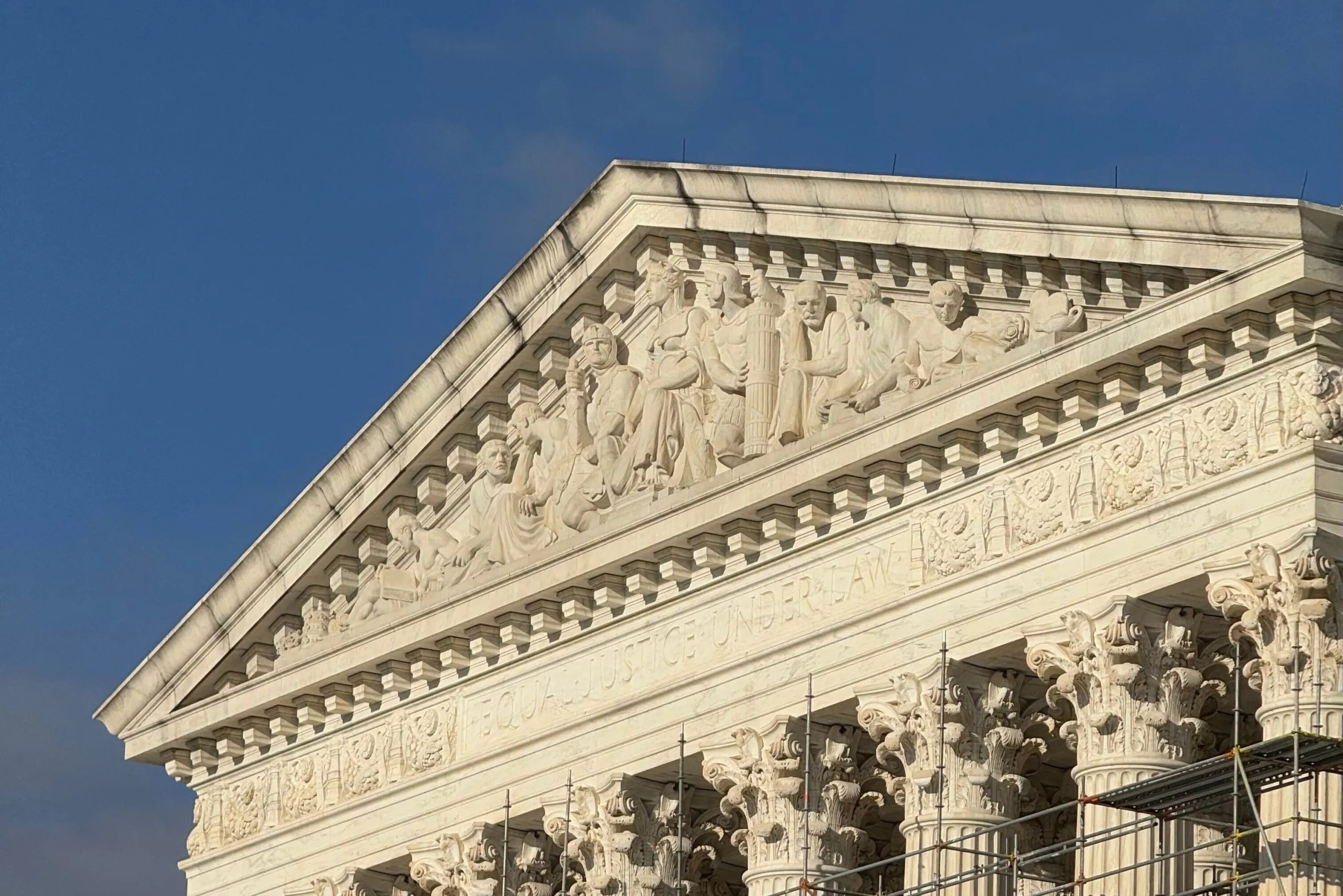
Carved details along top of Supreme Court building are pictured
(Katie Barlow)

As we’ve noted before, we read a lot of legal news in the process of preparing this newsletter. Here’s a headline we saw recently that we won’t soon forget: References to ‘The Wire’ helped taint man’s trial, NJ Supreme Court rules.

At the Court

On Monday, the court heard argument in United States v. Hemani, on whether a federal statute that prohibits gun possession by users of illegal drugs violates the Second Amendment. Amy’s argument analysis is featured in the On Site section below.

Also on Monday, the court released orders from its Friday conference.

Last night, the court resolved two pending matters on its interim relief docket, clearing the way for New York to use its current map in the 2026 elections and siding with parents who challenged California policies on transgender students. Find Amy’s coverage of these disputes in the On Site section.

Today, the court will hear argument in Hunter v. United States, on whether a federal appeals court properly dismissed a Texas man’s appeal of a mandatory-medication condition when he had signed an appellate waiver as part of his plea agreement but the judge who imposed the condition told him that he had a right to appeal. For more on the case, see the On Site section.

The court has indicated that it may announce opinions tomorrow morning at 10 a.m. EST. We will be live blogging beginning at 9:30 a.m.

Also on Wednesday, the court will hear argument in Montgomery v. Caribe Transport II, on whether freight brokers can be held liable for negligent hiring.

Morning Reads

Federal appeals court rejects Trump administration's push to delay start of tariff refund process after Supreme Court ruling

Jacob Rosen and Melissa Quinn, CBS News

On Monday, the U.S. Court of Appeals for the Federal Circuit declined a request from the Trump administration “to delay implementation of the Supreme Court ruling that invalidated most of President Trump’s tariffs, allowing next steps in processing of tariff refunds to begin swiftly,” according to CBS News. “The decision … clears the way for the lower court, the U.S. Court of International Trade, to begin the process of crafting relief for the small businesses that successfully challenged Mr. Trump’s global tariffs.”

Supreme Court sidesteps push in Alabama to scrap panhandling protections

Maureen Groppe, USA Today

The Supreme Court on Monday denied review in Taylor v. Singleton, “an invitation from Alabama to rule that begging is not protected speech under the First Amendment.” Alabama’s petition for review, which addressed state laws that criminalize panhandling, had been “backed by 19 Republican attorneys general from other states,” according to USA Today. The denial means that a lower court ruling in favor of Jonathan Singleton – “[a] homeless man from Montgomery,” Alabama, who “challenged the state’s panhandling bans as a violation of his free speech rights” – will remain in place.

US Supreme Court declines to hear dispute over copyrights for AI-generated material

Blake Brittain, Reuters

The court announced Monday that it will not “take up the issue of whether art generated by artificial intelligence can be copyrighted under U.S. law, turning away a case involving a computer scientist from Missouri who was denied a copyright for a piece of visual art made by his AI system,” according to Reuters. The Trump administration had asked the court to deny the petition, contending that copyright law has long required human authorship. “The Supreme Court previously rejected Thaler’s request to hear his argument in a separate case involving prototypes for a beverage holder and a light beacon concerning whether AI-generated inventions should be eligible for U.S. patent protection.”

Justice Thomas Bemoans Incivility as Security Prompts Cancellation of In-Person Speech

Ann E. Marimow, The New York Times

During a virtual appearance at a legal conference last week, Justice Clarence Thomas “expressed concerns that the Supreme Court faced increasing polarization, incivility and security threats, including one that apparently led the justice to appear at the event remotely instead of in-person as planned,” according to The New York Times. The details that went into the decision to switch Thomas’ appearance from in-person to virtual have not been made public. The article noted that there was a small protest outside the conference venue that appeared to be about Thomas’ participation in the event “and the Trump administration.” During his remarks, Thomas emphasized the importance of making connections across ideological lines and addressed staying on the bench until at least 2028 so as to “surpass the 36-year record for longest-serving associate justice.” “Well, I just get up every day and go to work,” Thomas said. “I don’t do a lot of that counting stuff.”

Supreme Court considers case involving FBI operative ready to burn everyone

Josh Gerstein, Politico

Craig Monteilh was an undercover operative for the FBI who became a whistleblower. He “provided inside details that supported an ACLU lawsuit alleging that” the FBI operation he was involved in “violated the religious freedom and privacy rights” of Muslims in California. But now, Monteilh says “that much of the information he gave to the ACLU was ‘made up,’” and it’s complicating a petition for review about protecting state secrets that’s currently pending before the Supreme Court, according to Politico. Monteilh hopes the justices “return the case to a lower court for a hearing where he can publicly air his grievances against both sides.”

On Site

From the SCOTUSblog Team

Supreme Court grants Republicans’ request to pause order to redraw New York congressional map

The Supreme Court on Monday night cleared the way for New York to go forward with the 2026 elections using the state’s existing congressional map. Over the objections of the court’s three Democratic appointees, the justices granted a request from a Republican member of Congress, a group of voters, and state election officials to pause an order by a state trial court that would have required the state to redraw the map to add Black and Latino voters.

The US Supreme Court in Washington, DC, on March 21, 2022.
From the SCOTUSblog Team

Court sides with parents in dispute over California policies on transgender students

The Supreme Court on Monday night granted a request from a group of California parents to reinstate a ruling by a federal district court that prohibits schools in that state from “misleading parents about their children’s gender presentation” and that requires schools to follow parents’ instructions regarding the names and pronouns that children use there.

The U.S. Supreme Court is seen in the early morning hours of November 4, 2022 in Washington, DC.
From the SCOTUSblog Team

Court turns down several cases, including on filing fees for indigent prisoners and ability of felons to possess guns

Over the objections of the court’s three Democratic appointees, the Supreme Court on Monday morning declined to hear a case involving the payment of filing fees by indigent prisoners. The announcement was part of a list of orders released on Monday from the justices’ private conference on Friday.

Photo taken on Feb. 25, 2022 shows the U.S. Supreme Court building in Washington, D.C.,
Argument Analysis

Supreme Court skeptical of law banning drug users from possessing firearms

The Supreme Court on Monday appeared skeptical that the indictment of a Texas man on charges that he violated a federal law prohibiting the possession of a gun by the users of illegal drugs could go forward. Ali Danial Hemani argued that the law violates the Second Amendment as it applies to him, and a majority of the justices seemed to agree.

The US Supreme Court is seen in Washington, DC, on January 10, 2025.
Case Preview

Justices to consider breadth of a federal defendant’s waiver of appeal

Today, the Supreme Court will address how broad federal defendants’ waivers of their right to appeal can be and the effect of a district court’s statement at sentencing that the defendant may appeal when he previously agreed to an appellate waiver.

The U.S. Supreme Court is shown March 17, 2025 in Washington, DC

SCOTUS Quote

JUSTICE GORSUCH: “[B]efore we lose track of what Justice Sotomayor is talking about, one – one can ask whether the habitual drunkard statutes are sufficiently – how and why sufficiently analogous. One could also ask, though, more basically whether this defendant would qualify as a habitual user, and I want to explore that before we lose track of it. Habitual drunkard, the American Temperance Society back in the day said eight shots of whiskey a day only made you an occasional drunkard.”

United States v. Hemani

Recommended Citation: Kelsey Dallas, SCOTUStoday for Tuesday, March 3, SCOTUSblog (Mar. 3, 2026, 9:00 AM), https://www.scotusblog.com/2026/03/scotustoday-for-tuesday-march-3/