Court reverses ruling on qualified immunity, denies review of death-row case and First Amendment challenge by citizen journalist

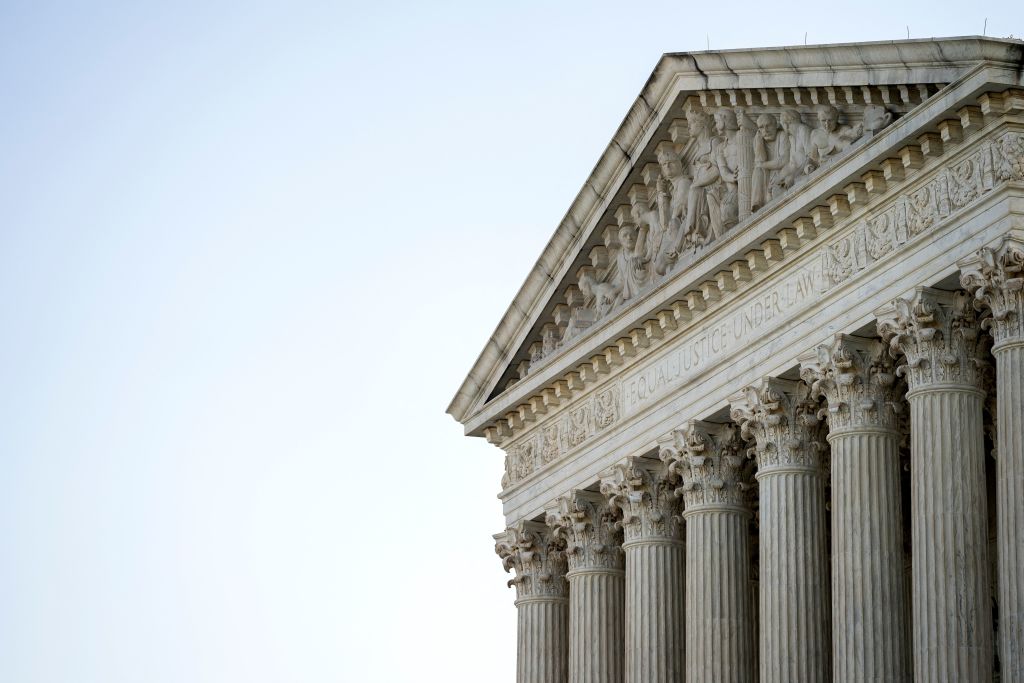
In a list of orders released on Monday morning, the Supreme Court reversed a ruling by a federal appeals court, holding that a Vermont police officer is entitled to qualified immunity from a lawsuit brought by a nonviolent protester who was injured during a sit-in at the state’s capitol. The justices also denied review in the case of a Texas man on death row seeking DNA testing that he says could prove his innocence. The court’s three Democratic appointees dissented in both cases. One of those justices, Sonia Sotomayor, also dissented from the denial of review in the case of a Texas journalist who was arrested, Sotomayor wrote, “for doing something journalists do every day: posing questions to a public official.”
The justices did not act on several high-profile petitions for review that they have repeatedly considered at their private conferences, including petitions challenging state bans on assault rifles and large-capacity magazines, a Fourth Amendment case involving a police officer’s justification to stop a car, and the FBI’s efforts to invoke the state-secrets privilege.
***
The court summarily reversed a decision by the U.S. Court of Appeals for the 2nd Circuit in the case of Jacob Zorn, a Vermont detective and a defendant in a lawsuit alleging that he used excessive force when he arrested Shela Linton during a 2015 demonstration inside the Vermont State House.
A federal district court in Vermont determined that Zorn was entitled to immunity, but the 2nd Circuit reversed that ruling. It reasoned that its 2004 decision in a case involving the arrest of anti-abortion protesters at a women’s health center in Connecticut “clearly establish[ed]” that the tactics that Zorn had used in arresting Linton “—such as a rear-wristlock—on a protestor who is passively resisting arrest constitutes excessive force and is therefore violative of that arrestee’s Fourth Amendment rights.” Therefore, the court of appeals concluded, law-enforcement officials like Zorn “were or should have been on notice on January 8, 2015 that they could be held personally liable for such conduct.”
Zorn, represented by the state of Vermont, came to the Supreme Court in September, asking the justices to review the 2nd Circuit’s qualified immunity ruling.
After considering the case at nine conferences, the justices reversed the 2nd Circuit’s decision in a six-page, unsigned opinion. Government officials, the majority explained, are entitled to qualified immunity “unless they could have ‘read’ the relevant” cases governing their behavior before acting “and ‘know[n]’ that it proscribed their specific conduct.” But the 2004 case on which the court of appeals relied, the majority said, “did not clearly establish that Zorn’s specific conduct violated the Fourth Amendment.” In fact, the majority stressed, the 2004 case “did not hold that any of” the police officers’ actions in that case “violated the Fourth Amendment, let alone all of them,” instead sending the case back to the lower court for a jury to consider the plaintiffs’ claims.
In a nine-page dissent, Sotomayor – joined by Justices Elena Kagan and Ketanji Brown Jackson – argued that the 2nd Circuit’s decision was not so demonstrably wrong that it met the high bar necessary for the Supreme Court to reverse it without additional briefing and oral argument. Instead, Sotomayor wrote, the majority “simply disagrees with how the Second Circuit applied a correctly stated legal standard … to this particular set of facts.” Sotomayor also characterized the ruling as a “resurgence and perpetuation of” the Supreme Court’s “‘one-sided approach to qualified immunity’ that ‘transforms the doctrine into an absolute shield for law enforcement officers, gutting the deterrent effect of the Fourth Amendment.’”
***
Nearly three years ago, the Supreme Court revived the case of Rodney Reed, who is on death row in Texas for the 1996 rape and murder of Stacy Stites. Reed has long insisted that he did not kill Stites but instead was in a secret relationship with her. Reed has pointed the finger at Stites’ fiancé – a white police officer who, he suggests, killed her after learning of her relationship with Reed, who is Black.
Reed sought to have several pieces of evidence found from the crime scene and Stites’ truck tested for DNA, but his efforts to do so in the state courts were unsuccessful, as were his efforts in the federal courts. By a vote of 6-3, the justices in April 2023 reversed a ruling by the U.S. Court of Appeals for the 5th Circuit holding that Reed was too late in challenging the Texas law governing DNA testing.
Reed’s case went back to the 5th Circuit, which once again ruled for the state. A three-judge panel held that Reed had “not shown that Texas’s scheme is unfair or unjust in such a way that it is fundamentally inadequate to vindicate the substantive right to postconviction DNA testing that it confers upon him.” In particular, the court of appeals rejected (among other things) Reed’s argument that a rule, imposed by the Texas state courts, barring DNA testing of evidence that may have been contaminated violates a defendant’s right to due process.
Reed returned to the Supreme Court in June, asking the justices to take up his case. “Despite compelling evidence of Reed’s innocence,” he wrote, “District Attorney Bryan Goertz refuses to DNA-test the murder weapon—the webbed belt used to strangle Stites.” And the non-contamination rule, Reed argued, “rests on the scientifically incorrect assumption that contaminated evidence cannot yield reliable DNA-testing results. But Texas itself has (and routinely uses) protocols for testing potentially contaminated samples to yield probative results” and allows their use at trial. “Texas,” Reed wrote, “cannot have it both ways.”
The state countered that Reed had not shown that the state’s procedures for post-conviction DNA testing were fundamentally inadequate, as it said the Supreme Court’s cases require. Moreover, the state added, Reed could have sought DNA testing “based on new technological developments” earlier, but “wasn’t diligent in seeking to avail himself of those developments.” Instead, the state suggested, he “was clearly trying to stave off an execution date with litigation.”
After considering the case at nine consecutive conferences, the court declined to take up Reed’s case for a second time. Sotomayor dissented, joined by Kagan and Jackson. She would have thrown out the lower court’s ruling and sent the case back for another look. Sotomayor deemed it “inexplicable” why the prosecutor’s office “refuses to allow DNA testing of the belt that was used to kill Stites, despite the very substantial possibility that such testing could exculpate Reed and identify the real killer.” “It is also inexplicable,” Sotomayor continued, “why the courts below did not proceed with more caution and carefully consider each of Reed’s arguments, especially given that his claim implicates the ‘constitutionally intolerable’ possibility of the ‘execution of a[n] . . . innocent person.’”
***
Finally, the justices denied review in the case of a Texas journalist, Priscilla Villarreal, who sued police and prosecutors in Laredo after she was arrested on allegations that she had violated a state law that makes it a crime to seek non-public information from a public official “with intent to obtain a benefit.” The charges were based on her efforts to confirm details for two stories – one about a border agent who died by suicide, and the other about a fatal traffic accident – with a Laredo police officer. Villarreal then published the information on her Facebook page, where she has over 100,000 followers.
Villarreal contended, as Sotomayor described, that the warrants for her arrest came after “a months-long investigation in which police officers worked closely with the local district attorneys’ office to come up with charges against her.” In affidavits supporting the application for the warrants, a police officer indicated that the “benefit” that Villarreal sought from the information was increased popularity on Facebook.
Villarreal says that in the 23 years since the Texas law was passed, it had never been enforced. A judge dismissed the charges against her, concluding that the law was so vague that it was unconstitutional.
Villarreal went to federal court, where she contended that the police officers and prosecutors had violated her civil rights. The majority of a three-judge panel of the U.S. Court of Appeals for the 5th Circuit agreed with her. It wrote that “[i]f the First Amendment means anything, it surely means that a citizen journalist has the right to ask a public official a question, without fear of being imprisoned.” By a vote of 9-7, however, the full court of appeals ruled that the prosecutors and police officers were entitled to qualified immunity.
Villarreal went to the Supreme Court in April 2024, seeking review of that ruling; the justices in October 2024 sent the case back to the 5th Circuit for another look after its ruling in Gonzalez v. Trevino, in which the court reinstated a retaliatory arrest lawsuit by a former member of the Castle Hills, Texas, city council.
The court of appeals again ruled, this time by a vote of 10-5, that the police and prosecutors could not be sued. Villarreal returned to the Supreme Court in July, asking the justices to take up her case. She argued that the Supreme Court’s “long-settled precedents” and “enduring First Amendment principles” “leave no doubt that arresting Villarreal for asking the government for information and publishing the response violated the First Amendment—and every reasonable official would have known that.”
The state urged the Supreme Court to deny review. It contended that “Villarreal’s ‘just asking questions’ framing runs afoul of this Court’s ‘repeated[]’ command ‘not to define clearly established law at a high level of generality’ when considering qualified immunity.” The state law that Villarreal was arrested for violating, it said, “does not criminalize merely asking questions,” but instead “requires conduct closer to inciting or commanding a public official to leak nonpublic information for the benefit of the requestor.”
In a 15-page solo dissent, Sotomayor argued that it was a “grave error” for her colleagues to deny review. “It should be obvious,” she wrote, that Villarreal’s “arrest violated the First Amendment.” “Tolerating retaliation against journalists, or efforts to criminalize routine reporting practices, threatens to silence ‘one of the very agencies the Framers of our Constitution thoughtfully and deliberately selected to improve our society and keep it free.’”
The justices will meet for another private conference on Friday, March 27. Orders from that conference are expected on Monday, March 30, at 9:30 a.m. EDT.
Posted in Court News
Cases: Villarreal v. Alaniz, Reed v. Goertz, Villarreal v. Alaniz, Zorn v. Linton