Watching tariffs come down

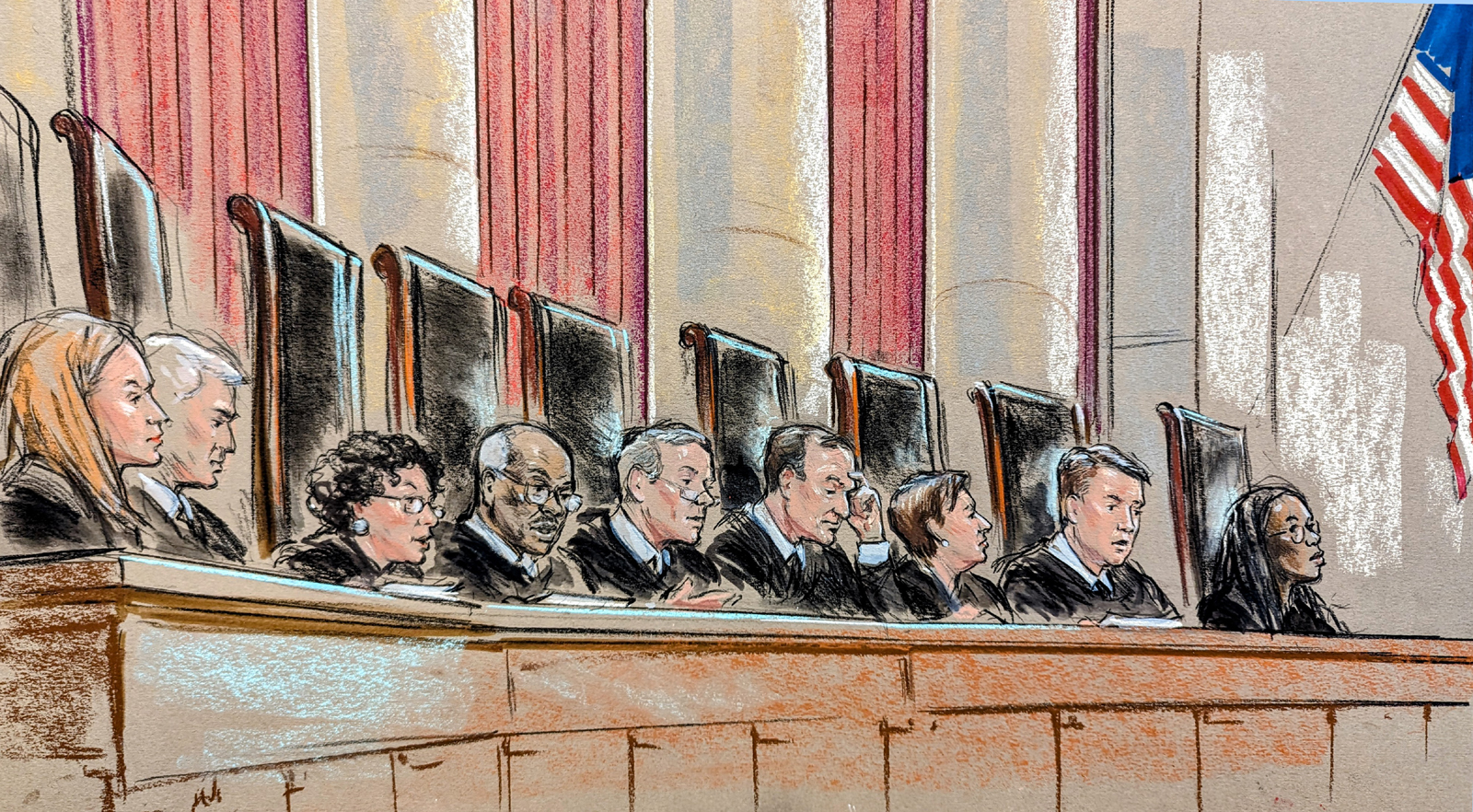
Today is the first time the court is taking the bench since its nearly four-week mid-winter recess. It is a day for bar admissions and possible opinions before the February sitting starts in earnest on Monday.
The tariff case is hanging in the air. Solicitor General D. John Sauer, who argued for the president’s policies, is here, with two assistants from his office. Neal Katyal, who argued for the challengers in the companion case of Trump v. V.O.S. Selections, is also in the bar section.
Two groups are here for admission to the Supreme Court Bar, one from Washburn University Law School and the other the Metropolitan Black Bar Association, of New York City. They don’t know in advance that they will get to witness such a historic day.
When the justices take the bench, all are present. Chief Justice John Roberts quickly gets to the dramatic point.
“I have the opinion of the court in Number 24-1287, Learning Resources versus Trump, and the companion case,” he says.
Everyone in the courtroom, including the fairly full public gallery, is at rapt attention now.
Roberts gives a short bit of background before getting to the question presented, whether the International Emergency Economic Powers Act, or IEEPA, authorizes the president’s tariffs.
“The court holds that it does not,” the chief justice says.
Sauer sits stone-faced and barely moving a muscle.
I don’t have a good view of Katyal while we’re all sitting, but I think I can assume he is at least smiling on the inside. (I noted in this column in November that Katyal’s friend John Mulaney, the entertainer who shares an interest in the court, was at the oral arguments. I have come to learn that he turned to one neighbor during the argument and whispered, “What’s IEEPA?” He surely knows by now.)
Roberts continues, referring to Article I, Section 8, of the Constitution setting forth the powers of the legislative branch, including the first clause specifying that “The Congress shall have Power To lay and collect Taxes, Duties, Imposts and Excises.”
“It is no accident that this power appears first,” he says.
He quickly goes through some recent cases in which the court has expressed reluctance to read into ambiguous statutory text extraordinary delegations of Congress’ powers, including those involving policies of President Joe Biden, a Democrat.
“It is also telling that in IEEPA’s half century of existence, no president has invoked the statute to impose any tariffs—let alone tariffs of this magnitude and scope,” the chief justice says.
“Finally,” he remarks, “The economic and political significance of the authority the president has asserted likewise provides a reason to hesitate before concluding that Congress meant to confer such authority.”
Here, Roberts helpfully provides a (slightly) early look at the lineup. He notes that three justices (which includes him) would rely on the major questions doctrine, while three in the majority judgment do not, but that “six agree that IEEPA does not authorize” the tariffs.
Roberts sums up with a reference to a personal favorite, Chief Justice John Marshall, and his observation in the 1824 case of Gibbons v. Ogden that the power to impose tariffs is “very clearly a branch of the taxing power.”
The chief justice notes the somewhat technical outcome in the lead case, Learning Resources, which is being sent back to the U.S. District Court in Washington with instructions to dismiss for lack of jurisdiction. (The court agrees with arguments that such tariff challenges should be brought in the U.S. Court of International Trade, where its consolidated case, V.O.S Selections, got its start.)
He then announces the somewhat complex lineup, including a dissent by Justice Clarence Thomas and the (principal) dissent by Justice Brett Kavanaugh, joined by Thomas and Justice Samuel Alito.
And then there is a bit of a pause, as if there might be an oral dissent coming. But no. Despite Kavanaugh’s sharp, 63-page dissent, today will not be the day for what (I think) would be his first dissent from the bench since he joined the court in 2018. (After all, he’s not in dissent all that much.)
Katyal bounds out of the courtroom as the ritual of bar admissions begins, while Sauer continues to sit, not moving until the justices leave the bench.
Two thoughts go through my head. Who gets to tell Trump about the outcome? (The president was reportedly slipped a note during a meeting with governors at the White House. Sauer appeared at Trump’s side at the president’s rather expressive press briefing in the afternoon, in which he stated, among other things, that the majority had been “swayed by foreign interests” and was “very unpatriotic and disloyal to the Constitution.”)
And what will next Tuesday’s State of the Union address be like? Roberts, Kavanaugh, and Justices Elena Kagan and Amy Coney Barrett are the active justices who attended last year’s Trump address to Congress. Will they attend this time? And are we in for some form of repeat of 2010, when President Barack Obama railed against the court over its then-recent decision in Citizens United? (That led to Alito’s famous “not true” retort mouthed to Obama.)
At least that will be televised.
Cases: Learning Resources, Inc. v. Trump (Tariffs), Trump v. V.O.S. Selections