Justices to hear argument on right to jury trial in FCC proceedings

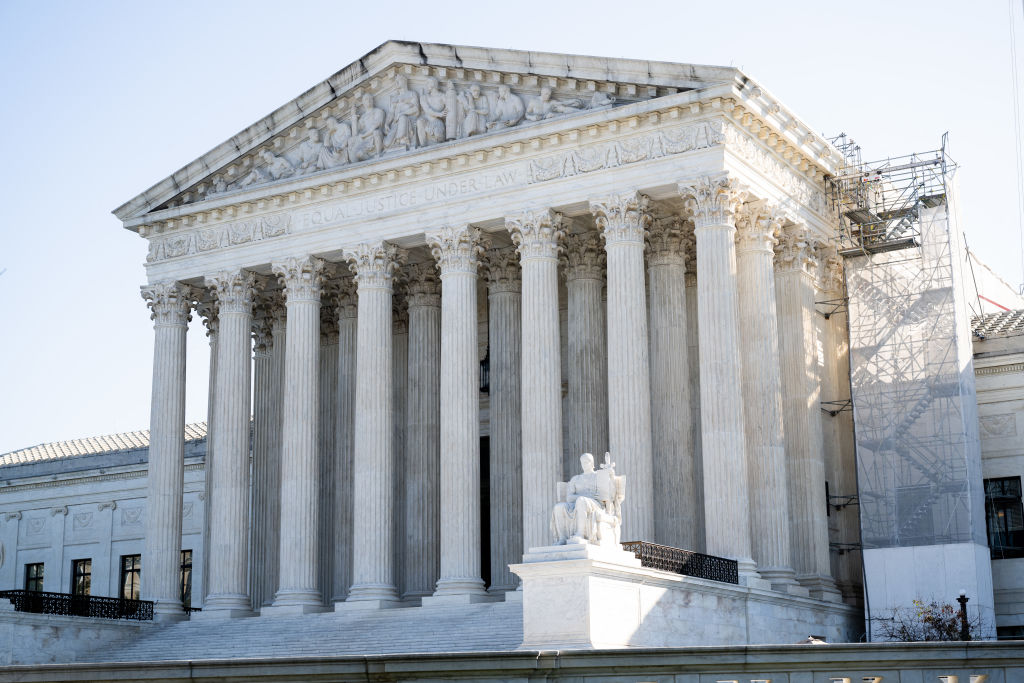
The Seventh Amendment guarantees a right to a jury trial in “suits at common law” – that is, lawsuits seeking legal remedies, such as money, rather than a remedy (known as equitable relief) that orders a defendant to do something or to stop doing something – in which $20 or more is at stake. In 2024, the Supreme Court ruled in SEC v. Jarkesy that the Securities and Exchange Commission’s imposition of fines in its administrative proceedings as a penalty for securities fraud violated that guarantee. On Tuesday, April 21, the justices will consider whether that same reasoning applies to fines that the Federal Communications Commission imposes for violations of federal communications laws.
FCC v. AT&T stems from a pair of in-house proceedings in which the agency concluded that AT&T and Verizon had violated a provision of the Telecommunications Act of 1996 that requires telecommunications carriers to protect confidential customer data – here, information about customers’ locations. Specifically, AT&T and Verizon had the opportunity to respond in writing to notices advising them that the FCC believed they had violated the law and assessing a penalty, but they did not have a hearing or a trial before the agency issued an order, known as a “forfeiture order,” directing them to pay the penalties within 30 days. The FCC fined AT&T $57 million and Verizon $46.9 million.
Both companies appealed, arguing that (among other things) imposing the fine in an in-house proceeding violated the Seventh Amendment right to a jury trial. The U.S. Court of Appeals for the 5th Circuit agreed with AT&T and threw out the fine. Judge Stuart Kyle Duncan wrote that, “in this process, which was completely in-house, the Commission acted as prosecutor, jury, and judge.”
But the U.S. Court of Appeals for the 2nd Circuit upheld the fine levied against Verizon. Writing for that court, Judge Alison Nathan said that “[n]othing about the Commission’s proceedings … transgressed the Seventh Amendment’s jury trial guarantee.”
Under the Communications Act, when a carrier like AT&T or Verizon receives a forfeiture order, it has two choices. First, it can pay the fine and then seek review in a federal appeals court, which will apply a fairly deferential standard. Second, it can refuse to pay the fine; if it does so, the Department of Justice has five years in which to file a lawsuit in a federal district court to enforce the order and collect the fine. In such a proceeding, the carrier would be entitled to a jury trial.
The dispute before the justices primarily centers on whether the availability of a jury trial in the Department of Justice’s lawsuit to collect the fine satisfies the Seventh Amendment. The FCC argues that it does. The Seventh Amendment, it says, only guarantees a right to jury trial in “suits at common law” and when $20 or more at stake. The in-house proceeding that leads to the forfeiture order is not a lawsuit, much less a lawsuit seeking money damages, U.S. Solicitor General D. John Sauer writes. And there is no money at stake, he insists, because the FCC cannot require a carrier “to pay a single dime.” The only obligation to pay comes if the DOJ brings a lawsuit to enforce the forfeiture order and wins – and the carrier has a right to a jury trial in that suit, Sauer stresses.
AT&T and Verizon counter that “[t]he Fifth Circuit got it right. The after-the-fact possibility of a jury trial in a separate debt-collection action does not satisfy the Seventh Amendment.” First, they contend, under the Seventh Amendment, the prospect that AT&T and Verizon can get a jury trial if the DOJ brings a lawsuit to enforce the forfeiture order is irrelevant. The Supreme Court, they emphasize, has never approved a “penalty-now-trial-later approach to the Seventh Amendment.” Instead, they say, they are entitled to a jury trial before the FCC issues the forfeiture order.
AT&T and Verizon also point to the forfeiture orders themselves as evidence that they are entitled to a jury trial. Those orders, they say, indicate that the FCC has considered the merits of the allegations against the carrier and “determined” that the carriers “shall be liable to the United States” and order the carriers to pay penalties by a specific deadline. The forfeiture orders “are clear that they are final commands, not tentative suggestions,” the carriers say.
The FCC pushes back, telling the justices that the premise of AT&T and Verizon’s argument – that the forfeiture order from the FCC “creates an immediate legal obligation to pay the specified amount” – “is wrong.” The carriers are not required to pay the FCC until it prevails at trial, the agency emphasizes. But, the agency writes, if the court agrees with the carriers that forfeiture orders are binding, it should strike down the provision of federal law that makes them so, “leaving the Commission free to issue non-binding orders that can be enforced in recovery suits.” Or, the FCC continues, if the problem is the text of the orders themselves, the Supreme Court “should make clear that the agency may lawfully issue forfeiture orders so long as it changes their wording.”
“[E]ven if a penalty-now-trial-later system could satisfy the Seventh Amendment in some circumstances,” AT&T and Verizon assert, the court should still strike down the FCC scheme because it requires a carrier to give up the right to judicial review of the order if it wants a jury trial – a violation of the “unconstitutional conditions” doctrine, the idea that the government cannot use coercion to get people to give up their constitutional rights
AT&T and Verizon further emphasize that as far as they know, carriers have always opted to pay the forfeiture order rather than wait to see whether the DOJ would bring an enforcement action. They do so, AT&T and Verizon contend, because “[w]hile waiting for that DOJ lawsuit that might never come, the carrier suffers serious practical and reputational harms from the final FCC order.” “Forcing carriers to suffer those ‘real-world impacts’ as the cost of preserving their jury-trial right is precisely ‘the type of coercion that the unconstitutional conditions doctrine prohibits.’”
In response, the FCC maintains that the unconstitutional-conditions doctrine does not apply here because a condition is only unconstitutional if its purpose is illegitimate – for example, “if its ‘only objective’ is ‘to discourage’ the exercise of the right.” But the process at issue serves the important purpose of avoiding “‘pointless delay’ when the ‘FCC’s factual findings are not in dispute,’” the FCC writes, and it “conserves judicial resources” by avoiding a separate trial. And even if carriers have always paid the fines rather than face the prospect of a recovery lawsuit by the DOJ, the FCC says, carriers are only “a small subset of the parties regulated by the” FCC; others have indeed refused to pay.
Finally, the FCC argues that a ruling in favor of AT&T and Verizon “would seriously disrupt the Commission’s administration of” federal communications laws. “Forfeitures,” it says, “are among the FCC’s most important enforcement tools.” Without them, “many vital rules—such as those protecting privacy, combating robocalls, and regulating broadcasting” would “go effectively unenforced.”
Posted in Court News, Featured, Merits Cases
Cases: Federal Communications Commission v. AT&T, Inc., Verizon Communications Inc. v. Federal Communications Commission