
Skip to content
Newsletter

SCOTUStoday for Thursday, March 26

Kelsey Dallas's Headshot
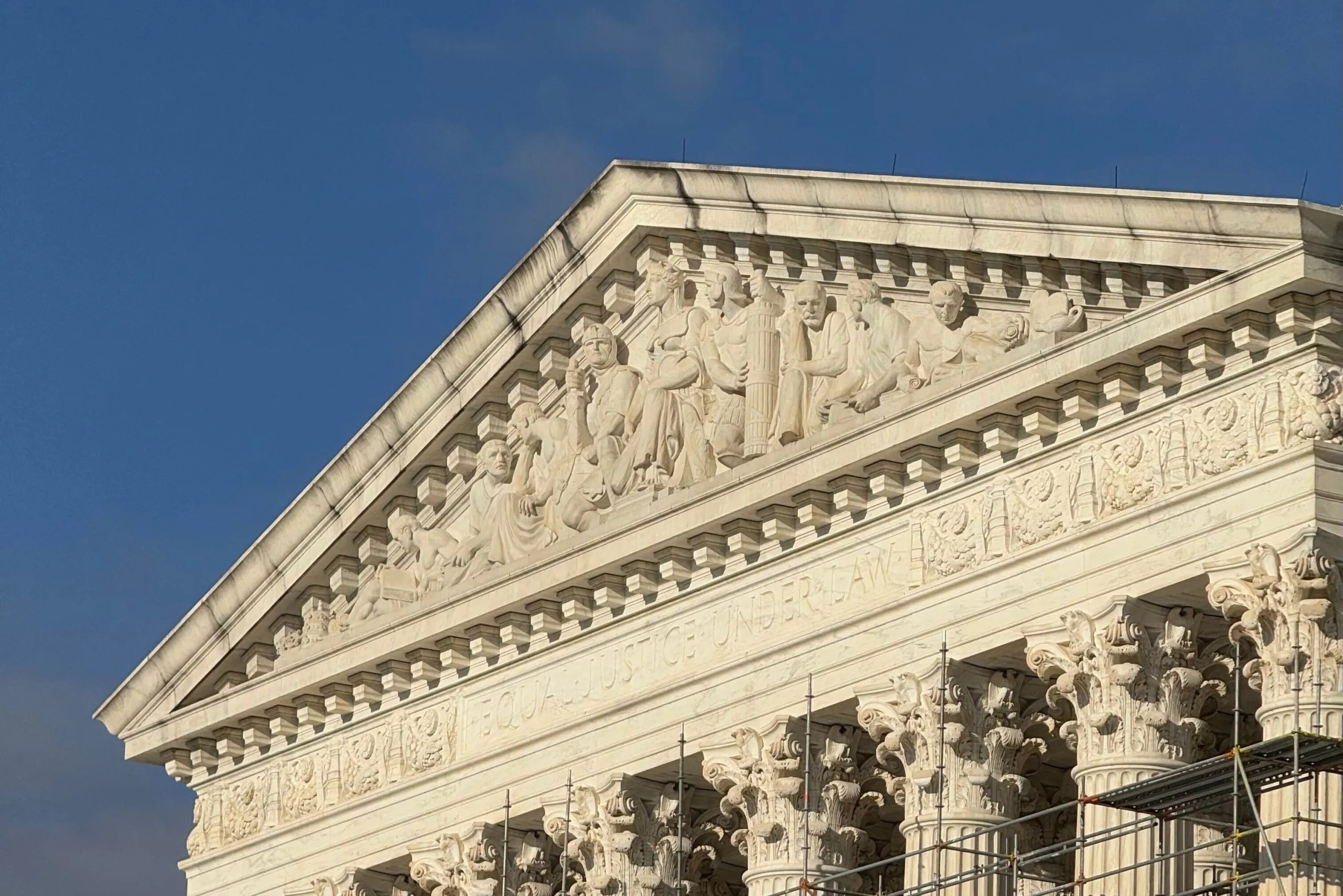
Carved details along top of Supreme Court building are pictured
(Katie Barlow)

Do you like piña coladas? What about getting caught in the rain? We here at SCOTUSblog liked discovering this week that Rupert Holmes, the man who wrote and recorded “Escape (The Pina Colada Song),” has written a play about Justice Ruth Bader Ginsburg.

At the Court

On Wednesday, the court released two opinions: In Rico v. United States, the court held that the Sentencing Reform Act of 1984 does not authorize a rule automatically extending a defendant’s term of supervised release when the defendant fails to report to a probation officer. In Cox Communications, Inc. v. Sony Music Entertainment, the court held that a company is not liable for copyright infringement for merely providing a service to the general public with knowledge that it will be used by some to infringe copyrights.

Also on Wednesday, the justices heard argument in Flowers Foods v. Brock, on whether “last-mile” drivers – drivers who deliver from a regional warehouse to a store – are exempt from the arbitration requirements of the Federal Arbitration Act.

On Friday, the justices will meet in a private conference to discuss cases and vote on petitions for review. Orders from that conference are expected on Monday at 9:30 a.m. EDT.

Next Wednesday, April 1, we will be live blogging as the Supreme Court hears argument in Trump v. Barbara, the birthright citizenship case. To learn more about the case, join our LinkedIn Live event with Briefly today at noon EDT.

Morning Reads

Navarro: Trump will still raise tariffs to 15 percent

Daniel Desrochers, Sam Sutton, and Victoria Guida, Politico

Peter Navarro, a senior trade adviser to President Donald Trump, said Wednesday that “Trump still intends to raise his current set of global tariffs to 15 percent, more than a month after the president pledged it would happen,” according to Politico. “It has happened, at least it’s in process to happen. … I wouldn’t get too lost in the details on that,” Navarro said. He added that the Supreme Court’s February ruling striking down the tariffs Trump imposed using the International Emergency Economic Powers Act “was the best possible outcome, because the justices ratified and affirmed the use of every other statute we’ve been using to implement tariffs.” Politico noted that “[t]he majority’s decision did not explicitly take a position on other trade laws.”

Maryland Supreme Court Strikes Down Local Climate Suit Against Big Oil

Karen Zraick, The New York Times

The Maryland Supreme Court on Tuesday “ruled against reviving climate lawsuits brought by Baltimore, Annapolis and Anne Arundel County that were struck down by lower courts,” holding that “federal law overrides state law on air pollution that crossed state lines.” Through the lawsuits against “26 multinational oil and gas companies,” those governments sought “to recover damages caused by the effects of greenhouse gas emissions, accusing them of deceiving the public about the dangers of using their products.” Around “three dozen similar lawsuits have been filed nationwide in the past decade,” and the Supreme Court has agreed to hear argument next term in one such case out of Colorado. “The question before the justices in that case mirrors the central one in Maryland, namely whether federal law ‘precludes state law claims seeking relief for injuries allegedly caused’ by greenhouse gas emissions.”

Judicial Conduct Panel Denies Newman’s Reinstatement Bid

Michael Shapiro, Bloomberg Law

On Tuesday, the Judicial Conference’s administrative committee, which is comprised of “seven appellate and district court judges,” denied 98-year-old “Pauline Newman’s effort to regain her position on the Federal Circuit,” where she “has been blocked from getting new case assignments for nearly three years” after refusing “to undergo a neuropsychological exam and to turn over certain medical records,” according to Bloomberg Law. The committee’s decision on Newman’s administrative challenge to her suspension arrived as “the nation’s oldest active federal judge” waits for word from the Supreme Court on if it will take up her legal challenge to her colleagues’ actions.

State of Oklahoma sued over rejection of Jewish charter school

Nuria Martinez-Keel, Oklahoma Voice

Last year, the Supreme Court considered a Catholic virtual charter school’s bid to become the country’s first religious charter school and ultimately deadlocked 4-4 – Justice Amy Coney Barrett had recused herself – leaving an Oklahoma Supreme Court ruling against the school in place. But this week, “[l]egal efforts to found the nation’s first religious charter school in Oklahoma have reignited,” and Oklahoma’s attorney general and Statewide Charter School Board are facing a new lawsuit over a Jewish charter’s schools effort to operate in the state, according to Oklahoma Voice. The Jewish school’s “founders allege religious groups are wrongfully excluded from opening charter schools with faith-based instruction – a similar argument Oklahoma Catholic leaders made when trying to establish St. Isidore of Seville Catholic Virtual School.”

Roberts tasked with trying to tame Supreme Court

Ella Lee and Zach Schonfeld, The Hill

In the latest edition of their newsletter for The Hill, Ella Lee and Zach Schonfeld highlighted a few hiccups during this week’s oral arguments – that is, moments when Chief Justice John Roberts and others seemed frustrated with Justices Sonia Sotomayor and Ketanji Brown Jackson for “dominat[ing] discussions” and, in Sotomayor’s case, repeatedly interrupting one of the advocates. They noted that Roberts “was more assertive” than usual this week in his effort “to steer and balance” court sessions by, for example, cutting off one of Sotomayor’s interruptions.

On Site

Argument Analysis

Justices dubious about “harsh” rules for omissions by bankrupt debtors

Tuesday’s argument in Keathley v. Buddy Ayers Construction displayed a bench almost uniformly skeptical of a lower court’s absolute standard for responding to the failure of a debtor in bankruptcy to mention one of its assets to that court, according to Ronald Mann.

Cherry blossoms bloom outside of the U.S. Supreme Court building on Tuesday, March 24, 2026.
Case Preview

Justices to hear argument on whether a crime’s “contemplated effects” can expand venue beyond where offense was committed

The Supreme Court will hear argument on Monday in Abouammo v. United States, in which it will consider whether federal prosecutors can try a defendant not only in the district where the offense actually occurred, but also in the district where the crime’s “contemplated effects” are felt.

U.S. Supreme Court building on Wednesday, March 18, 2026.
Case Preview

Court to consider ability of federal courts to confirm arbitration awards

Next week’s argument in Jules v. Andre Balazs Properties considers a technical question about the jurisdiction of federal courts to enforce an arbitration award. The question is whether a federal court that has a pending case over which it had jurisdiction to compel arbitration can use that jurisdiction to entertain a motion to confirm the arbitration award.

The U.S. Supreme Court is seen on March 04, 2026 in Washington, DC.
Contributor Corner

The Supreme Court and voting identification

In his Courtly Observations column, Erwin Chemerinsky revisited past cases in which the Supreme Court addressed voter identification requirements and fees associated with voting, reflecting on what role these cases could play in a potential future lawsuit over the Safeguard American Voter Eligibility Act, which has passed the House but stalled in the Senate.

The statue, Authority of Law, by American sculptor James Earle Fraser outside the Supreme Court of the United States. The High Court building was built during the Great Depression and completed in 1935. Architect Cass Gilbert's design is based on a Greco-Roman temple.

Podcasts

Amarica's Constitution

Created to Born to Barbara

Akhil Reed Amar and Andy Lipka visit a high school in Garden City, New York, to speak with high school students about Akhil’s book, Born Equal. They trace one of America’s great credos – “All Men Are Created Equal” – from the founding, all the way to Lincoln, and beyond, to the 14th Amendment; and finally to birthright citizenship and next week’s Supreme Court case.

SCOTUS Quote

MS. BENNETT: “Sure. So this question came up in 1925.”

CHIEF JUSTICE ROBERTS: “I didn’t remember that.”

Flowers Foods v. Brock (2026)

Recommended Citation: Kelsey Dallas, SCOTUStoday for Thursday, March 26, SCOTUSblog (Mar. 26, 2026, 9:00 AM), https://www.scotusblog.com/2026/03/scotustoday-for-thursday-march-26/