The Supreme Court of Canada

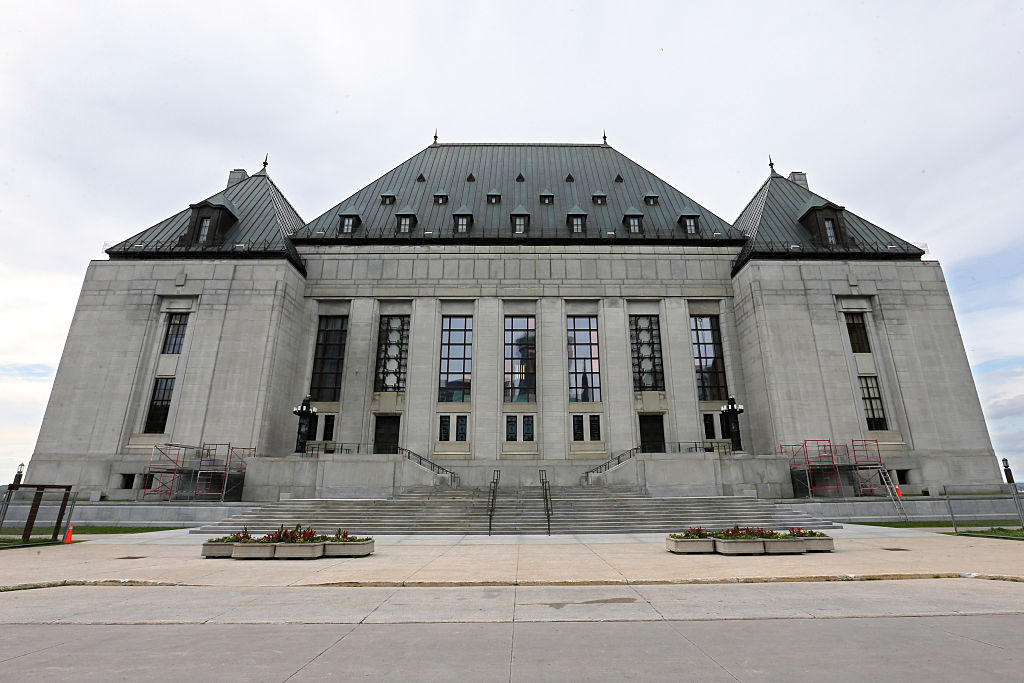
Welcome to SCOTUSblog’s recurring series in which we interview experts on different supreme courts around the world and how they compare to our own. For our debut column, we covered the Supreme Court of the United Kingdom. Today we visit our northern neighbor with the help of Professor Adam Dodek, a scholar and frequent commentator on the Supreme Court of Canada.
Professor Dodek is a Professor of Constitutional Law at the University of Ottawa. A graduate of Harvard Law School and a Fulbright Scholar, he clerked for the U.S. Court of Appeals for the Ninth Circuit, the Supreme Court of Israel, and the Supreme Court of Canada. He was a member of the three-person group who advised Prime Minister Justin Trudeau on reforms to the Supreme Court of Canada’s appointment process that were implemented in 2016.
Our written interview is below.
So let’s begin with the basics. How many justices are on the Supreme Court of Canada?
There are nine judges, consisting of the chief justice and eight “puisne” (unfortunately pronounced “puny”) judges who are equivalent to associate justices of the Supreme Court of the United States. “Puisne” is old French for “later born” and distinguishes an “inferior” judge from the chief justice.
How are these justices selected?
Supreme Court justices are appointed by the Governor General (the King’s representative in Canada) on the advice of the Prime Minister. The role of the Governor General is strictly formal; it is the Prime Minister who makes the choice. The Prime Minister has extremely wide discretion; the statutory requirements under the Supreme Court Act are minimal (a Supreme Court justice must have at least 10 years’ experience at the bar or be appointed from a lower court). The Supreme Court Act requires that at least three of the judges must be appointed from Quebec (due to its distinctive civil law system). By convention, three judges are appointed from Ontario, two from Western Canada, and one from Atlantic Canada.
In 2016, Prime Minister Justin Trudeau set up a process whereby interested candidates had to apply for advertised vacancies (full disclosure: I was one of a group of three professors who provided advice on these reforms). An independent selection committee reviewed applications and selected candidates to be interviewed and provided the prime minister with a shortlist of candidates from which to select. It is not known whether Prime Minister Mark Carney will follow this process. One justice announced her intention to retire effective May 30, 2026, and as of the date of this interview, no process has been announced.
There is no role for the legislative branch in the selection of Supreme Court of Canada justices. However, a practice has developed that the nominee appears before an ad-hoc committee of parliamentarians for questioning, usually moderated by a law professor. The committee has no power to veto a nominee and the questioning of nominees has been rather gentle compared to U.S. Senate hearings.
What is the profile of a typical justice? For example, do they often come from having served as a judge on a lower court?
Most Supreme Court of Canada judges are appointed from the courts of appeal and most of them were trial court judges before. It is common that those justices were trial court judges before their elevation to the court of appeal. Since 1988, there has almost always been one judge who was appointed directly from practice to the Supreme Court of Canada.
Do the justices serve terms – if so, of what length?
Supreme Court of Canada judges may serve until mandatory retirement at age 75. This is in line with the mandatory retirement age for most judges in Canada and for Canadian Senators.
Does the Supreme Court of Canada only hear appeals? Are there any cases in which it has original jurisdiction?
The Supreme Court of Canada is the highest court of appeal for Canada and hears appeals from provincial and federal courts of appeals. It also has original jurisdiction in “reference cases,” which are requests for advisory opinions submitted to it by the federal cabinet. The scope of permissible reference questions is extremely broad. Some of the biggest landmark cases have been references. The Supreme Court of Canada also hears “as of right” appeals; appeals where there is a statutory right to appeal from a lower court to it. These mostly involve criminal cases but also include appeals from references initiated by provincial governments in their provincial courts of appeal.
Can the Supreme Court of Canada overturn acts of Parliament? If so, how often does this occur?
Yes. The Supreme Court of Canada can overturn acts of the federal Parliament and of provincial legislatures. It is not that unusual. The Supreme Court of Canada overturns acts of Parliament or provincial legislatures roughly 0-3 times per year.
Are cases decided by a simple majority?
Yes.
How is the opinion writer assigned?
The chief justice assigns the opinion writer for the court’s unanimous or majority decision after each two-week period of hearings, based on the judges’ expertise, workload, and preferences. Although there are nine judges on the court, not all nine hear all appeals. The court may sit in panels of five, seven, or nine judges (and exceptionally in eight). The chief justice sets the size and composition of the panel for each case. Usually, the court will sit nine justices for important cases. All decisions are published in both English and French and counsel may argue in either language.
Is there a tradition of concurrences or dissents on the court?
Yes. Until the 1960s, it was quite common for each justice, or groups of two or three justices, to write separate opinions. Over time, the practice developed of writing majority decisions with concurrences and dissents. Dissents at the Supreme Court of Canada tend to be less strident with fewer personal attacks than dissents at the Supreme Court of the United States. The Supreme Court of Canada has a higher rate of unanimous decision making than the Supreme Court of the United States, but it has been more fractured over the past 5-10 years.
What were some major issues recently decided by the Supreme Court of Canada?
In Bedford (2013), the court invalidated a number of prostitution-related offences. The court struck down the Criminal Code prohibition on physician-assisted suicide in Carter v. Canada (2015). That decision ushered in a regime known in Canada as “Medical Assistance in Dying.”
The court decides many high-profile federalism cases involving the constitutional division of powers between the federal Parliament and provincial legislatures. In the Greenhouse Gas Pricing Act Reference (2021), the court, by a 6-3 margin, upheld the constitutionality of the federal Parliament’s legislation which establishes a national minimum price for carbon emissions.
Later this month, the Supreme Court will hear an appeal from Quebec on the use of the Canadian Charter of Right’s “notwithstanding clause” which allows the federal Parliament and provincial legislatures to “override” certain constitutionally-protected rights. The use of the notwithstanding clause has become more frequent and more controversial over the past decade. Another case will be heard by the Supreme Court this fall involving the province of Saskatchewan’s use of the notwithstanding clause to protect legislation restricting gender-identity policies in schools. Some American jurists, such as the late Robert Bork, have been enamored of “the Canadian override” and advocated for its adoption in the U.S. Constitution.
What have been some particularly controversial issues decided by the Supreme Court of Canada throughout its history?
In 1982, the Supreme Court decided whether the federal Parliament could unilaterally patriate the Constitution from the United Kingdom, making it wholly Canadian and adding a constitutionally-entrenched bill of rights known as the Canadian Charter of Rights and Freedoms. That decision was known as the Patriation Reference. In 1998, the court decided whether and how Quebec (and by extension other provinces) could secede from Canada. That decision is known as the Quebec Secession Reference.
In R. v. Morgentaler (1990), the Supreme Court of Canada struck down the criminal prohibition on abortion. The same year, by a narrow margin of 4-3, the court upheld the constitutionality of criminal prohibitions on hate speech in R. v. Keegstra.
The United States Supreme Court is often seen as partisan. Does the Supreme Court of Canada have a partisan reputation?
Not particularly, especially when compared to the United States Supreme Court. In Canada, we don’t usually refer to a judge by the Prime Minister who appointed them. We don’t speak of “Liberal justices” or “Conservative justices” the same way Americans speak of “Democratic justices” and “Republican justices.” The last three chief justices (Antonio Lamer, 1990-2000; Beverley McLachlin, 2000-17; and Richard Wagner, 2017-) were all appointed to the high court by the prime minister of one political party (Liberal Party or Conservative Party) and elevated to chief justice by the prime minister of the other political party.
Would you say the Supreme Court of Canada is considered a particularly powerful institution – say, compared to the Prime Minister or Parliament?
Yes, most certainly, especially compared to Parliament. Under the Canadian parliamentary system, the prime minister is the leader of the party that can control Parliament so usually Parliament follows and approves the Prime Minister’s agenda. As a result, the Prime Minister in Canada is very powerful, arguably even more powerful than the U.S. President (within each’s system of government). There is no strict separation of powers in Canada.
What aspect of the Supreme Court of Canada do you see as superior to that of the Supreme Court of the United States?
In many ways, the Supreme Court of Canada is more accessible than the Supreme Court of the United States. In particular, the Supreme Court of Canada hearings are webcast live (save in exceptional circumstances) and archived. The court gives advanced notice to the media and the public on when judgments will be released so there is not the same guessing game as in the United States.
The Supreme Court of Canada is also much more open to considering international and foreign law than the Supreme Court of the United States is. I think this is a strength and not a weakness, as some American jurists assert.
Now I’ll ask the opposite: What aspect of the Supreme Court of the United States do you see as superior to that of the Supreme Court of Canada?
I think the Supreme Court of the United States’ workload and workflow is superior to that of the Supreme Court of Canada. The Supreme Court of Canada has decided only 34-59 cases per year over the past six years. It does not release all judgments by the summer each year the way the Supreme Court of the United States does. Thus, it is not unusual to wait for a year or more for the Supreme Court of Canada to issue a decision after it has heard a case. And unlike the Supreme Court of the United States, the Supreme Court of Canada almost never gives reasons for denying leave to appeal (i.e., cert petitions).
Posted in Featured, Recurring Columns, Supreme courts around the world