The justices and gender pronouns

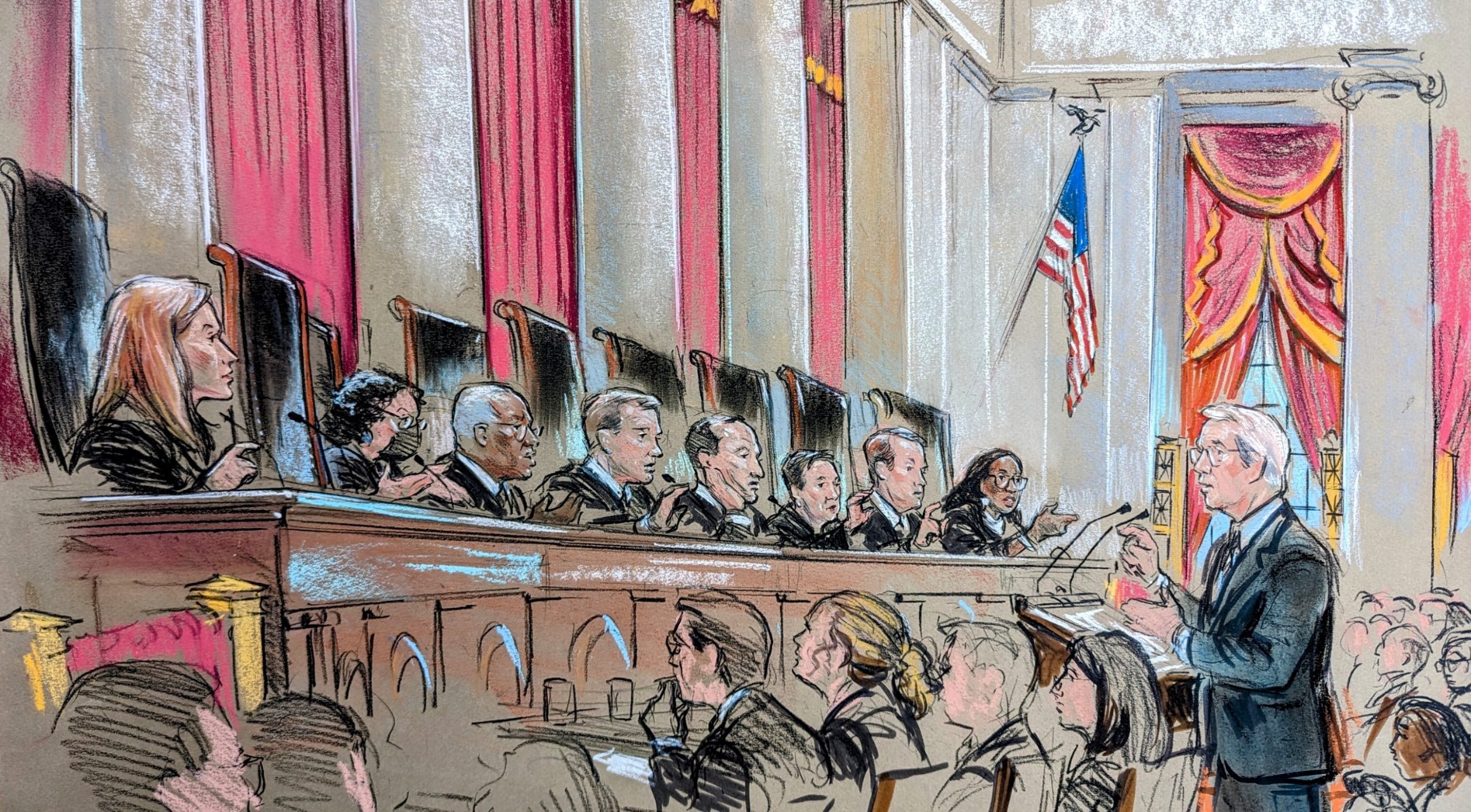
Last month, the Supreme Court heard oral arguments in Little v. Hecox and West Virginia v. B.P.J. At issue was whether Idaho and West Virginia laws that prohibit transgender women and girls from competing on schools’ female sports teams violate the Constitution’s equal protection clause and Title IX, a federal civil rights law that bars sex discrimination in educational programs and activities that receive federal funding. The cases generated a great deal of attention, and by arguments’ end there was a consensus that the court was “skeptical of challenges to bans on trans athletes.”
What gained less attention was the language employed by the justices during oral argument, and in particular, the pronouns they used when referring to transgender people. This varied significantly by justice – although, based on past cases, such choice of language may offer only limited insight into how each justice is likely to rule.
Gender and the justices
The justices’ use of pronouns has not gone previously unnoticed. In 2010, a study reviewed opinions from the 2006-07, 2007-08, and 2008-09 terms and found significant variations in “gendered language” among them. For example, four justices (Chief Justice John Roberts and Justices Antonin Scalia, David Souter, and Stephen Breyer) frequently used generic male pronouns, Justice Samuel Alito preferred gender-neutral language, and Justice Ruth Bader Ginsburg alternated between pronouns.
Such variety was also present in the court’s first decision involving an openly transgender person, the 1994 case of Farmer v. Brennan. Specifically, Farmer was a case brought by a “transsexual” prisoner (in the words of Brennan’s counsel, Elizabeth Alexander), who sought damages after being transferred to a federal prison facility where she was sexually assaulted by another inmate.
At oral argument, Alexander described Dee Farmer as “a young, nonviolent prisoner of feminine appearance and demeanor.” Like Alexander, several of the justices used “she” to describe Farmer. This included Justice Sandra Day O’Connor (asking about an injunction “to prevent her from being moved to a different facility”), Ginsburg, and Chief Justice William Rehnquist (“Well, where… where would the Government be free to move her if she gets her injunction?”).
Deputy U.S. Solicitor General Paul Bender, representing the federal government, did not use female pronouns (“he is presently in administrative detention at Florence”). Nor did Scalia (“[h]e’s in a different institution now, right?”).
Regardless of its split in pronoun usage, the court ultimately voted unanimously in Farmer, holding that prison officials may be liable for damages if they act with “deliberate indifference” to a substantial risk of serious harm. Souter, writing for eight members of the court, took a middle path on pronouns, avoiding all but one reference (referring to Farmer as “he” at opinion’s end). In their separate opinions, Justices Harry Blackmun (concurring) and Clarence Thomas (concurring in the result, if not the majority’s reasoning), though ideological opposites, referred to Farmer exclusively as “he,” while Stevens did not refer to Farmer at all, much less use any pronouns, in his one-paragraph, 59-word concurrence.
Gloucester County School Board v. G.G.
The court dealt with transgender plaintiffs and pronouns again in 2016, in the case of Gloucester County School Board v. G.G.This involved a high-profile petition in a case brought by Gavin Grimm (G.G.), a transgender boy who was denied access to the boys’ restroom at his high school, under a school board policy requiring transgender students to use only single-stall, unisex restrooms or restrooms corresponding with their “genders as assigned at birth.” Grimm filed suit, alleging that the bathroom policy violated both the equal protection clause and Title IX.
On the docket, two attorneys filed “friend of the court” briefs in support of the school board in which they referred to Grimm as female in the case caption (“[b]y her next friend and mother”). This diverged from the court’s official caption (“[b]y his next friend and mother”), which was consistent with Grimm’s gender identity. In response, the clerk of the court, Scott S. Harris, sent two identical, formal letters to the attorneys, in which he cited Rule 34’s requirement that brief covers match the case caption, and directed the attorneys to “[p]lease ensure careful compliance with this requirement in this and other cases in the future.”
Bostock v. Clayton County
The next major case in which the justices confronted pronouns for transgender people was in R.G. & G.R. Harris Funeral Homes Inc. v. EEOC, consolidated with Bostock v. Clayton County, and decided in 2020. The plaintiff in R.G. was Aimee Stephens, a transgender woman who was fired after informing her employer that she intended to transition; Stephens then brought suit under Title VII of the Civil Rights Act, which (among other things) bars employment discrimination based on sex.
During oral argument, the justices and lawyers avoided using gendered pronouns. Given this, the language of the decision proved somewhat surprising. In holding that “sex” included sexual orientation and gender identity, Justice Neil Gorsuch referred to Stephens as “she” throughout his majority opinion, for which he was lauded on the left and criticized on the right (for example, Ed Whelan of National Review accused Gorsuch of “dutifully parrot[ing] some of the rhetoric of transgender ideology”).
The dissenters, on the other hand, opted for gender-neutral language. Alito, joined by Thomas, remarked on the usage of “they” (“several different sets of gender-neutral pronouns have now been created and are preferred by some individuals who do not identify as falling into either of the two traditional categories”) and warned that the court’s decision could lead to punishments for failure to use one’s “preferred pronoun.” In his separate dissent, Justice Brett Kavanaugh did not express any position.
United States v. Skrmetti
Just last term, the court decided United States v. Skrmetti, a challenge to the constitutionality of a Tennessee law banning the use of puberty blockers and hormone therapy for transgender minors.
ACLU attorney Chase Strangio, the first openly transgender person to argue before the Supreme Court, argued for the challenger. The majority of the justices did not directly acknowledge Strangio’s gender, but the two that did – Roberts and Justice Amy Coney Barrett – addressed Strangio as “Mr.” (for which both justices received criticism in some circles).
Also of note: for the first time in perhaps any oral argument, a justice (Elena Kagan) used the word “cis” – an abbreviation for “cisgender,” a term describing someone whose gender identity matches the sex they were assigned at birth. (This term was also used by U.S. Solicitor General Elizabeth Prelogar during argument.)
The majority, in an opinion written by Roberts (and joined in full by Thomas, Gorsuch, Kavanaugh, and Barrett, and in part by Alito) ruled for the state. Nevertheless, throughout it, Roberts consistently referred to transgender people based on their gender identity, including the specific litigants before the court (writing, for example, that one litigant “chose a male name for himself around the age of three”). Roberts also included a footnote stating, “We use ‘transgender boy’ to refer to an individual whose biological sex is female but who identifies as male,” and vice versa for a “transgender girl.”
Thomas, Barrett, and Alito separately concurred, referring to the challengers in broad terms and without identifying pronouns – for instance, “males seeking to transition into females” (Thomas), “the transgender population” (Barrett), and “such a plaintiff” (Alito). (Barrett, who referred to Strangio by his gender identity during the argument, wrote separately to express her belief that transgender status does not constitute a suspect class and such individuals are thus not entitled to heightened constitutional protections.)
The transgender athlete cases
Which brings us to where we began: Little v. Hecox and West Virginia v. B.P.J. In the oral arguments for both of these cases, the justices used either gender-neutral pronouns or those used by the challengers. The term cisgender (or cis) was also frequently invoked, used five times in Hecox and 18 times in B.P.J. by both the justices (specifically, Barrett and Justices Sonia Sotomayor and Ketanji Brown Jackson) and lawyers before the court (including Principal Deputy Solicitor General Hashim Mooppan, representing the Trump administration, which appeared as a “friend of the court” supporting the states).
Shifting usage
Although the justices may still not entirely agree on their pronoun usage with regard to transgender people, there is no doubt that such usage has shifted dramatically over the years. In Farmer, even some of the more liberal justices were uncomfortable – if not downright dismissive – of matching the party’s pronoun with that person’s gender identity, although the court ultimately sided with the transgender litigant in that case. Today, several justices appear to treat this as a matter of courtesy, while others – such as Alito and Thomas – tend to avoid it altogether.
What is less clear is how this correlates with the actual rulings. In Skrmetti, for example, Roberts used the challengers’ preferred language but decided firmly against them. And if the oral arguments were any indication, the same pattern may well play out in the transgender athlete cases. In other words, while the justices’ use of language may have changed, this is not necessarily reflective of which side proves successful.
Posted in Court Analysis
Cases: Gloucester County School Board v. G.G., Bostock v. Clayton County, Georgia, R.G. & G.R. Harris Funeral Homes Inc. v. Equal Employment Opportunity Commission, United States v. Skrmetti, Little v. Hecox (Transgender Athletes), West Virginia v. B.P.J. (Transgender Athletes)