Court to hear oral argument on law banning guns on private property

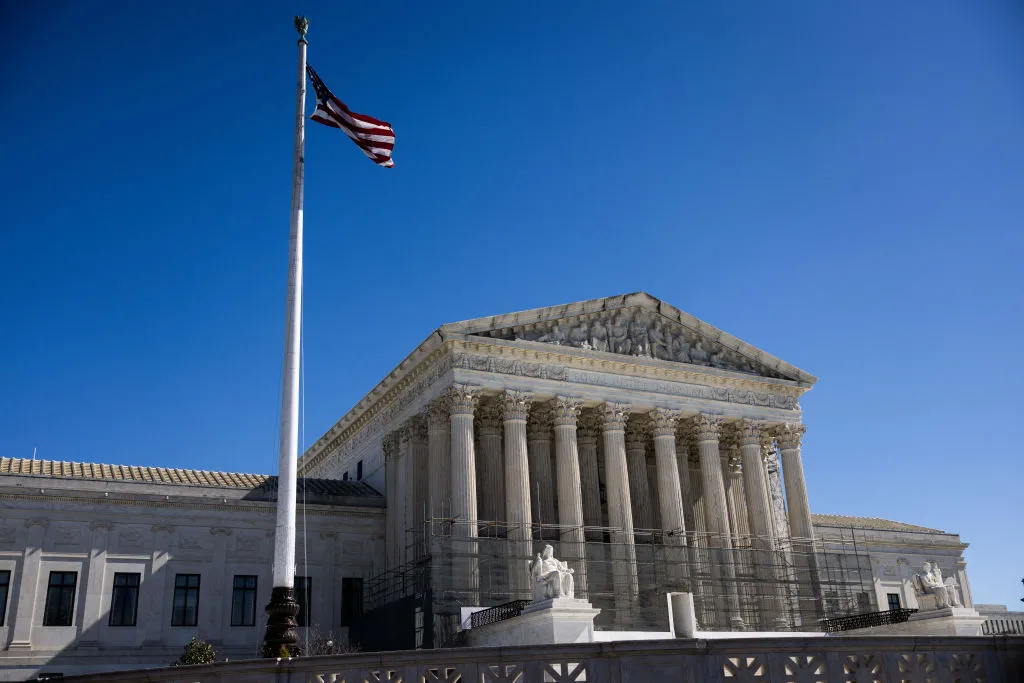
The Second Amendment provides that “the right of the people to keep and bear Arms, shall not be infringed.” On Tuesday, in Wolford v. Lopez, the Supreme Court will hear oral argument in the latest chapter of the ongoing dispute over the scope of that right: a challenge to a Hawaii law that bans gun owners from bringing their guns onto private property that is open to the public without specific permission from the property’s owner. Four other states have similar laws: California, Maryland, New York, and New Jersey.
Defending the law, Hawaii tells the justices that the law was “designed to vindicate both the right to bear arms and property owners’ undisputed right to choose whether to permit armed entry onto their property.” But the gun owners challenging the law argue that “Hawaii is attempting to thwart constitutional rights newly recognized” by the Supreme Court in its gun-rights jurisprudence. “This Court,” they say, “did not brook such resistance after Brown v. Board of Education. It should not do so now.”
Unlike some other parts of the Constitution, the line of Supreme Court cases interpreting the Second Amendment is relatively short. In 2008, in District of Columbia v. Heller, the court ruled that the Second Amendment protects an individual right to keep guns inside the home for self-defense. Two years later, in McDonald v. City of Chicago, the court held that the Second Amendment also applies to the states.
More than a decade later, in New York State Rifle & Pistol Association v. Bruen, the court struck down a New York handgun-licensing law that required New Yorkers who want to carry a handgun in public to show a special need to defend themselves. More broadly, the court made clear in Bruen that the Second Amendment’s guarantee of the right “to keep and bear arms” protects an expansive right to carry a handgun outside the home for self-defense. Going forward, Justice Clarence Thomas explained in his opinion, courts should uphold gun restrictions only if they are “consistent with the Nation’s historical tradition of firearm regulation.”
In 2023, in response to the court’s decision in Bruen, Hawaii passed the law at the center of this case, which prohibits anyone with a concealed-carry permit from bringing a gun on private property that is open to the public unless the property owner affirmatively gives permission to do so. A violation of the law is a misdemeanor, carrying a sentence of up to a year in prison.
Three Maui residents with concealed-carry permits, as well as a local gun-rights group, went to federal court in Hawaii to challenge the ban. The U.S. Court of Appeals for the 9th Circuit upheld the Hawaii law. It concluded that “a national tradition likely exists of prohibiting the carrying of firearms of private property without the owner’s oral or written consent.” A divided court later turned down the challengers’ request to reconsider that ruling.
The challengers came to the Supreme Court last April, asking the justices to decide whether the permission requirement for private property violates the Second Amendment. The justices granted that request in October. (At the same time, the justices declined to weigh in on the methodology that the court of appeals used to uphold a separate provision of the law banning guns in so-called “sensitive” places, such as parks, beaches, playgrounds, and places that serve alcohol. The challengers had argued that the court of appeals should have looked at regulations from the time of the country’s founding rather than at laws from the mid- to late 19th century.)
In its brief on the merits, Hawaii insists its law does not target conduct covered by the Second Amendment at all, because the Second Amendment simply “codified the right to bear arms as it existed at the Founding” of the United States. At that time, Hawaii stresses, there was no right to enter private property without permission from the owner – much less to do so with a gun. And even if consent to enter the property might in some scenarios be implied, Hawaii continues, that determination rests on “state law and local custom.” “Accordingly,” the state says, “Hawai’i is free to enact a law clarifying that the public’s implied license to enter private property does not include an invitation to bring a gun, particularly because that accords with the well-established custom in Hawai’i.”
The challengers contend that the text of the Second Amendment “simply recognizes a right to bear arms, which is precisely what [they] wish to do. That is the end of the textual inquiry.” The challengers concede that property owners can bar other people, including people carrying guns, from their property. But the Hawaii law goes farther than that, they say, making “it a crime to carry guns even where the owner of property open to [the] public is merely silent. That presumption,” they argue, “tramples on the Second Amendment.”
Hawaii responds that, even if the Second Amendment does apply, its law does not violate the Constitution because “it fits comfortably within our Nation’s history of firearm regulation.” The state points to what it describes as a “raft of colonial-era laws” that required the owner’s explicit consent to bring guns onto private property, “at least where the land was developed or fenced, a category that readily includes the sort of retail facilities on which [the challengers] have focused their current challenge.” Such laws, the state argues, are “relevantly similar,” as Bruen requires, to Hawaii’s ban because they had the same purpose and they accomplished that purpose in the same way: The colonial-era laws were intended “to protect a property owner’s right to exclude firearms,” and they did so not by prohibiting guns altogether but by “condition[ing] that entry on obtaining the property owner’s consent.”
According to Hawaii, “[r]equiring evidence of a more extensive and widespread historical tradition would turn the Second Amendment into a ‘regulatory straightjacket.’ It would also [] overread legislative silence. As Justice Barrett has explained, ‘originalism does not require’ th[e] Court to ‘assume[] that founding-era legislatures maximally exercised their power to regulate.”
But the challengers push back, telling the justices that there is no historical tradition of laws “broadly banning law-abiding citizens from peaceably carrying firearms on private property open to the public without first getting express permission from the proprietor.” In upholding Hawaii’s ban, they say, the court of appeals relied on two laws, neither of which is analogous.
The first was a 1771 New Jersey law that barred poaching on lands that were closed to the public. But that law, the challengers wrote, “simply codified the American rule that hunters could hunt on unimproved lands not their own, while improved lands remained off limits. That is a trespass law,” they concluded, rather than a law that – like Hawaii’s – generally prohibits “carrying firearms on any and all private property without advance express consent.”
And the second, the challengers continue, was an 1865 Louisiana law, enacted as part of that state’s Black Codes to restrict the rights of formerly enslaved people, that barred the carrying of guns on “premises or plantations” – that is, private property – without the owner’s consent. “A law controlling access to land barred to the public cannot serve as an analogue for a law restricting access to property held open to the public,” the challengers asserted. And in any event, the challengers added, the Louisiana law “came too late.” The Second Amendment, they stress, “should be understood according to its public meaning in 1791, as that ‘meaning is fixed according to the understandings of those who ratified it.’”
The Trump administration, which filed a “friend of the court” brief supporting the challengers, echoes their argument that the law “lacks any well-established historical analogue.” But the law is unconstitutional for the additional reason, U.S. Solicitor General D. John Sauer writes, that “firearms regulations are per se unconstitutional if they are designed to thwart the right to publicly carry arms, or if they effectively negate the right. Hawaii’s restrictions fail both metrics.”
Both the Trump administration and the challengers characterize the effect of the law as sweeping. The challengers tell the justices that the restriction “is more than merely inconvenient; it requires licensees to leave their firearms at home whenever they go out in public if there is any chance of visiting private property open to the public.” And the government suggests that gun owners with a concealed-carry permit “who stop for gas with a pistol in the glove compartment risk a year in prison if they fail to obtain the gas-station owner’s unambiguous consent.”
Hawaii portrays the effect of the law as significantly narrower, emphasizing that gun owners can bring their guns onto private property “so long as the owner or one of his agents gives oral or written authorization. That means that, to bring a gun into a shop or convenience store, one need only ask an employee for an ‘okay.’” And the Trump administration is wrong “in suggesting that the law prevents pulling into a gas station or private parking lot with a gun stored appropriately in the vehicle; the law applies to carrying a gun on one’s person, not storing a gun in a car,” Hawaii writes.
A decision in the case is expected by the summer.
Posted in Court News, Merits Cases
Cases: New York State Rifle & Pistol Association Inc. v. Bruen, Wolford v. Lopez