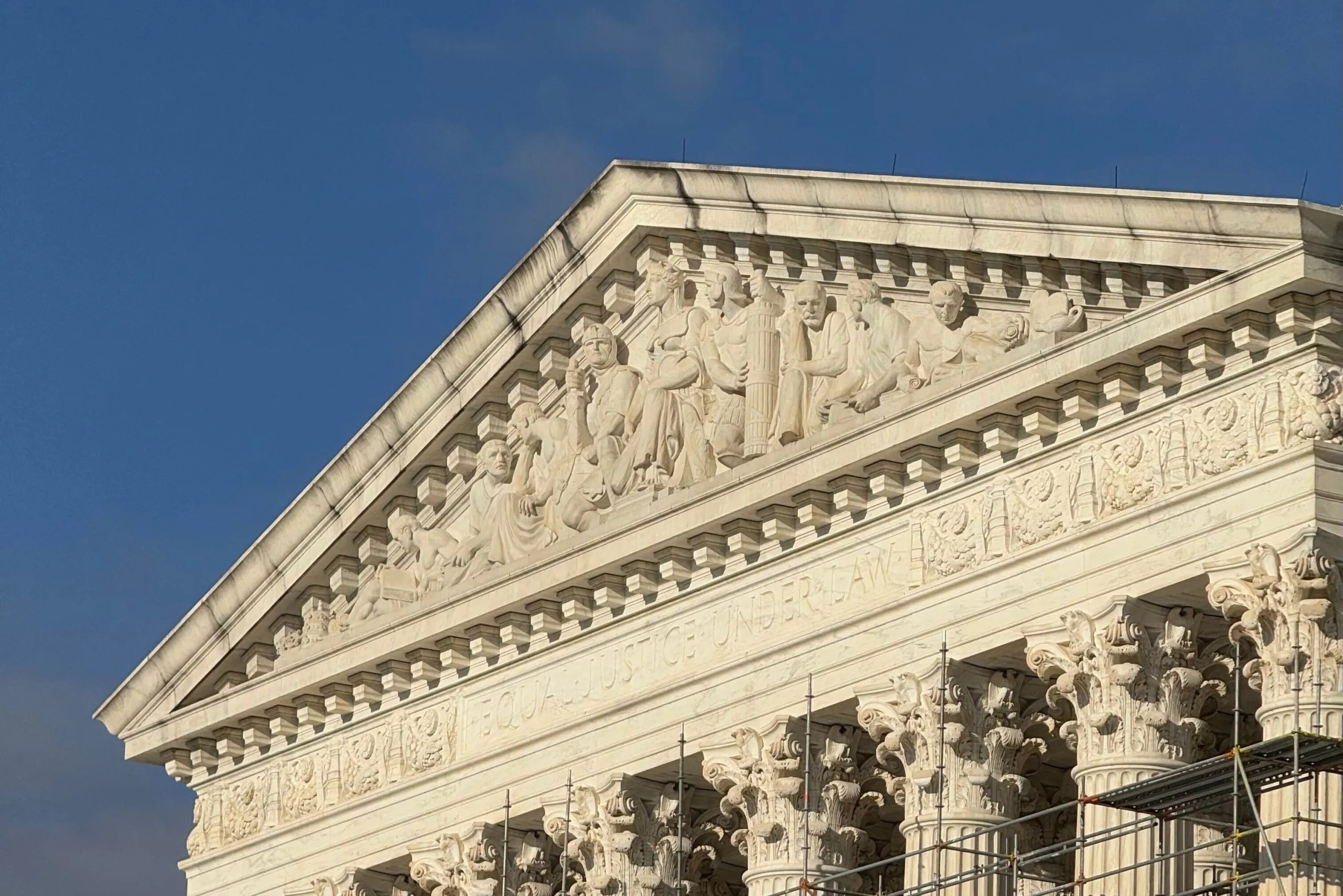


The iconic marble façade of the Supreme Court Building prominently displays the words “Equal Justice Under Law” above its main (west) entrance facing the U.S. Capitol. But even Supreme Court obsessives may be unfamiliar with its counterpart inscription on the rear (east) pediment: “Justice the Guardian of Liberty.” These inscriptions – like many things having to do with the Supreme Court – have their own surprising history.
The phrase “Equal Justice Under Law” originated not with a jurist or prominent philosopher (as far as we know), but with Cass Gilbert’s architectural firm. (Gilbert was the Supreme Court building’s architect, having been chosen by the Supreme Court Building Commission in 1929.) The phrase first appeared on a firm drawing from July 7, 1931, although it is not known if Gilbert came up with the phrase himself. Earlier drafts from 1929–1930 used placeholders such as “LEX ET JUSTITIA” (“Law and Justice”) and “EQUAL AND EXACT JUSTICE” (taken from President Thomas Jefferson’s First Inaugural Address).
As for the east pediment’s inscription, “Justice the Guardian of Liberty,” the original proposed inscription was “Equal Justice is the Foundation of Liberty,” but this was rejected by Chief Justice Charles Evans Hughes. Instead, in a May 16, 1932, handwritten note (possibly from the bench during a court session) between Hughes and Justice Willis Van Devanter (who also served on the building commission), the chief justice wrote that “I rather prefer ‘Justice the Guardian of Liberty.’” Van Devanter replied with a simple “Good (W.V.),” and Hughes subsequently directed the use of that phrase. Like the west inscription, no ancient, literary, or historical source has been identified as the origin of those words.
Both inscriptions were executed in English, as Hughes rejected Latin alternatives for the sake of public accessibility, and they were among the final elements settled upon before the building’s completion in 1935. Whatever their actual source, the words have taken on a life of their own, “symboliz[ing] the American heritage of democracy and the rule of law.”