Justices seem dubious of government’s argument in criminal venue case

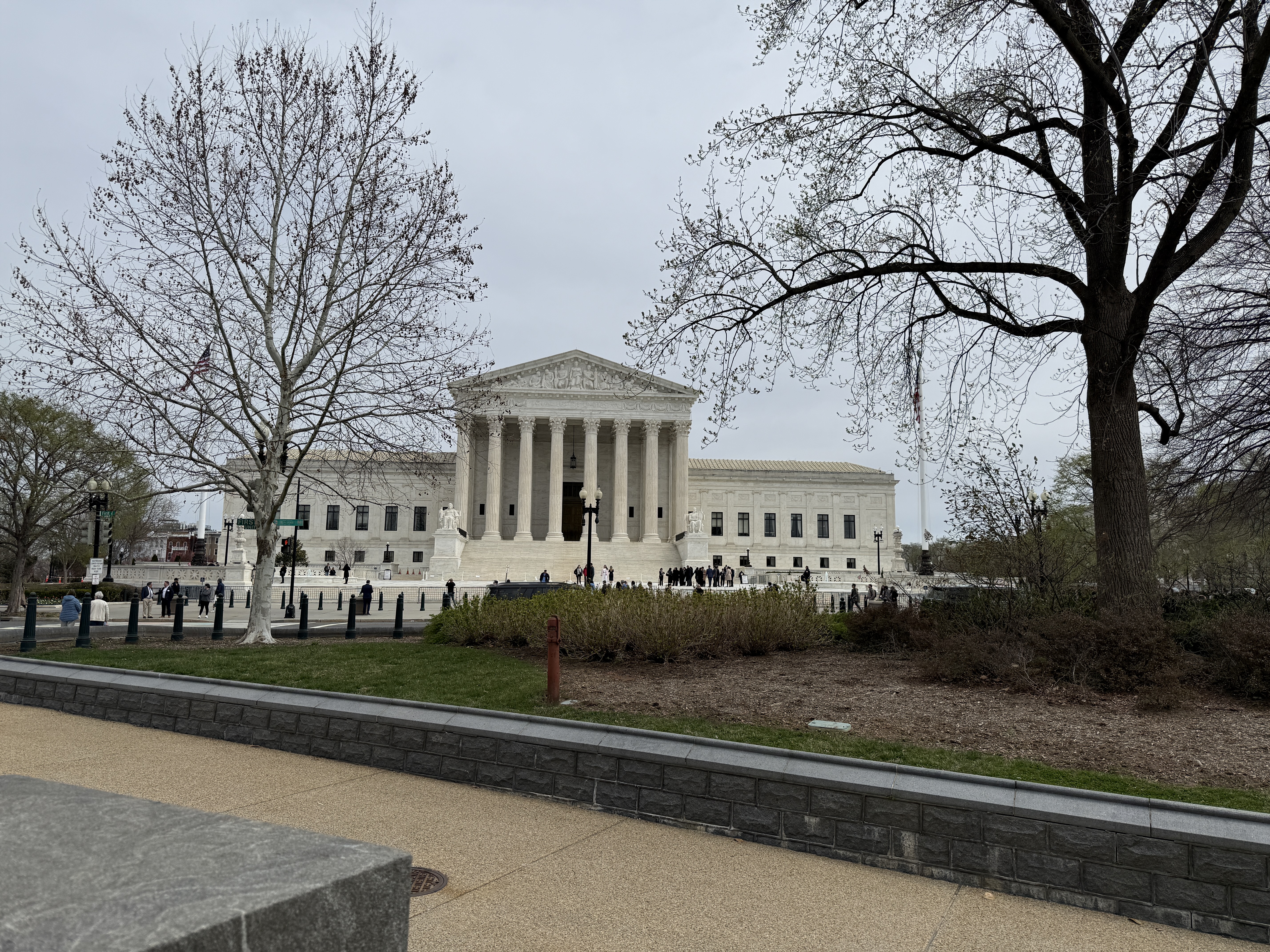
The Supreme Court on Monday considered whether federal prosecutors can try a defendant not only in the district where the offense occurs, but also where the crime’s “contemplated effects” are felt. During the roughly 80-minute argument in Abouammo v. United States, the justices seemed to suggest that the answer was no, with several of them pressing the government on whether its approach was both rooted in the text of the statute at issue and faithful to the Constitution.
Ahmad Abouammo was convicted of violating 18 U.S.C. § 1519, which criminalizes falsifying documents in a federal investigation. He did so by creating a fake invoice on his computer in Seattle and emailing it to FBI agents. The government then prosecuted him in San Francisco, where the FBI investigation was based, rather than in Seattle where he created the document. Abouammo challenged the venue in which he was tried, arguing the statute’s plain language made the crime complete when he finished falsifying the document, regardless of where he sent it.
The core issue centers on what conduct determines where a crime is “committed” for federal venue purposes. The vicinage requirement, or the Constitutional guarantee that a defendant be tried where the crime was committed, was a reaction to Parliament transporting American colonists to England for trial, where they faced a less favorable venue. Specifically, Article III of the Constitution requires that “[t]he Trial of all Crimes … shall be held in the State where the said Crimes shall have been committed,” and the Sixth Amendment speaks of a right to trial “by an impartial jury of the State and district wherein the crime shall have been committed.”
Tobias Loss-Eaton, representing Abouammo, argued that in the court’s venue cases, the venue “has always turned on the location of the offense’s essential conduct” – and here that was the falsification itself, which occurred entirely in Seattle. The government, represented by Assistant to the Solicitor General Anthony Yang, countered with a more expansive theory: that Section 1519 is an “inchoate offense” (that is, an offense constituting “merely a step towards the commission of another crime”) akin to conspiracy.
Justice Clarence Thomas asked a hypothetical on whether, under Loss-Eaton’s theory, the offense would be complete – and venue fixed in Seattle – if Abouammo had simply saved the false draft to his laptop and never sent it. Loss-Eaton answered affirmatively, explaining that the text of Section 1519 requires only three elements: (1) knowingly (2) falsifying a document (3) with the intent to impede an investigation. The moment those elements are satisfied, the offense is “complete[] and … over,” even if the defendant immediately thought better of it, deleted the file, or never communicated it to anyone. Loss-Eaton added that he did not take the government to dispute this interpretation of Section 1519.
Chief Justice John Roberts followed up by expressing some skepticism about the practical implications of that broad interpretation: “[I]t just seems very bizarre to me … [are] there any other statutes that are like that? I mean, the guy … tears it up. You’re going to prosecute him?”
Loss-Eaton responded by stating the statute’s breadth was deliberate, pointing to the “Enron scandal and Arthur Andersen shredding documents” that Congress had in mind when originally writing Section 1519. In this, Congress intentionally wrote a “broad document integrity offense” that does not require “actual communication to investigators or obstructive effects.” Practically speaking, Loss-Eaton said, the government would rarely, if ever, learn of a case in which someone created and immediately destroyed a document – but this practical rarity is also irrelevant to the statutory text, Loss-Eaton said.
Since the government charged Abouammo under this broad reading of 1519, the “essential conduct” element occurred entirely in Seattle. So, Loss-Eaton said, the email to San Francisco was not an element required for conviction. Given this, the government “want[ed] to have it both ways,” relying on the statute’s breadth for an easy conviction while simultaneously treating an uncharged, non-essential “effect” (the document arriving in San Francisco) as the basis for venue in that district.
Justice Elena Kagan pressed Loss-Eaton on whether courts have actually applied the statute in scenarios where the false draft was never sent. Loss-Eaton responded that he knew of no such cases. Justice Amy Coney Barrett then used a series of hypotheticals to probe whether venue would change if a communication was required; for example, if Abouammo had physically handed the false document to agents in his house versus emailing them. Loss-Eaton was consistent in replying that neither would affect the venue decision.
Justice Neil Gorsuch raised the government’s additional argument that when Abouammo emailed the document, a separate copy was created on the FBI’s San Francisco servers, potentially providing a new act of falsification in that district. Loss-Eaton dismissed this as both factually and legally problematic, relating it to faxing or mailing two copies of a false statement, which do not create two violations.
The government’s theory faced considerable challenges, including when Roberts and Gorsuch turned to the historical purpose of the venue clause. As they noted, the vicinage requirement was added to the Constitution specifically because Parliament had sent colonists back to England for trial, which the Founders sought to prevent in their new government. Roberts asked if under the government’s theory, prosecutors could haul colonists to England because the Boston Tea Party, while occurring entirely in Boston, had “effects” in London. Yang insisted this was different because Section 1519 is an “inchoate offense” that specifically requires intent to commit another crime (here obstruction). But this distinction didn’t appear to satisfy the justices.
Justice Ketanji Brown Jackson asked Yang whether, if the government decided that Section 1519 cases are best prosecuted in the Southern District of New York, agents from New York then traveled to Seattle to interview Abouammo, and the exact same facts unfolded, venue would be proper in New York because that is the origin of the investigating agents. Yang replied yes, if Abouammo “intended to and specifically did affect the investigation in New York,” venue would be proper there even though “all relevant conduct in terms of the statute occur[red] in Seattle.”
The government’s other argument lay in the assertion that Section 1519 is similar to conspiracy, where venue lies wherever an overt act occurs (that is, an act in furtherance of the conspiracy), even if the act isn’t an element of the offense. This met further resistance from some of the justices (most pointedly through Justice Thomas, who stated the obvious: “Mr. Yang, this is not conspiracy.”)
That said, not everyone was entirely unsympathetic to the government. In particular, Justice Samuel Alito pointed to the 1916 decision in Lamar v. United States, which held that venue was proper in New York for a defendant who impersonated a government official over the phone. Loss-Eaton distinguished Lamar as conduct-based: the phone call itself, as a communicative act, happened on both ends – where the caller was and where the listener was. The court wasn’t looking to contemplated effects, as in Abouammo’s case, but to where the essential act of impersonation occurred.
Alito also seemed interested in the timing required for intent; for instance, if someone could withdraw from the offense “for one half a second.” Loss-Eaton maintained that all three elements (knowing falsification with intent to impede the investigation) must co-occur.
Ultimately, Justice Elena Kagan perhaps best summarized the government’s difficulties, telling Yang that “if you look to essential conduct elements,” Abouammo wins, and that the government was “looking outside the statute itself” (not a good look with this court).
While it’s never wise to make firm predictions before the opinion is announced, given the tone of the justices’ questioning it would appear they may resolve this one cleanly, declaring that venue for Abouammo lies where he created the fake document. But we will only know for sure when the opinion is announced, likely by late June or early July.
Posted in Court News, Featured, Merits Cases
Cases: Abouammo v. United States