Just who are “the people”?

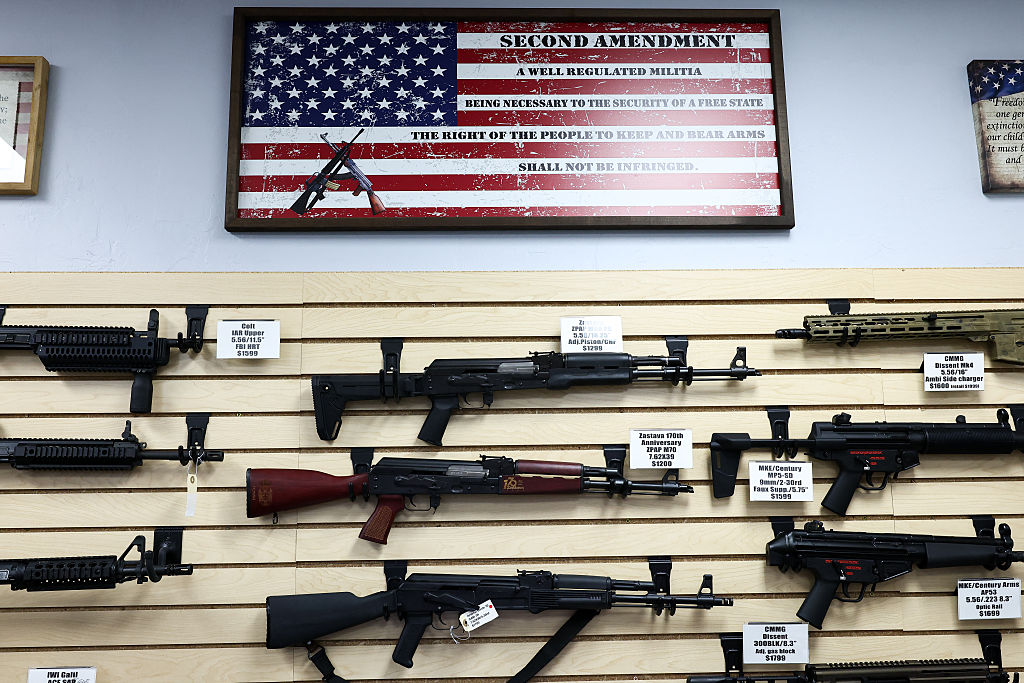
The Second Amendment states that “[a] well regulated Militia, being necessary to the security of a free State, the right of the people to keep and bear Arms, shall not be infringed.” As both critics and supporters of the amendment recognize, little of that language is particularly straightforward. What is a “well regulated Militia,” and how does that apply to today’s arguments over gun control? What constitutes “Arms,” and when is keeping and bearing them “infringed”?
Amid that morass, one phrase that would seem (at least on the surface) a good deal more intuitive is “the people.” After all, doesn’t the people consist of, well, everyone? The answer is … not exactly. So who exactly are “the people” that may possess firearms in the first place? And how might this play into the court’s future decisions on the Second Amendment?
“The people” defined (somewhat)
To try and answer this question, we need to go back to the 2008 case of District of Columbia v. Heller, in which the court recognized a personal right to own a handgun for self-defense. In grounding this right, the court first considered who constituted “the people” in the context of the Second Amendment.
According to the majority, “in all six other provisions of the Constitution that mention ‘the people,’ [being the Constitution’s preamble, Section 2 of Article I, the First Amendment, the Second Amendment, the Fourth Amendment, the Ninth Amendment, and the 10th Amendment] the term unambiguously refers to all members of the political community.” For that proposition, it cited to the 1990 case of United States v. Verdugo-Urquidez. Interestingly, Verdugo-Urquidez was not a Second Amendment case. Rather, Rene Martin Verdugo-Urquidez was a Mexican citizen and resident who was arrested by DEA agents for drug-related offenses and transported to the United States. A DEA agent then sought and obtained authorization from Mexican authorities to search Verdugo-Urquidez’s residences for evidence but did not obtain a search warrant from a U.S. magistrate judge. The question before the court was whether the Fourth Amendment applies to a search and seizure conducted by U.S. law enforcement of property that is owned by a nonresident alien and located in a foreign country – in other words, whether Verdugo-Urquidez was one of “the people” entitled to Fourth Amendment protections.
The court’s opinion in the case began by contrasting the Fourth Amendment’s use of “the people” (being “[t]he right of the people to be secure in their persons, houses, papers, and effects”) with the text of the Fifth and Sixth Amendments, which use “person” and “accused” instead. Based on this distinction in terminology (and the context of that case), the court found that “the people” was a “term of art” used “to protect the people of the United States against arbitrary action by their own Government,” but not “to restrain the actions of the Federal Government against aliens outside of the United States territory.” Specifically, “the people” “refers to a class of persons who are part of a national community or who have otherwise developed sufficient connection with this country to be considered part of that community.”
Relying on Verdugo-Urquidez, the Heller court concluded that the Constitution’s use of “the people” “unambiguously refers to all members of the political community” and there is then “a strong presumption that the Second Amendment right is exercised individually and belongs to all Americans.” Left unresolved, however, was what it means to be a “member of the political community.” Although the cases below are not exhaustive, this issue has most often arisen regarding three categories of people: (1) felons, (2) minors, and (3) noncitizens.
Felons
One of the biggest unresolved questions is whether felons are members of the “political community” and can therefore be restricted from owning firearms. According to 18 U.S.C. § 922, anyone convicted of a felony (or any crime punishable by more than a year in jail) may not lawfully possess a gun. In support of this statute, the government has long argued that felons have “forfeited their membership in the political community” through their offensive acts, and, in support of this, pointed to them being denied such things as “the right to vote,” “the right to hold public office,” and “the right to serve on juries.”
Although most federal courts of appeals have sided with the government that felons may not possess firearms, the government’s argument that felons are not part of “the people” in the first place has met with less success. In the 2024 decision of Garland v. Range, for example, the U.S. Court of Appeals for the 3rd Circuit sharply disagreed that felons were not necessarily members of the “political community.” As the 3rd Circuit noted, the government’s position was internally inconsistent with other provisions in the Constitution: The phrase “the people” is used in the First and Fourth Amendments as well, but “[f]elons are not categorically barred” from the protection of those rights “because of their status.” Additionally, the 3rd Circuit rejected any free floating “law-abiding” exception to the Second Amendment, which would give legislatures the authority “to decide whom to exclude from ‘the people’” and thereby manipulate the Second Amendment simply by “choosing a label.”
Although in dissent, then-Judge Amy Coney Barrett opined similarly in the 2019 case of Kanter v. Barr while on the U.S. Court of Appeals for the 7th Circuit. According to Barrett, “[n]either felons nor the mentally ill are categorically excluded from our national community.” Deciding otherwise would mean such people “could be in one day and out the next” as a matter of “legislative grace.” Like the 3rd Circuit, Barrett thus objected to such a precarious definition of “the people” – a position she would be likely to echo if such a question were to come before her as a justice.
Minors
Another category of such cases addresses firearm restrictions that apply to individuals under the age of 21. As with felons, it has been argued that 18- to 20-year-olds (and those younger) are not members of “the people.” For example, in the 2024 case of Worth v. Jacobson, Minnesota contended that people under 21 were not among “the people” because “at common law, individuals did not have rights until they turned [that age].”
The U.S. Court of Appeals for the 8th Circuit rejected that argument, concluding such persons were part of the “political community” even if this had not necessarily been the case at the Founding. The court first noted that Minnesota had not “overcome the ‘strong presumption’” that the Second Amendment “applies to ‘all Americans.’” It then rejected the idea that, because 21 was the age at which individuals received full “civil and political rights” at the nation’s start, anyone under 21 cannot be part of the “political community.” In making that argument, the 8th Circuit analogized this to Heller’s rejection of the idea that the Second Amendment protects only “arms” that existed at the Founding; while the Constitution is “fixed according to the understandings of those who ratified it,” it “can, and must, apply to circumstances beyond those the Founders specifically anticipated.” In any event, the court noted that even if 18- to 20-year olds were not adults at the Founding, that changed when the 26th Amendment “set[] the age of majority at age 18.”
The U.S. Court of Appeals for the 10th Circuit decided similarly in the 2024 case of Rocky Mountain Gun Owners v. Polis. There, Colorado argued that individuals under the age of 21 are not among the people because at the Founding they would have ”lived under the supervision of their parents or guardians and did not possess full rights, including the right to vote.” Although the 10th Circuit ultimately upheld the challenged regulation, it made clear that “ordinary, law-abiding citizen[s] under the age of 21” are defined as part of the people. The circuit court noted that for the government to argue that “only those with the full legal rights or ability to vote – at the Founding or otherwise – is to miss the forest for the trees.”
Noncitizens
A final group of cases where this question has arisen are those involving noncitizens who are unlawfully present in the United States. These individuals (as well as temporary visitors on a nonimmigrant visa) are prohibited from possessing a firearm by federal law. Perhaps unsurprisingly, it is in this context that the government’s arguments have gained the most traction. That said, even these have not proven entirely successful.
In the 2024 case of United States v. Medina-Cantu, the U.S. Court of Appeals for the 5th Circuit determined that a noncitizen who is unlawfully present in the United States is not considered to be part of “the people.” The court pointed to the Supreme Court’s language in Heller that refers to “the right of law-abiding, responsible citizens to use arms” in self-defense, along with the reference to “members of the political community” and the Second Amendment right presumptively belonging to “all Americans.” Based on these portions of the Heller opinion, the 5th Circuit concluded that “illegal aliens are not law-abiding, responsible citizens or members of the political community, and aliens who enter or remain in this country illegally and without authorization are not Americans as that word is commonly understood.”
The U.S. Court of Appeals for the 6th Circuit, however, took a different approach. In 2025’s United States v. Escobar-Temal, the 6th Circuit began by pointing out that “the right of the people” appears in the First, Second, and Fourth Amendments and has the same meaning throughout all of these provisions (otherwise, as pointed out earlier, the Constitution would appear to be internally inconsistent). The court acknowledged that mere presence in the country is not enough by itself to confer such rights when an individual enters the United States unlawfully. But the 6th Circuit also refused to limit the definition of “the people” to citizens because “‘[t]he Constitution’s text shows the when the Framers meant to limit a provision’s application to “Citizen[s]” … they did so expressly.’” And while not necessarily always the case, it was conceivable that some persons unlawfully present in the United States could become part of “the people” when they have “developed substantial connections with” the country. Indeed, the 6th Circuit concluded that was true in the case before it, where the defendant had developed such “sufficient connections” by “arriv[ing] in the United States in 2012 and liv[ing] in the same community for approximately a decade,” “consistently work[ing] as a flooring contractor,” and having “two American citizen children.”
Where things stand
So – at least in terms of the Second Amendment – who are “the people”? Like a great deal else having to do with this amendment, the Supreme Court has left much to be resolved. It would appear that most law-abiding citizens (and permanent residents) over the age of 21 fit comfortably into this category. But, until the court says otherwise, the boundaries of who else does so will remain a matter of legislative grace rather than a constitutional guarantee.
Posted in Court Analysis, Featured