The dissent that believed the Olympics belong to everyone

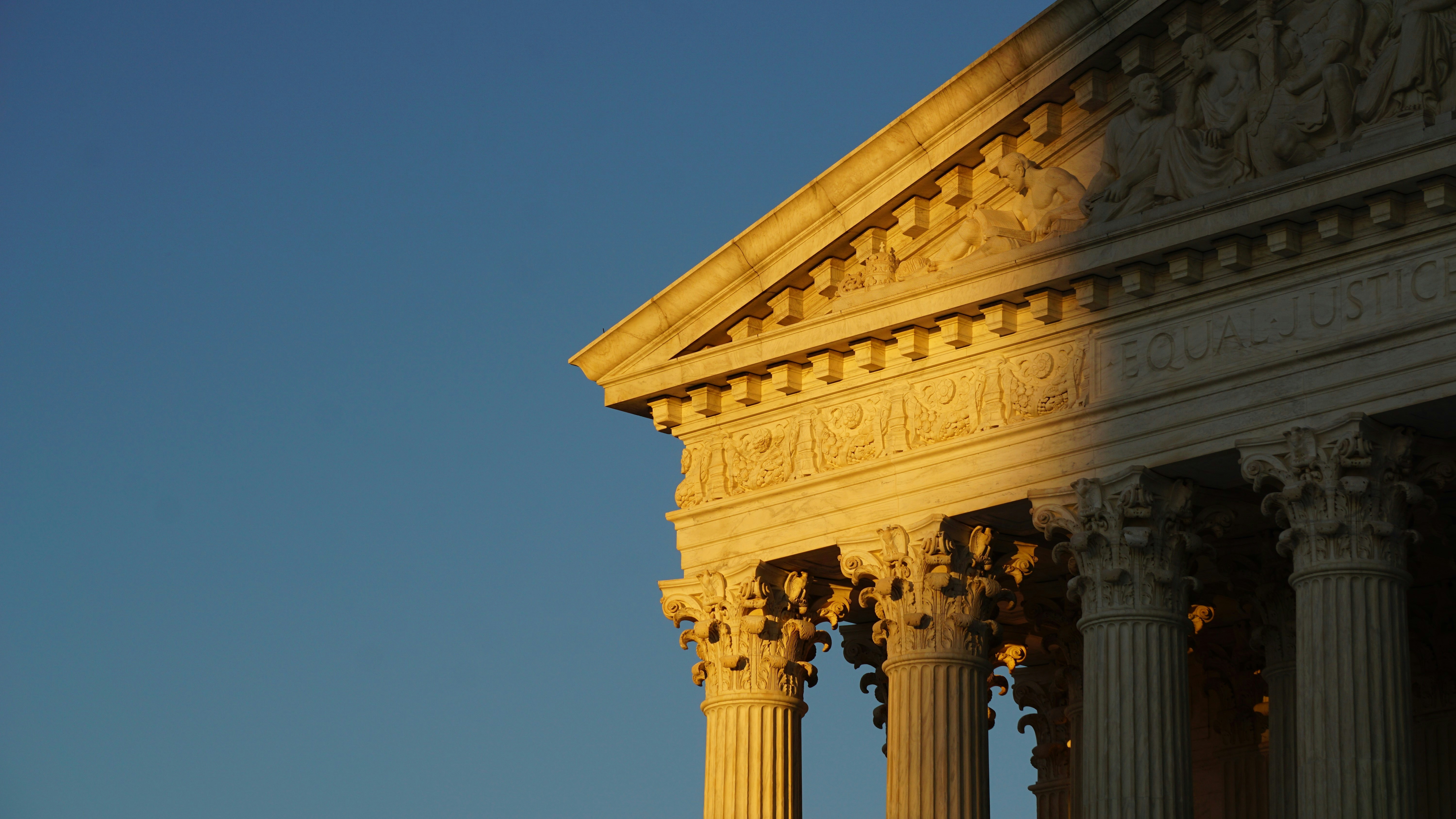
In Dissent is a recurring series by Anastasia Boden on Supreme Court dissents that have shaped (or reshaped) our country.
The Olympics are one of those rare moments when the country comes together whatever its divisions and stays up late watching a skater joyfully complete a near perfect routine just years after quitting the sport completely – or cheers as a hockey player scores the winning goal in overtime moments after losing a few teeth to an opponent’s stick. The athletes’ personal stories somehow feel like our own.
In 1981, former Olympian Thomas Waddell believed the word “Olympic” itself belonged to everyone. He wanted to organize a “Gay Olympic Games” – a nine-day, international athletic competition in San Francisco meant to challenge stereotypes about the gay community. He had heard that using the term “Olympic” required permission from the United States Olympic Committee, so he asked for it, but it declined. On the advice of the ACLU, he used the name anyway, and the USOC sued to stop him.
The resulting Supreme Court case – San Francisco Arts & Athletics, Inc. v. United States Olympic Committee – highlights a tension that arises when Congress decides to get involved in something, but not too involved. The government had chartered the USOC, armed it with powers that no other private organization had ever held, and then watched from across the street as the USOC exercised those powers in broad and seemingly arbitrary ways. The USOC had sued to stop the term Gay Olympics, for example, but not the Crab Cooking Olympics, the Senior Olympics, the Special Olympics, or the dozens of “Olympic” restaurants, dry cleaners, and other establishments that line U.S. streets. When San Francisco Arts & Athletics, inc., the organizer of the Gay Olympic Games, argued that this selective enforcement violated the Constitution’s guarantee of equal treatment under the laws, the USOC said it was a private organization and the Constitution therefore did not apply to it.
Most justices agreed that the USOC had the power to block SFAA from using the word “Olympic.” But even a few of those in the majority dissented when it came to power without accountability, and about the increasingly blurry line Congress sometimes draws between a creature of its own making and an arm of the state.
I. Olympic dreams
One night in the early 1980s, while flipping through television channels and landing on a gay bowling tournament, Dr. Thomas Waddell had an idea. Waddell had placed sixth in the decathlon at the 1968 Mexico City Olympics and had worked as a military paratrooper and physician. Watching the bowlers compete for glory, he wanted to challenge the prevailing stereotype of gay men. He wanted, as the Gay Olympics charter would eventually put it, to “bring people together for greater understanding and physical fitness and not for the purpose of establishing one group being better than any other.” Why not model it on the greatest athletic competition in the world?
And why not use the word “Olympic”? There were, after all, all sorts of Olympic derivatives in the world – the Firemen’s Olympics, the Rat Olympics, the wrist-wrestling Olympics, even something called the Alcoholic Olympics. “The bottom line is that if I’m a rat, a crab, a copying machine or an Armenian, I can have my own Olympics,” Waddell later said. “If I’m gay, I can’t.”
Waddell had heard that using the word Olympic required the blessing of the United States Olympic Committee, which was a relatively recent congressional creation. Congress had long left the organization of U.S. Olympic participation to a private body called the Amateur Athletic Union, but the AAU had managed things badly – excluding women from some events, allowing internal politics to hamper athletic performance, and failing to keep pace with the increasingly sophisticated national programs in other countries.
In response, Congress passed the Amateur Sports Act of 1978, which dissolved the AAU’s authority, chartered the USOC as its replacement, gave it exclusive governance over participation by the United States in the Olympic Games, and granted it extraordinary control over Olympic words and symbols, including the exclusive right to use the word “Olympic” for commercial and promotional purposes.
Waddell wrote to the USOC executive director explaining his vision, but the USOC refused to allow him to use the word “Olympic” to describe his planned event. So, Waddell initially agreed to change the name to the Gay Olympic Games. Then, after the ACLU advised him that he had a solid legal argument, he resumed using the original name. The USOC sued in August 1982, just weeks before the first games were to begin. A federal district court granted a temporary restraining order and then a preliminary injunction, forcing organizers to frantically remove the word “Olympic” from posters, T-shirts, tickets, and bumper stickers, ultimately renaming the event the “Gay Games.” Waddell was disappointed. He didn’t think “Gay Games” carried the same weight.
Typically, one defense in trademark law is that the contested use is not confusing to consumers. So SFAA argued that nobody would think this was the actual Olympics. But the U.S. Court of Appeals for the 9th Circuit ruled in 1986 that no such defense was available under the Amateur Sports Act, and that Congress’ ban on the word’s use did not violate the First Amendment because SFAA had “satisfactory alternative means” to express itself. Over the objections of three jduges, the full court declined to rehear the case.
The lead dissent was written by Judge Alex Kozinski, joined by two other judges. Kozinski wrote that the panel’s decision “threatens a potentially serious and widespread infringement of personal liberties.” Quoting Justice John Harlan II’s 1971 opinion in Cohen v. California – the famous “Fu*k the Draft” jacket case – Kozinski wrote that “we cannot indulge the facile assumption that one can forbid particular words without also running a substantial risk of suppressing ideas in the process.” And then, in his own words: “To say that the SFAA could have named its event ‘The Best and Most Accomplished Amateur Gay Athletes Competition’ no more answers the First Amendment concerns here than to suggest that Paul Robert Cohen could have worn a jacket saying ‘I Strongly Resent the Draft.’”
There were also, Kozinski noted, serious equal protection concerns. “Handicapped, juniors, police, Explorers, even dogs are allowed to carry the Olympic torch,” he wrote, “but homosexuals are not.”
SFAA appealed to the Supreme Court, represented by Mary C. Dunlap, an openly gay San Francisco attorney who had broken her thumb that same year playing goalkeeper in the soccer semi-finals of the second Gay Games. She flew to Washington for oral argument in what she said “no one [would] ever be able to prevent [her] from calling” the “Gay Olympics case.”
II. Olympic arguments
The case presented several issues: the scope of the USOC’s statutory rights (that is, whether Congress had authorized it to bar uses of the term “Olympic” or only those that cause consumer confusion); whether Congress’ grant of those rights violated the First Amendment (or whether as the district court said, SFAA had “no more First Amendment right to market the ‘Gay Olympics’ than they would Gay Coca-Cola”); whether the USOC was engaged in “state action” and therefore had to abide by the Constitution; and if so, whether its selective enforcement violated principles of equal protection.
Oral argument opened with a pointed debate over a missing comma. The statute covered “the words ‘Olympic’, ‘Olympiad’, ‘Citius Altius Fortius’, or any combination or simulation thereof tending to cause confusion.” Justice Antonin Scalia pressed Dunlap. Without a comma after “thereof,” the natural grammatical reading was that “tending to cause confusion” modified only “combination or simulation thereof,” not the word “Olympic” standing alone. This meant that USOC could bar uses of the term whether they were confusing or not.
Dunlap pushed back: in her view, the legislative history showed Congress had wanted to reach only confusing uses, and the absence of a comma shouldn’t be allowed to give the USOC a crown monopoly over an ancient word. Scalia remained skeptical – though Dunlap later described him as “playfully hostile” rather than outright hostile.
Other justices pressed just how far USOC’s monopoly reached. The organization’s attorney was forced to concede to Justice John Paul Stevens that a cereal manufacturer would be barred from putting an athlete’s picture on the box stating it had helped him win three Olympic medals. The exchange prompted laughter when Justice Sandra Day O’Connor got the attorney to admit that “Breakfast of Olympic Champions,” was “clearly covered.”
But for the most part, the justices were clearly with USOC.
III. Olympic decision
The court affirmed the 9th Circuit and ruled for the USOC on all counts. Justice Lewis Powell wrote the majority opinion. It was his final term, and he announced his retirement the same month the decision came down. The year before, Powell had authored Bowers v. Hardwick, holding that the Constitution offered no protection to gay intimacy. He later said Bowers was the opinion he most regretted. He never expressed any regret about this one.
Powell was joined by Chief Justice William Rehnquist and Justices Byron White, Stevens, and Scalia in full. The opinion stated that the statute did cover all uses of the term, whether they tended to cause confusion or not, that this was not an unconstitutional burden on protected speech, and that the USOC was not engaging in any state action. Because it was a private organization rather than a state actor, it could engage in discriminatory enforcement free of the Constitution’s limits. Justices Harry Blackmun and O’Connor joined the parts related to the statutory interpretation and protected speech, but they dissented with regard to state action. Justices William Brennan and Thurgood Marshall dissented across the board.
On the First Amendment, the majority applied the intermediate scrutiny test from the 1968 case of United States v. O’Brien for laws that incidentally burden expression while pursuing a permissible government purpose. Congress had a legitimate interest in encouraging the USOC to perpetuate a “quality product,” according to the court, and SFAA could convey its message without using the word “Olympic.” In fact, it had renamed its event “Gay Games I” and “Gay Games II” and successfully drew 1,300 participants from 12 countries in 1982 and 3,400 in 1986.
On this point, Brennan and Marshall dissented alone, contending that the USOC’s monopoly on language was unconstitutionally overbroad.
But on state action, they picked up two more dissenters in Blackmun and O’Connor. These four justices would have held that USOC was a state actor because it performed the distinctively governmental and important function of representing the nation to the world community: “Every aspect of the Olympic pageant, from the procession of athletes costumed in national uniform, to the raising of national flags and the playing of national anthems at the medal ceremony, to the official tally of medals won by each national team, reinforces the national significance of Olympic participation.” In the dissenters’ view, the public associated the USOC with the United States itself.
“Private organizations sometimes participate in international conferences resplendent with billowing flags,” these dissenters continued, “[b]ut the Olympic Games are unique: at stake are significant national interests that stem not only from pageantry, but from politics.” And in fact, when the president had told the USOC to boycott the 1980 Moscow Olympics out of foreign policy concerns, it did.
In sum, the dissenters wrote, the public viewed the USOC as linked to the state. The USOC sometimes made decisions based on U.S political interests. And it wielded extraordinary state-like power. The USOC sure looked like a state actor, and if it was, it had to abide by constitutional limits just like the government. This meant that its selective enforcement of the Olympic trademark and viewpoint discrimination was likely unconstitutional and illegal.
The dissenters concluded by observing the irony of the case. USOC’s primary source of funding was its government-granted monopoly over the word “Olympic.” It would be an “‘irony amounting to grave injustice’ if, to finance the team that is to represent the virtues of our political system, the USOC were free to employ Government-created economic leverage to prohibit political speech.”
O’Connor wrote a separate dissent joined by Blackmun. Rather than deeming the actions outright discriminatory, as Brennan and Marshall had, they would have sent the case back to the lower court for it to determine whether the USOC’s enforcement was unequal.
The upshot was that the USOC won on every count. The word “Olympic” belonged to the USOC.
IV. Aftermath
Waddell had known for years by then that he had AIDS, and he died just weeks after the decision was released. “The Supreme Court’s terrible decision probably did not hasten Tom’s death,” Dunlap said. “It just made it all the more bitter.” The USOC had been awarded its attorneys’ fees and had placed a lien on Waddell’s house to collect them. A few weeks before he died, the USOC waived its legal fees and lifted the lien.
The Gay Games continued without the word. Gay Games IV in New York City in 1994 drew more than 11,000 athletes and 500,000 spectators, setting a record at the time as the largest athletic competition in world history. Closing ceremonies were held at Yankee Stadium. This year, the Gay Games will be held in Spain.
The arguments over state action at the heart of the Gay Games dispute reflect a recurring structural problem in U.S. law: what happens when Congress creates a private entity, invests it with governmental powers and privileges, even pressures it into politically laden decisions, and then that entity argues that its conduct falls outside constitutional constraints because it is technically “private”? Similar questions surround the National Collegiate Athletic Association and the Financial Industry Regulatory Authority, which have cozy relationships with the government – their rules must even sometimes be approved by the government – yet have been considered “private” and thus free from constitutional constraints. And the issue arose in different form this term, as the court considered whether private entities acting on behalf of the government can claim its immunities as well as its powers.
So, just as the Gay Games will go on, so will the questions this case raised.
Posted in In Dissent, Recurring Columns