Supreme Court skeptical of law banning drug users from possessing firearms

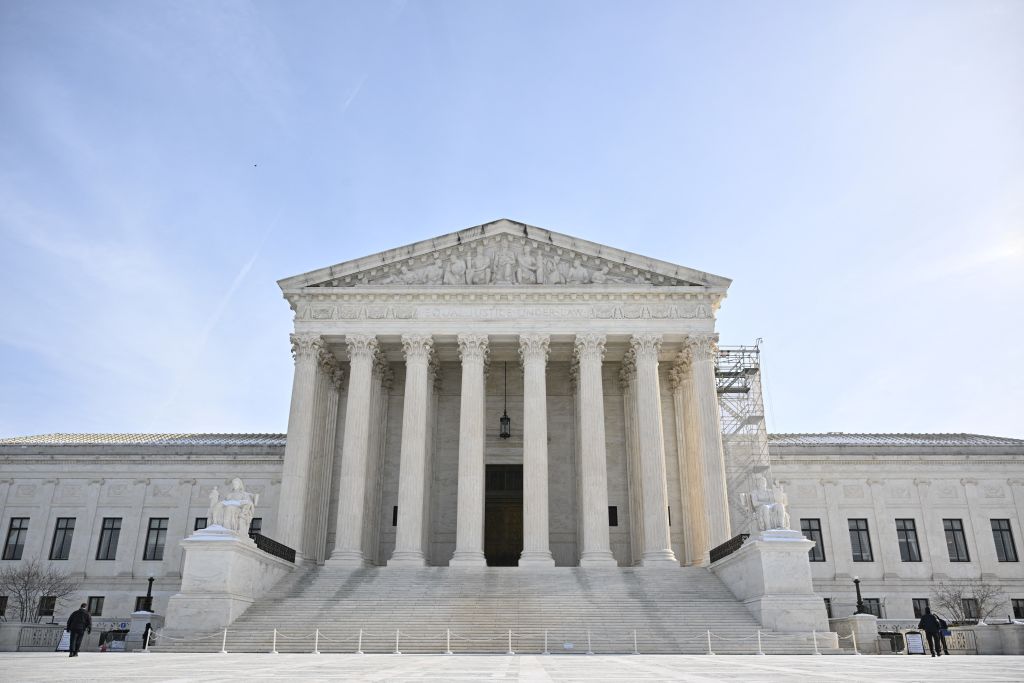
The Supreme Court on Monday was skeptical that the indictment of a Texas man on charges that he violated a federal law prohibiting the possession of a gun by the users of illegal drugs could go forward. Ali Danial Hemani argued that the law violates the Second Amendment – which guarantees “the right of the people to keep and bear Arms” – as it applies to him, and a majority of the justices appeared to agree.
In 2022, FBI agents found a pistol, marijuana, and cocaine at Hemani’s home. Hemani told the agents that he used marijuana roughly every other day.
Hemani was charged with violating a federal law that makes it a crime for anyone who is “an unlawful user of or addicted to any controlled substance” to have a gun. A federal trial judge threw out the charge, at Hemani’s request. U.S. District Judge Amos Mazzant relied on a recent decision by the U.S. Court of Appeals for the 5th Circuit, which had held that the law used to indict Hemani is unconstitutional when it is used to charge someone who may have used drugs regularly, but was not shown to be under the influence of drugs when he had the gun. The court of appeals upheld that ruling, prompting the federal government to come to the Supreme Court.
Representing the federal government, Principal Deputy Solicitor General Sarah Harris told the justices that “[t]he Second Amendment does not prohibit the government from temporarily disarming habitual marijuana users while they persist in using frequently. That tailored restriction,” Harris said, “easily fits within the historical tradition of disarming categories of people who present a special danger of misuse.” And as the Supreme Court’s recent Second Amendment cases require, Harris argued, the government had provided a “historical analogue” to the modern law “that is relevantly similar [in] why and how it restricts Second Amendment rights”: early American laws providing for the imprisonment or confinement of “habitual drunkards.”
Justice Neil Gorsuch focused on what he characterized as a more basic point: whether Hemani even qualified as a “habitual user” of marijuana. Gorsuch first observed that the term “habitual drunkard” carried a very different meaning in early American history, because people generally drank alcohol more often and in greater volumes. “John Adams,” Gorsuch said, “took a tankard of hard cider with his breakfast every day,” while “James Madison reportedly drank a pint of whiskey every day.”
And if those Founding Fathers were not “habitual drunkards,” Gorsuch continued, “then what do we know about Mr. Hemani? We know he uses marijuana … about every other day.” “[W]e don’t even know the quantity of how much he uses every other day,” Gorsuch emphasized. And the federal government, Gorsuch said, “has not been able to define what a user is.”
Justice Amy Coney Barrett shared a similar concern, asking Harris about a scenario in which someone takes the sleeping pill Ambien, for which their spouse has a prescription. Would that mean, Barrett asked, that the person with the prescription for Ambien would not violate the law at the center of this case, but the spouse who did not have the prescription would?
When Harris answered that Barrett was correct, Barrett pushed back. Barrett told Harris that she “agree[d] … that legislatures can regulate to keep guns out of the hands of dangerous people.” But in the Ambien example, Barrett suggested, “it’s not the drug itself … that’s causing the dangerousness. It couldn’t be because, if my husband has a prescription and I don’t, what is it about Ambien itself that would make one of us more likely to be dangerous? It’s not,” Barrett said. “It’s the lawfulness. And so too here with the marijuana, I just don’t see anything in the scheme that actually reflects Congress’ judgment that this makes someone more dangerous.”
Justice Clarence Thomas also echoed these concerns, asking Harris whether someone who regularly used anabolic steroids would be barred from having a gun under the government’s interpretation. Harris told him that they would, although she stressed that anabolic steroids fall within a “schedule” – a category – that the government regards as less serious than drugs like heroin and fentanyl. The federal government, she said, “only cares really about prosecuting” users of drugs like those that have “a serious danger of abuse.”
Justice Ketanji Brown Jackson expressed broader frustration with the court’s current framework for resolving Second Amendment cases. When Harris suggested that “it is a fair judgment” that someone who frequently uses drugs like heroin, PCP, or ketamine is “exceptionally dangerous” even if they are not addicted to those drugs, Jackson acknowledged that “it might be a fair judgment,” but she contended that it was “precisely what” the court’s Second Amendment jurisprudence “prohibits, that we don’t credit the judgments of the modern legislature about who is dangerous and who needs to be disarmed as a result.”
Representing Hemani, Erin Murphy argued first that the law at the center of the case “can’t constitutionally be applied to anyone because the statute fails to provide fair notice of what makes someone an unlawful user of a controlled substance who can be stripped of their Second Amendment right.” But in any event, Murphy continued, applying the law to Hemani would still violate the Second Amendment because early American laws restricting the rights of “habitual drunkards” do not provide the kind of historical analogue that the Supreme Court’s cases require. Those laws, she said, “applied only to habitual drunkards, not to habitual drinkers.”
Murphy’s suggestion that the law was so vague as to be unconstitutional got relatively little traction. But Justice Sonia Sotomayor was receptive to Murphy’s other argument, asking whether “the government is … giving ‘unlawful user’ a definition that’s not present in the statute, correct?” And in early American history, Sotomayor continued, “there’s nothing … that has created” a definition of “use.”
Chief Justice John Roberts was skeptical that Murphy was, as she contended, seeking a narrow rule. He asked why, under the same reasoning, it wouldn’t also be unconstitutional to apply the law to someone who used drugs like PCP or methamphetamine.
Murphy responded that “the same principle should govern … but that doesn’t mean that the statute is unconstitutional as to every drug.” The restrictions placed on “habitual drunkards,” she said, rested on the idea that someone who drank so much “that they can’t care for themselves or their affairs” and have “lost self-control” would “pos[e] a public safety risk.” “[I]f you apply that” principle here, she explained, “there are going to be some substances where it may be that pretty much anybody who uses them regularly” would be too dangerous to have a gun.
That answer led to another objection from Roberts and, later, Justice Samuel Alito, who worried aloud that such a rule would require courts to engage in case-by-case decisions about whether a particular person or a particular drug is “one that’s particularly dangerous or particularly addictive.” “And it just seems to me,” Roberts said, “that takes a fairly cavalier approach to the necessary consideration of expertise and the judgments we leave to Congress and the executive branch.”
Murphy countered that courts already make these kinds of decisions on a regular basis – for example, “you have to engage in an analysis of someone’s actual use to figure out whether they’re addicted to a controlled substance.”
Alito pressed Murphy on this issue, telling her that he “struggle[d] to figure out how these individualized determinations can be made in the context of a criminal prosecution. The … way in which criminal prosecutions are conducted makes this extremely difficult,” he said. Moreover, he observed, such a determination might require expert testimony, “and the jury would decide whether the person met the test for being a dangerous person.”
Murphy tried to reassure Alito, telling him that she didn’t “think the government is going to need to do that when it comes to a lot of cases and a lot of substances.” But in any event, she continued, the key question for the jury is “whether somebody’s use is impairing their ability to function, and the government can then choose to present evidence” about the defendant’s life and the drug that he or she is alleged to use “habitually.”
It is not clear whether Alito was convinced, but Murphy may not ultimately need his vote.
A decision in the case is expected by summer.
Posted in Court News, Merits Cases
Cases: United States v. Hemani