
We may not know yet how the many tariff refund disputes will be untangled, but we learned Wednesday that the Trump administration thinks it only needs until August to finish rebuilding the system of tariffs that the Supreme Court knocked down. For more on the latest tariff developments, see the Morning Reads section below.
At the Court
On Wednesday, the Supreme Court released two unanimous opinions: In Urias-Orellana v. Bondi, the court held that the Immigration and Nationality Act requires federal courts of appeals to apply the substantial-evidence standard when they review a determination that an asylum seeker’s experiences do not rise to the level of persecution. In Galette v. New Jersey Transit Corporation, the court held that the New Jersey Transit Corporation is not an arm of the state of New Jersey and thus is not entitled to share in New Jersey’s interstate sovereign immunity from suit.
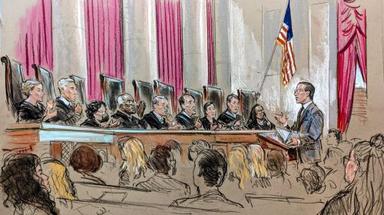
Also on Wednesday, the court heard argument in Montgomery v. Caribe Transport II, on whether freight brokers can be held liable for negligent hiring.
Tomorrow, the justices will meet in a private conference to discuss cases and vote on petitions for review. Orders from that conference are expected on Monday at 9:30 a.m. EST.
Morning Reads
Bessent says global 15% tariff starts this week, predicts Trump duties will return to old levels later this year
Kevin Breuninger, CNBC
During a Wednesday appearance on CNBC, Treasury Secretary Scott Bessent said that the recently imposed 10% global tariff will likely rise to 15% sometime this week and that, by August, tariff rates will “effectively return to where they stood before the Supreme Court” struck down President Donald Trump’s signature tariffs. “It’s my strong belief that the tariff rates will be back to their old rate within five months,” Bessent said. The current 10% tariff, which will rise to a 15% tariff, was “imposed under Section 122 of the Trade Act of 1974 [and] can last for only 150 days unless Congress approves an extension.” Over the course of those 150 days, “the Office of the U.S. Trade Representative and the Commerce Department will complete trade-related studies that can allow them to impose more tariffs,” Bessent said.
Judge rules companies are entitled to refunds for Trump tariffs overturned by the Supreme Court
Paul Wiseman and Mae Anderson, Associated Press
Judge Richard Eaton of the U.S. Court of International Trade ruled on Wednesday that “all importers of record” are “‘entitled to benefit’ from the Supreme Court ruling that struck down” Trump’s tariffs, according to the Associated Press. “Eaton was ruling specifically on a case brought by Atmus Filtration, a Nashville, Tennessee, company that makes filters and other filtration products, claiming a right to a tariff refund,” but his decision is expected to broadly benefit importers and consumers who paid tariffs. Trade lawyer Ryan Majerus, a partner at King & Spalding and a former U.S. trade official, told the AP that “he expects the government to appeal or ‘seek a stay to buy more time for U.S. Customs to comply.’”
How Trump Keeps Withholding Money After Being Sued 198 Times
Emily Badger and Alicia Parlapiano, The New York Times
The New York Times has published an in-depth look at lawsuits over the Trump administration’s changes to a variety of government funding programs, including its efforts to keep funds from communities that don’t cooperate with federal immigration enforcement and from organizations that promote DEI programs. The analysis includes 198 lawsuits and notes that the “[w]hen plaintiffs have sought immediate relief, district court judges have temporarily blocked the administration’s actions 79 percent of the time, signaling plaintiffs’ likely success on the merits. In the 26 instances where district judges have issued partial or final rulings, the administration lost 23.” By comparison, “appellate courts have reversed or paused orders against the administration in about 40 percent of their rulings.” The article noted that the Supreme Court’s June ruling “ending nationwide injunctions” has lessened the impact of lower court losses, which helps explain why the Trump administration has persisted with its plan to withhold funding from groups it disagrees with even in the face of so many lawsuits.
Bayer's $7.25 billion Roundup settlement gets initial OK from Missouri judge
Diana Novak Jones, Reuters
On Wednesday, “[a] state court judge in Missouri gave an initial green light … to a proposed $7.25 billion settlement to resolve thousands of lawsuits claiming Bayer’s Roundup weedkiller causes cancer,” according to Reuters. “The deal is aimed at resolving most of the roughly 65,000 remaining claims pending in federal and state courts” and comes as the Supreme Court prepares to hear argument in April on whether “state-court claims that [the company] failed to warn about Roundup’s risks are barred because the U.S. Environmental Protection Agency has found no such risk [that Roundup causes cancer] and requires no such warning.” The judge “said he would hear objections from people impacted before deciding” whether to grant final approval to the settlement in July, which is around the same time the Supreme Court is expected to rule.
The Tariffs Ruling Reveals a Growing Rift Between Two Liberal Justices
Mathias Valenta, Slate
In a column for Slate, Mathias Valenta revisited the court’s ruling in the tariffs case, highlighting the differences between the concurring opinions from Justice Elena Kagan and Justice Ketanji Brown Jackson. The opinions, according to Valenta, were a reminder of “the differing strategies that Kagan and Jackson have adopted in their roles as members of the court’s liberal minority.” In her opinion, which was joined by Jackson and Justice Sonia Sotomayor, Kagan appeared to be “trying to beat the conservative majority at its own textualist game,” which fits with her broader effort to “moderat[e] the conservative majority.” Jackson, meanwhile, used her concurrence to “dismiss[] the majority’s ‘pure textualism’ altogether,” continuing her more direct confrontation with the court’s conservative wing.
On Site
The SCOTUS attorney switcheroo
In his Empirical SCOTUS column, Adam Feldman dug into what he calls the “SCOTUS attorney switcheroo,” the change in counsel that sometimes occurs as a case travels from the lower courts to the Supreme Court. Although such a change “may not – on the surface – seem like a very big deal, it has implications not only on the nature of what the court hears but what actually gets decided by the justices,” Feldman wrote.
Birthright citizenship: an empirical analysis of supposedly originalist briefs
In their Brothers in Law column, Akhil and Vikram Amar, along with Amad Ross, analyzed the amicus briefs filed in the birthright citizenship case that claim to employ originalism – that is, the theory of legal interpretation that emphasizes the Constitution’s text, structure, and history. The column contends that “only a few of the self-proclaimed originalist briefs epitomize the best form of originalism.”
Court unanimously sides with government in immigration dispute
The Supreme Court unanimously sided with the federal government on Wednesday, holding in an opinion by Justice Ketanji Brown Jackson that federal courts of appeals must use a relatively deferential standard of review when assessing the Board of Immigration Appeals’ determination that asylum seekers did not experience the level of persecution necessary to qualify for asylum protections.
Family Federation for World Peace and Unification International v. Moon
During their private conference on Friday, the justices are expected to consider a petition for review in a church-property dispute that raises interesting First Amendment questions.
The case, Family Federation for World Peace and Unification International v. Moon, is one of many that arose around the time of the death of the Unification Church’s founder, Sun Myung Moon, in 2012. It is focused on control of Unification Church International, which the petition describes as a “financial support nonprofit organization that the Church created to hold some of its most valuable assets.”
In the lawsuit, a group of church members accused those who directed UCI just before Moon’s death, including Moon’s son Hyun Jin “Preston” Moon, of, among other things, unlawfully amending UCI’s articles of incorporation and mishandling UCI funds, including by giving “its ‘most valuable assets’ away to a Swiss entity, Kingdom Investments Foundation,” that was not affiliated with the church. The group is seeking control of UCI and recovery of lost assets.
Preston Moon and other UCI directors have contended that the lawsuit stems from theological concerns, rather than legal ones. They assert that Sun Myung Moon recognized Preston Moon as his religious successor before his death, thereby empowering him to make the changes to UCI that led to the lawsuit.
For nearly 15 years, the case has been bouncing back and forth between lower courts that have disagreed over whether allowing it to proceed would violate the First Amendment. In 2022, the District of Columbia Court of Appeals reversed and vacated a trial court ruling against the UCI directors, holding that the trial court’s decision “turned on deciding disputed questions of religious doctrine and purpose” that were “nonjusticiable under the First Amendment[]” because they required the court to pick a side in a theological, rather than legal, dispute. The trial court then dismissed the church members’ remaining claims, and the D.C. Court of Appeals affirmed the dismissal last year, prompting the group of church members to appeal to the Supreme Court.
In their petition for review, the church members contend that the D.C. Court of Appeals applied an “overexpansive reading[]” of the First Amendment. Courts can examine “church-related facts,” including documents outlining a church’s structure and mission, without violating religious freedom, and that kind of permissible examination is what’s required in this case, they say. The church members further argue that the lower court’s decision has left them “remediless,” and urge the justices “to ensure that churches are not denied recourse when their property is fraudulently taken.”
For their part, the UCI directors maintain that “this dispute was never one civil courts could adjudicate” because of the ongoing dispute over who controls the Unification Church and affiliated entities. While the Supreme Court in the past has said that courts can weigh in on church-property disputes when it’s clear who has authority over the church because such disputes don’t hang on theological questions, that is not the case here, the directors argue.
Family Federation for World Peace and Unification International v. Moon is scheduled to be considered by the justices for the first time at their private conference on Friday.
SCOTUS Quote
MR. CLEMENT: “[Y]ou know, you have an amicus brief from 28 states and they pulled off the incredible feat of having California and Texas on the same amicus brief.”

Recommended Citation: Kelsey Dallas, SCOTUStoday for Thursday, March 5, SCOTUSblog (Mar. 5, 2026, 9:00 AM), https://www.scotusblog.com/2026/03/scotustoday-for-thursday-march-5/