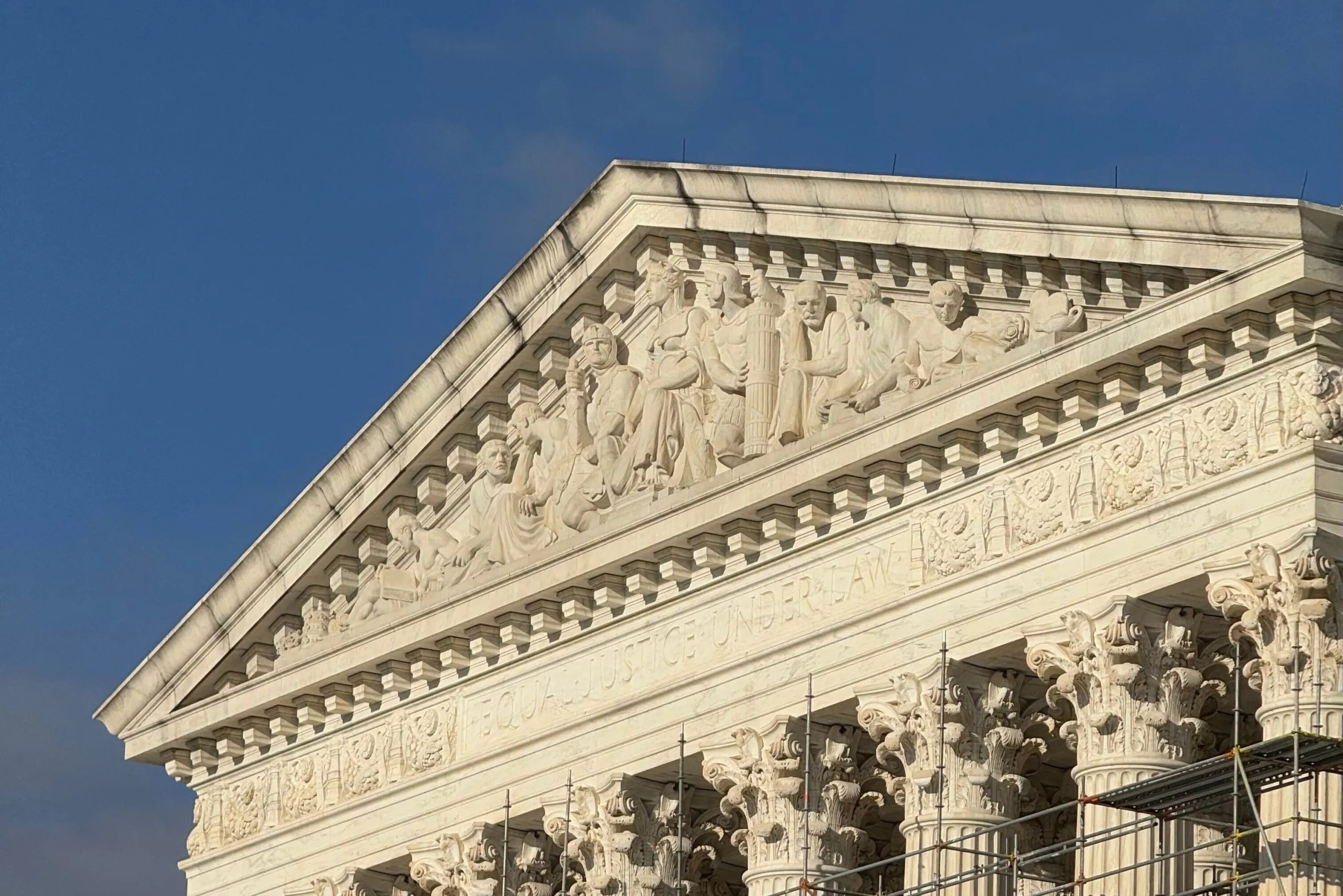


The first associate justice to be elevated to chief justice (most don’t count Chief Justice John Rutledge’s stint as an associate justice, since he never heard a single case), Chief Justice Edward Douglass White was appointed by Presidents Grover Cleveland (as an associate justice) and William Howard Taft (as chief), respectively.
Born in 1845 and raised on his family’s plantation in southern Louisiana, White was the grandson of James White, a delegate to the Continental Congress, and the son of Edward White, who served as Louisiana governor, a judge, and a five-term member of the U.S. House of Representatives. His father owned a sugar-beet plantation, relying on around 50 enslaved people. The younger White only knew his father for three years, however, as he died in 1847. White’s mother subsequently remarried, and the family moved to New Orleans. (Until Justice Amy Coney Barrett’s appointment to the Supreme Court in late October 2020, White was the first and only justice from Louisiana.)
White, who came from a Catholic family, attended a Jesuit boarding school and then Georgetown College (now University). When the Civil War began, the future chief justice, then 15 years old, moved back home – “like most Southern students attending a Northern school,” according to the Supreme Court Historical Society –and joined the Confederate Army. In 1863, White was one of the thousands of Confederate troops who became trapped for weeks in Port Hudson, Louisiana, by Union forces.
A little less than two years later, White was again captured by the Union army in further combat and was imprisoned in New Orleans – where he would remain for about a month until Robert E. Lee surrendered on April 9, 1865. White was released in a prisoner exchange at Red River Landing, the spot of one of the Civil War’s last battles, before heading home to New Orleans. (White later became friends with Justice Oliver Wendell Holmes, who fought for the Union and was shot through the back of the neck in the Battle of Antietam, and he would put a bouquet on Holmes’ desk each year on the battle’s anniversary.)
White then attended the University of Louisiana (now Tulane University) for law school, which his late father had established as governor by signing its precursor’s charter. After graduating, he practiced law in New Orleans, briefly served on the Louisiana state senate, and was appointed to the Louisiana Supreme Court in 1878. The appointment didn’t last long, however, as White didn’t meet the new minimum age requirement of 35 to serve (he was 33 at the time). Ten years later, he was chosen by the state Legislature to represent Louisiana in the U.S. Senate, partly due to his role in abolishing the corrupt Louisiana Lottery, which had been granted a charter in 1868 based on supposed bribes to state legislatures.
In New Orleans, White also met his future wife, who eventually married him after 20 years of courtship. Meanwhile, White’s legislative work (which included opposing tariff reductions) drew Cleveland’s attention – who then nominated him to the Supreme Court in February 1894. The Senate confirmed White the same day (likely due to the fact that he was from the same party as the Senate majority) – and would do so again when Taft nominated him to chief justice (then an unprecedented move for an associate justice) in December 1910 following the death of Chief Justice Melville Fuller.
White’s best-known cases include those on race and civil rights. He authored the ruling in Guinn v. United States that rejected certain “grandfather clauses,” which allowed those whose grandfathers had been able to vote before the 15th amendment was ratified to register to vote without first passing a literacy test. As with his predecessor, however, White joined the majority in Plessy v. Ferguson. White also ruled on compelled military service (he wrote a unanimous majority opinion in the Selective Draft Law Cases of 1918 that held the government could expand its conscription requirements) and on the Sherman Antitrust Act (he established the “rule of reason” in evaluating “unreasonable” trade restraints in Standard Oil Co. of New Jersey v. United States, which federal courts continue to apply).
In addition, his court restrained war-related speech (holding that under Debs, Schenck, and Abrams, speech or activities interfering with the war could be criminalized), and the “Insular Cases,” which held that only some Bill of Rights protections apply within the U.S. territories.
The ninth chief justice spent 27 years on the court before dying in May 1921. White reportedly insisted on working until the very end – even until his eyes began to fail. As the Supreme Court Historical Society summarizes White’s legacy, “[d]uring his 27-year tenure on the Court, Edward Douglass White played a critical role in interpreting the law in the rapidly transforming post-Civil War and industrial United States.” Others have asserted, however, that White’s leadership “proved less than adequate to meet the challenges of [such a] tumultuous era.”