Court grapples with whether federal law supersedes negligent hiring claims against freight brokers

Updated on March 6 at 10:50 a.m.
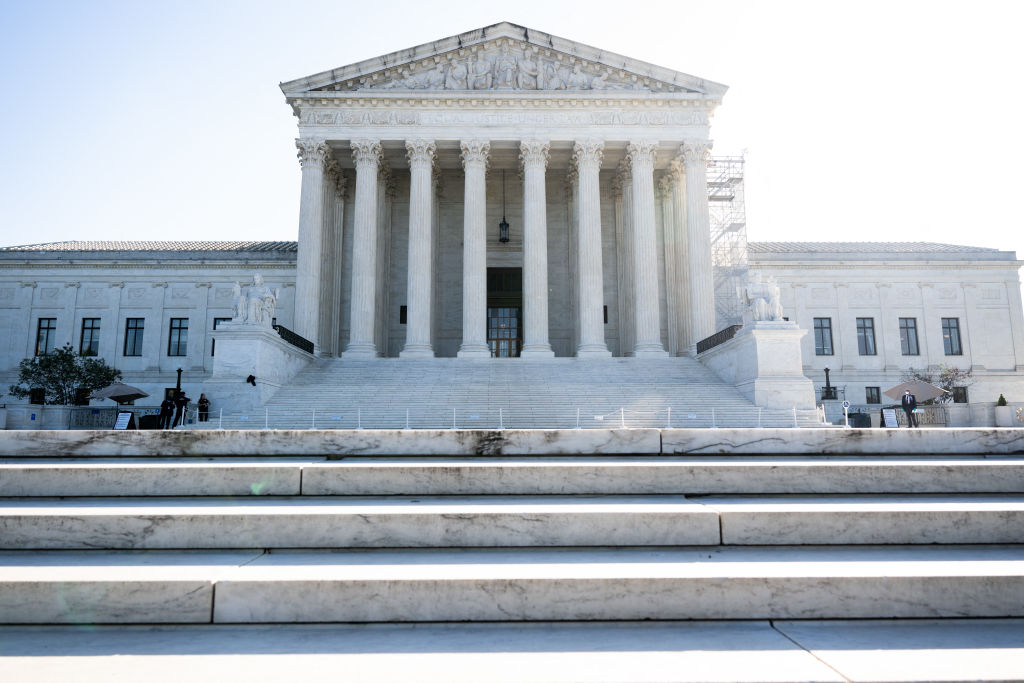
The Supreme Court on Wednesday heard argument in Montgomery v. Caribe Transport II, LLC, a case on whether federal law prevents state law claims allowing brokers to be held liable for negligently selecting motor carriers or drivers.
“A quick way to estimate any case’s importance is to look at which groups are interested enough to submit amicus curiae (‘friend of the court’) briefs,” one journal article suggested the day before the oral argument. “Based on this metric, Caribe Transport [was] a blockbuster, featuring amicus participation from the biggest companies (Amazon), trade associations (U.S. Chamber [of] Commerce), and even the federal government (acting through the Solicitor General).”
The case stems from an accident on an Illinois highway in which Shawn Montgomery suffered severe injuries. The driver of the vehicle that hit Montgomery was employed by Caribe Transport II, an Indiana-based interstate motor carrier. The shipment, a load of plastic pots, was arranged by freight broker C.H. Robinson Worldwide and its affiliates under a carrier agreement with Caribe II.
Montgomery filed suit in 2019 against, among others, Caribe Transport II and Robinson, contending that the broker negligently hired a motor carrier. Robinson moved to dismiss the negligent-hiring counts against it, arguing that Montgomery’s state claims were superseded by Section 14501(c)(1) of the Federal Aviation Administration Authorization Act of 1994, which bars state suits “related to a price, route, or service” of brokers “with respect to the transportation of property.”
The district court held that while the negligent-hiring claims related to broker services, they fell within the safety exception of Section 14501(c)(2)(A), which preserves “safety regulatory authority of a State with respect to motor vehicles.”
On appeal, the U.S. Court of Appeals for the 7th Circuit affirmed, holding that “the FAAAA preempts state law claims that a freight broker negligently hired a motor carrier.”
Montgomery then came to the Supreme Court, which granted review in early October to resolve a conflict between the U.S. Court of Appeals for the 6th and 9th Circuits (which held such a claim is not preempted) and the U.S. Courts of Appeals for the 7th and 11th Circuits (which held that “[a]ny claim that a broker negligently selected a driver to haul a load of property” is preempted).
Representing Montgomery, Paul Clement told the justices on Wednesday that Congress intended to deregulate the economics of the trucking industry, but intentionally preserved state safety regulations for motor vehicles, and that state negligent hiring torts had traditionally been used against carriers and brokers alike.
Justice Brett Kavanaugh raised what he characterized as an “oddity” in Clement’s theory: that it would (counterintuitively) mean state claims against brokers are preempted for intrastate but not interstate transportation. Clement responded by arguing Congress had a separate clause for interstate transportation. Justice Elena Kagan similarly pressed Clement on why Congress would have created the intrastate versus interstate issue, to which Clement responded that it might have been due to different interest groups – but that ultimately, this case focuses on Section 14501(c) and not other provisions.
Kagan also pressed Clement on whether his theory would allow suits against shippers. Clement replied yes. When Kagan later raised the companies’ argument that reading the safety exception broadly would make the phrase “with respect to motor vehicles” swallow the entire preemption clause, Clement countered that the statutory definition of “transportation” is massive — it includes vessels, warehouses, and docks — so the motor-vehicle carve-out is not nearly as broad as might be surmised.
There were also lots of questions on what exactly constitutes a “direct connection” to motor vehicles. Justice Samuel Alito asked how far this reached – and if the limit is proximate cause (the motor vehicle being sufficiently as opposed to distantly related to the accident). Clement agreed that the limit is proximate cause and that nothing “wildly indirect” or “butterfly effect” would qualify, based on the court’s own language in prior cases excluding things “tenuous, remote, or peripheral.”
In her first question of the argument, Justice Amy Coney Barrett asked whether the court should decide the case under the safety exception. Clement urged the justices to do so. Justice Ketanji Brown Jackson raised the prospect that Congress simply wanted to preserve the status quo on safety, leaving states free to decide who gets sued. Clement agreed and added that the states get to make judgments about whether liability goes to the broker or carrier.
As is his style, Kavanaugh focused on practicality and “common sense,” asking how brokers are supposed to check drivers’ English proficiency (“a critical issue at the current moment”) or drug use without forcing them to hire only large, established carriers. Clement replied that brokers, both large and small, can insist on proper testing programs and that the threat of liability stops them from picking the cheapest, unchecked options. (Later in the argument, Clement added that, as noted in Montgomery’s reply brief, 45% of carriers don’t actually own their vehicles and 94% have never had a safety exam by the federal government.)
Representing the companies, Theodore Boutrous argued that brokers are middlemen who arrange transportation but never touch or control a motor vehicle. Claims targeting their “core service” of matchmaking are therefore preempted under (c)(1) and not saved by the narrow (c)(2) exception, Boutrous contended. Boutrous disagreed with Justice Sonia Sotomayor that brokers are “putting the driver in the seat” – rather, carriers are. Boutrous also told the court that allowing negligent-hiring suits against brokers would create a patchwork that “bollix[es] up the broker duty” and interstate commerce.
In response, Justice Clarence Thomas asked Boutrous whether brokers would win on proximate-cause grounds regardless. Boutrous replied that they often do, but only after expensive discovery.
Sotomayor then asked why, if a state can deem a driver unfit (or mandate an age requirement or seatbelts), can it not hold the broker liable for putting that driver behind the wheel of a truck. Boutrous’ answer was that the Federal Motor Carrier Safety Administration already licenses freight carriers, so states cannot second-guess that federal judgment.
Sopan Joshi, an assistant to the U.S. solicitor general who argued as a “friend of the court” in support of the companies, stressed the textual contrast between the broad phrase “transportation of property” in the preemption clause and the narrower “motor vehicles” in the exception. The federal scheme, he said, treats carriers, not brokers, as the “lowest-cost-avoider” responsible for safety. Allowing broker liability, Joshi said, would shrink the pool of available carriers to only the largest ones (“brokers are going to follow the … no one ever got fired for buying IBM principle”), which counters the deregulation that Congress intended in passing the FAAAA.
Perhaps Joshi’s most memorable line, though, was in his opening statement. “Suppose there were a rule that applied with respect to coffee, cream, and sugar and then an exception that applied only with respect to coffee,” Joshi said. “You would naturally think that the exception does not apply with respect to cream and sugar, even though that phrase in isolation might cause you to adopt the opposite view. I think that’s kind of what’s going on here, and that’s why I think [the companies’] reading of the statute is the better one.”
In his rebuttal, Clement returned to Joshi’s coffee analogy: if you sue McDonald’s because its coffee spilled and burned you, that claim is “with respect to coffee,” not some unrelated service. Here, Clement says, the tort is squarely “with respect to” the “80,000-pound motor vehicle” that caused the injury. He urged the court to reverse on the safety-exception ground and leave it at that.
A decision in the case is expected by June.
Posted in Court News, Featured, Merits Cases
Cases: Montgomery v. Caribe Transport II, LLC