Birthright citizenship: an empirical analysis of supposedly originalist briefs
Brothers in Law is a recurring series by brothers Akhil and Vikram Amar, with special emphasis on measuring what the Supreme Court says against what the Constitution itself says. For more content from Akhil and Vikram, please see Akhil’s free weekly podcast, “Amarica’s Constitution,” Vikram’s regular columns on Justia, and Akhil’s new book, Born Equal: Remaking America’s Constitution, 1840-1920.
More brief-writers than ever are claiming to be “originalists.” Indeed, in the birthright citizenship case, Trump v. Barbara, 33 of the 65 amicus and party briefs on the merits – more than half – feature the word originalism or a close cognate (e.g., originalists or original meaning or original understanding) at least once. Alas, only a few of the self-proclaimed originalist briefs epitomize the best form of originalism – as readers shall soon see, thanks to the significant data compiled and analyzed by Akhil and Vik’s co-author Amad Ross later in this column.
Originalism at its best focuses on the Constitution’s text, its enactment-and-amendment history, and on its overall structure.
Consider first the text of the key clause at issue in Barbara: “All persons born or naturalized in the United States, and subject to the jurisdiction thereof, are citizens of the United States.” Surely faithful originalists should attend to what the words say and what they do not say. The Trump administration – by basing one’s entitlement to citizenship on the status of his or her parents – essentially reads into the amendment the words parent, parental domicile, parental allegiance, mother, and father. But these words are not in the amendment. The amendment’s text focuses entirely on the child – the one who is “born.” Some, but only some, of the self-described originalist briefs give this key textual point the enormous weight it deserves. Sadly, no brief other than Akhil’s strongly highlights the elephantine problems of adjudication and implementation that words such as parent, parental domicile, parental allegiance, mother, or father would have entailed in the 1860s had these words been part of the amendment – problems nowhere discussed in any detail by the amendment’s enactors and ratifiers.
Next, consider the amendment’s enactment history. The amendment built on crucial rulings by the Lincoln administration in 1862-64. Yet most briefs contain not a single reference to Lincoln! And the amendment was surely at its core about former slaves and their children, yet most briefs contain no or only a few references to slaves.
Much of the amendment emerged from a closed-door Republican party caucus in Congress. The ultimate congressional vote was essentially party-line, with virtually all Republicans on one side and all Democrats on the other. Many of the ratification votes in state legislatures were also party-line votes with little substantive discussion in public. A great deal of the most important public conversation occurred during the congressional campaign of 1866, when the amendment functioned as the Republican Party platform, and Democrat President Andrew Johnson led an unprecedented national campaign against the amendment in his ill-fated continental road trip known as the “swing around the circle.”
Thus, the best brand of originalism should pay heed to what leading Republicans said about the birthright citizenship clause in this campaign and pay special attention to how these Republicans at every turn emphasized to ordinary voters that the phrase “subject to the jurisdiction” essentially meant “under the flag.” As noted in our last column, a very fine friend-of-the-court brief by leading scholars filed by the Constitutional Accountability Center features a particularly nice passage from the 1866 election campaign, a passage about native-born foundlings who would surely be made citizens by the 14th Amendment even if their parents were unknown. Yet almost none of the other Barbara briefs even mentions the 1866 general-election conversation, and only Akhil’s friend-of-the-court brief, supplemented by a Brothers-in-Law SCOTUSblog column first posted on February 23, focuses in a sustained way on the 1866 campaign speeches and the crucial “under the flag” trope.
Consider finally constitutional structure. The clause focused on soil, not blood, and in this respect tightly intertwined with the 13th Amendment’s repudiation of hereditary slavery and the 15th Amendment’s cognate rejection of blood-based rules for voting. Several fine briefs do highlight the ways in which the Trump administration aims to make the Constitution, at the margins, more hereditary and more caste-like. Akhil’s brief additionally emphasizes that fuzzy rules about parental domicile and parental allegiance would have undermined the Lincolnian Republicans’ aim to enable southern Blacks to vote with no ifs, ands, or buts.
***
As promised above, here are some eye-opening data compiled by Amad:
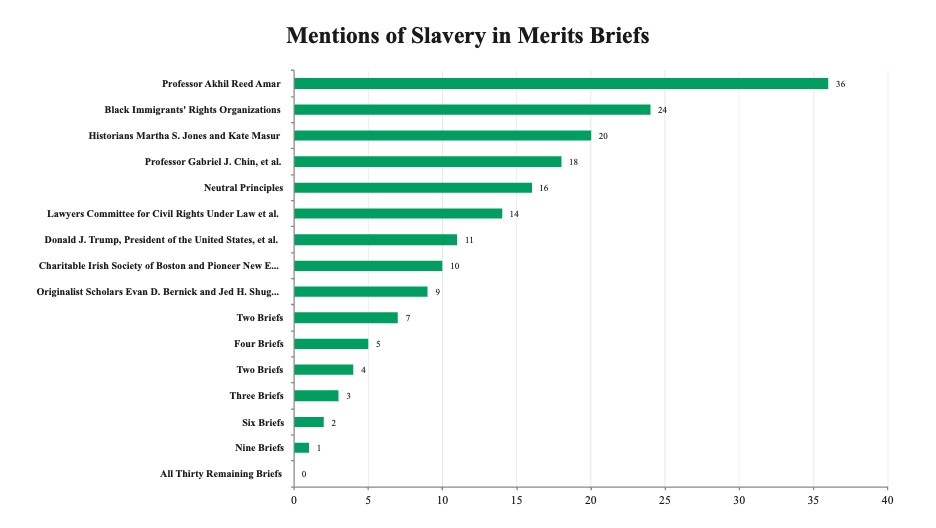
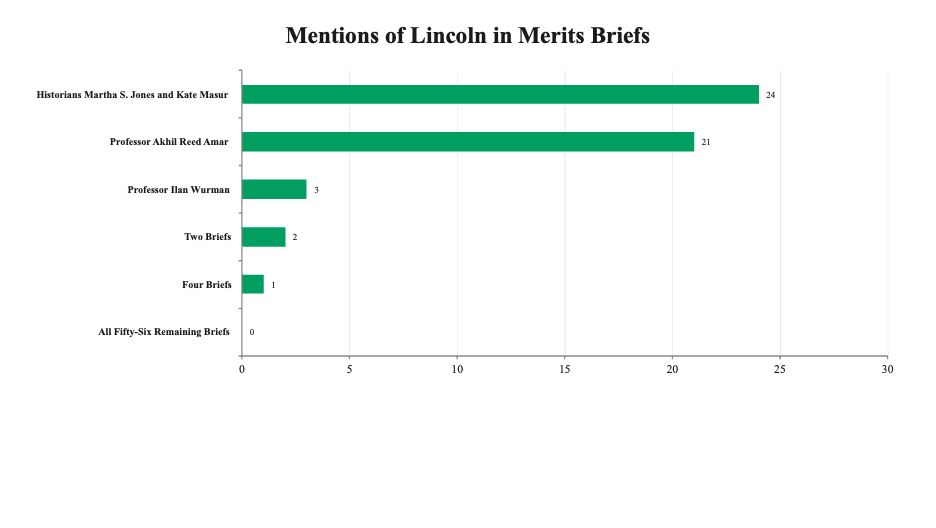
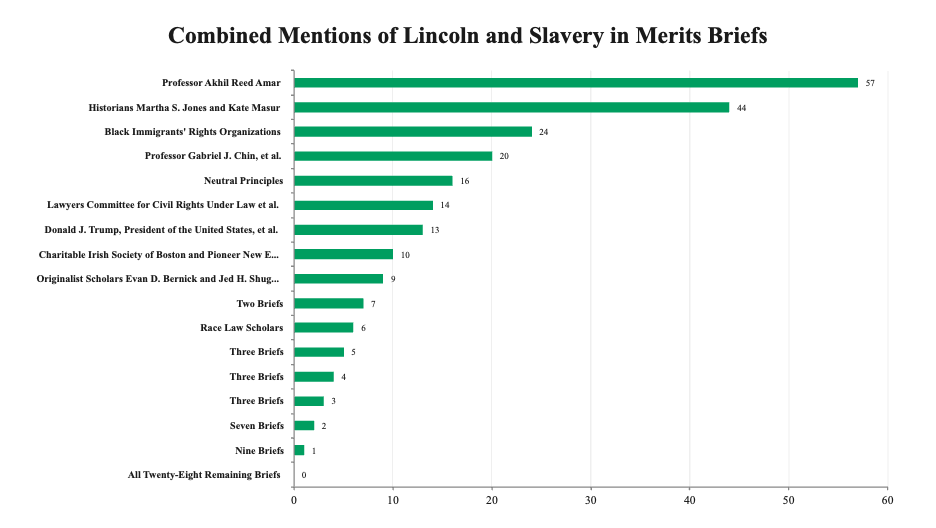
Merits Briefs – Full Data

These graphics track usage of “originalism,” “slavery,” and “Lincoln” in the 65 merits briefs submitted thus far in Trump v. Barbara. Uses in the Table of Authorities are excluded to avoid double-counting, and cognates include “originalist,” “original meaning,” “original public meaning” and “original understanding,” as well as “slave,” “enslavement,” and “enslaved.”
The results are striking. Many briefs claim the mantle of originalism, but few actually do originalism in its best incarnation. Thirty of the 65 briefs never once mention the people the citizenship clause was most centrally about – slaves and their children. And 56 of the 65 briefs ignore the president whose administration first embraced birthright citizenship as a matter of executive policy – Abraham Lincoln.
Some of the briefs that trumpet originalism the loudest in support of the Trump administration’s position say the least about the 14th Amendment’s core historical themes. Former Attorney General Edwin Meese III, for example, mentions originalism 23 times in his brief yet mentions slavery only twice – and Lincoln not at all. Senator Ted Cruz’s brief purports to recover the original understanding of citizenship at the time the 14th Amendment was drafted – without a word about why the drafters revisited that understanding in the first place.
The divide between the two sides is itself revealing. Of the 20 petitioner-side briefs (that is, in support of the Trump administration), not a single one mentions Lincoln more than three times, and only two mention slavery more than five times. The pattern suggests that the side seeking to narrow birthright citizenship has avoided the historical materials most relevant to understanding the clause’s original meaning – an odd posture for self-described originalists.
The near-universal neglect of Lincoln deserves special emphasis. Lincoln’s Attorney General, Edward Bates, issued a landmark opinion in 1862 holding that free men born in the United States are citizens regardless of race – the first such ruling by any federal officer. Lincoln’s administration – led by Secretary of State William Seward and Treasury Secretary (and future Chief Justice) Salmon Chase – repeatedly acted on this principle in the years before the 14th Amendment was drafted. Yet only nine of 65 briefs mention Lincoln at all, and only two – Akhil’s and a brief submitted by historians Martha S. Jones and Kate Masur – discuss Lincoln in any depth.
Hmmm.
***
Today’s column is our third on Trump v. Barbara. For the first two, see here and here. We will be running many more Barbara columns in the run-up to oral argument on April 1. Stay tuned.
Posted in Brothers in Law, Featured, Recurring Columns
Cases: Trump v. Barbara (Birthright Citizenship)