Court rejects ICE contractor’s right to immediate appeal

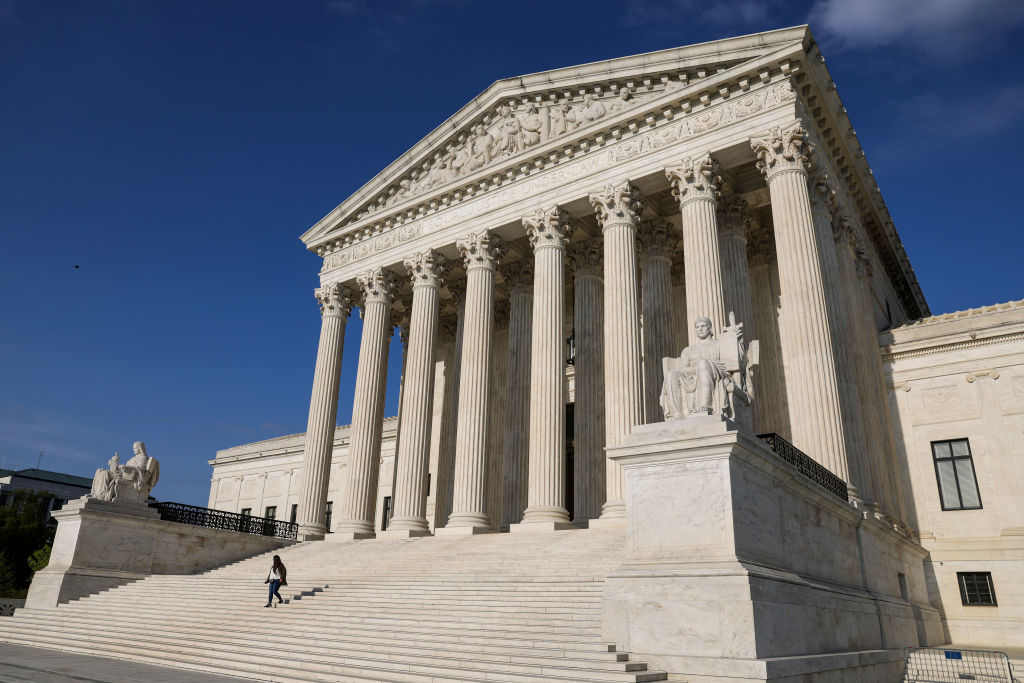
The opinion yesterday in The GEO Group v. Menocal rejects the efforts of a contractor for ICE to get an immediate appeal from a district court judgment. The case involves claims by ICE detainees challenging the conditions of their confinement by a contractor operating an ICE detention facility – specifically, the detainees contended that the contractor’s operation of the facility involved forced, unpaid labor, violating various federal and state laws.
The contractor, GEO Group, asked the trial court to dismiss the suit out of hand, arguing that it was simply following ICE’s instructions. When the district court refused, the contractor appealed. It lost again in the appellate court, as that court concluded that this is not the kind of question that justifies an immediate appeal – the contractor, so the court of appeals held, had to wait until after a trial in the district court to bring the case to the appellate court.
Justice Elena Kagan’s opinion reaches the same result. She starts from Yearsley v W.A. Ross Construction, the case in which the Supreme Court created the defense on which the contractor relies. As she states in the opinion’s introduction, “Yearsley provides a defense to liability, not an immunity to suit.” For that reason, “an order denying its protection can be effectively reviewed [only] after a final judgment” and “[s]o appellate review of such an order, as of most pretrial rulings, must await completion of the district court’s proceedings.”
Kagan emphasizes that “[f]inality [of a decision] as a condition of review is an historic characteristic of federal appellate procedure,” dating to the First Judiciary Act of 1789. Under the current version of that statute, she explains, the appellate courts have jurisdiction only over “final decisions” of the district court, which happen when it “resolves the entire case” and “leaves nothing for the court to do but execute the judgment.” The point of the rule, in her words, is that “by preventing piecemeal appeals,” finality “promotes the efficient administration of justice and preserves the proper balance between trial and appellate courts.”
To be sure, Kagan acknowledges that a “‘small class’ of decisions” are exempt from the finality rule under what is known as the “collateral-order doctrine,” which she describes as “narrow” and “stringent.” Among other things, the doctrine is available only for rulings that are “effectively unreviewable on appeal from a final judgment” – such as “a right ‘that would be irretrievably lost absent an immediate appeal.’” She then goes on to say that appealability of a refusal to dismiss an action before trial typically will “turn on whether the defendant has asserted a defense to liability or instead an immunity from suit.”
The heart of her opinion is Kagan’s explication of the “fundamentally different kind of argument” that you get from a “party asserting a merits defense in a lawsuit” as compared to “a party asserting an immunity.” The party asserting a defense “advances some reason why his conduct was not unlawful,” arguing that for that reason “he should not be found liable: Because he obeyed the law, he should not, for example, have to pay damages.”
An immunity defense looks much different, according to Kagan, because “a party asserting an immunity ‘makes no challenge’ to ‘the merits of the charge against him.’” That person “need never say he followed the law, because his claim of immunity does not turn on his conduct’s legality.” The “classic example” she offers “is sovereign immunity: It shields the Government from suit (absent a waiver) regardless whether the Government violated the law.”
Next, Kagan reasons, “[t]hat difference between a merits defense and an immunity entails another: The latter, but not the former, is in its ‘essence’ an ‘entitlement not to stand trial.’” Thus, immunity “ensures that the defendant need not ‘answer for his conduct’ in court at all.” In contrast, she says a defense “offers something different, and of lesser value,” a “judgment of non-liability. But it does not allow the defendant to escape the varied rigors and costs of legal proceedings.”
For that reason, Kagan concludes, only an immunity can be “effectively unreviewable on appeal from a final judgment.” The immunity, unlike a defense “is irretrievably lost once trial occurs, even supposing the defendant were to prevail.” By contrast, “the right to a finding of non-liability … can be effectively vindicated after a trial has occurred, through the reversal of an adverse final judgment.”
Against that background, it is easy for Kagan to justify denying an appeal to the contractor in the present case. Reviewing the Yearsley opinion, she shows it is replete with references to liability – conclusions that there is “no liability on the part of the contractor” and “no ground for holding [the contractor] liable.” That reasoning, she comments, “describes a defense, not an immunity,” which means that the contractor by “invoking Yearsley” here is “making the argument of a merits defense—that it is not liable because it complied with the law.” She emphasizes that Yearsley “never refers to an ‘immunity,’ or otherwise suggests that the defendant receives a pass from legal proceedings; it asks only whether the contractor may be found ‘liable.’”
Although that reasoning seems more than sufficient to justify the decision, Kagan goes on to explore a more basic weakness of the contractor’s view – the notion that a private contractor can accede to immunity solely because of a contract with the government. Kagan recounts numerous Supreme Court decisions ranging throughout the 20th century to support the general idea that “sovereign immunity belongs alone to the Government” and to “deny that government agents can assert [some] ‘derived’ form of sovereign immunity.” To accept the contractor’s argument that the contract in this case sheltered the contractor under the government’s sovereign immunity is a step that seems palatable to none of the justices.
The only justices who did not join Kagan’s opinion were Clarence Thomas and Samuel Alito. They did not, though, disagree with her conclusion that the trial should proceed against the ICE contractors. If anything, their views on appealability are even more restrictive than the majority’s. Thomas, for example, calls for the court to more or less completely abandon the collateral-order doctrine. And Alito asks for a more direct analysis of whether the basis of the claimed defense raises a sufficiently important public policy question to justify an immediate appeal. Here, he concludes, Yearsley is not sufficiently weighty to justify that result.
The majority decision was heavily foreshadowed at the argument when counsel for the contractor faced withering and all-but unceasing criticism of its argument for immunity. I don’t have the sense that this decision will change anything markedly in what people would have understood about the availability of interlocutory appeals. My guess, though, is that it will find relatively frequent citation by the lower courts for Kagan’s thoughtful delineation of the differences between immunities and defenses.
Aside from the court’s answer to the question before it is the practical import of the decision, which both paves the way for litigation in the district court about this particular ICE facility and offers a Supreme-Court-validated roadmap for similar litigation against other such facilities.
Posted in Court News, Merits Cases
Cases: The GEO Group, Inc. v. Menocal