California urges court to permit it to use congressional map enacted to counter Republican gains in Texas

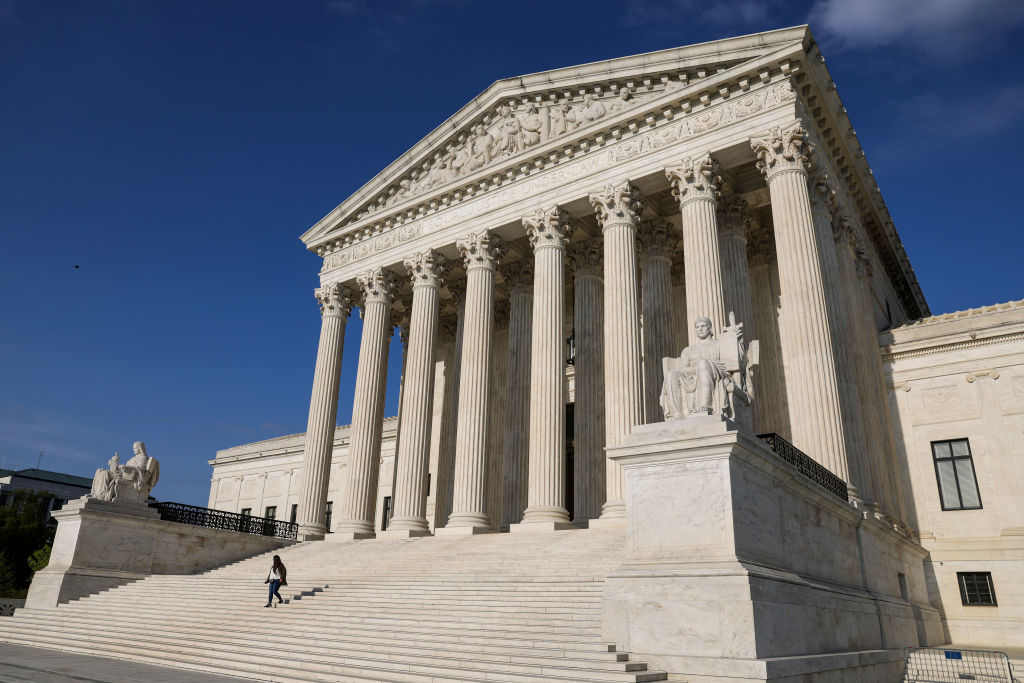
Lawyers for the state of California on Thursday urged the Supreme Court to leave in place a new congressional map intended to give Democrats five additional seats in the U.S. House of Representatives. Christopher Hu, the deputy solicitor general of California, called the desire by Republicans to retain a majority in the House a “natural political objective.” But it is “deeply unnatural,” the state contended, for a group of California Republicans challenging the map to ask the justices “to step into the political fray, granting one political party a sizeable advantage by enjoining California’s partisan gerrymander after having allowed” Texas to implement a map intended to allow Republicans to pick up five additional seats in that state.
The filing was the most recent chapter in the battle by both political parties to try to gain an advantage in the House – where Republicans currently have a majority by only a slim margin – through redistricting. As a general rule, states only redraw their maps every 10 years, in response to the decennial census. But in August, under pressure from the Department of Justice, Texas adopted a new map that it hoped would give Republicans five more seats in the House.
In November, a three-judge district court – which Congress has charged with hearing congressional redistricting challenges – ruled that there was “[s]ubstantial evidence” that Texas had relied too heavily on race in drawing the map, and it prohibited the state from using the new map in the 2026 elections.
Texas went to the Supreme Court, which on Dec. 4 granted the state’s request to put the lower court’s ruling on hold. The court’s three Democratic appointees dissented from that decision.
In August, the California Legislature adopted the Election Rigging Response Act to create a congressional map with five new Democratic seats. A 2010 amendment to the state’s constitution gave an independent commission, rather than the Legislature, the power to redistrict. The act thus proposed a new ballot initiative, known as Proposition 50, that would amend the state constitution to allow the use of the new map from 2026 through 2030. On Nov. 4, 2025, voters in California approved the measure in a special election, with 64% of the roughly 11 million voters casting ballots in favor of the temporary redistricting.
A group of California Republicans went to court three days later, seeking to block the use of the map. Like the challengers in the Texas case, they contended that the map violated the Constitution by relying on race as the primary factor in drawing 16 congressional districts, impermissibly favoring Latinos there.
A divided three-judge district court in Los Angeles declined to do so. The majority opinion, written by U.S. District Judge Josephine Staton, concluded “that the evidence of any racial motivation driving redistricting is exceptionally weak, while the evidence of partisan motivations is overwhelming.” The majority also rejected the challengers’ contention that “even if the voters intended to adopt the Proposition 50 Map as a partisan counterweight to Texas’s redistricting, their intent does not matter, as they were simply dupes of a racially-motivated legislature.” Instead, the majority determined that “the voters’ intent in adopting the Proposition 50 Map … was exactly as one would think: it was partisan.”
The challengers came to the Supreme Court on Jan. 20, asking the justices to intervene. They argued that “[f]rom the outset of California’s redistricting efforts, the aim of offsetting a perceived racial gerrymander in Texas was explicit.” They also contended that the majority of the three-judge district court should have given more weight to the testimony by the private consultant who drew the California map – who “boasted publicly and on social media,” they said, that the new map “would maintain, if not expand, Latino voting power in California.” They further told the justices that they were merely seeking a “narrow injunction” that would preserve the status quo by requiring California to use the congressional map in place for the last two federal election cycles. Finally, they asked the court to act by Feb. 9, when the window opens in California for congressional candidates to file paperwork declaring their candidacies.
Two days later, the Trump administration (which had also sought to block the new map in the district court) filed a brief supporting the challengers’ request. U.S. Solicitor General D. John Sauer conceded that “California’s motivation in adopting the … map as a whole was undoubtedly to counteract Texas’s political gerrymander. But that overarching political goal,” he argued, “is not a license for district-level racial gerrymandering.”
In its brief on Thursday, the state contended that the challengers “have all but abandoned any theory that Proposition 50 as a whole was adopted to benefit Latino voters.” Indeed, it said, the new map has the same number of majority-Latino districts – 16 – as the old one. “It would be passing strange for California to undertake a mid-decade effort with the predominant purpose of benefitting Latino voters and then enact a new map that contains an identical number of Latino-majority districts,” the state wrote. And even to the extent that the challengers now focus on alleged racial gerrymandering in just one district, the state continued, there too “the Latino voting-age population decreased after Proposition 50’s enactment.”
The state further argued that the challengers “are asking the Court to treat California’s map differently from how it treated Texas’s map, thereby allowing a Republican-led State to engage in partisan gerrymandering while forbidding a Democratic-led State from responding in kind.” In the Texas case, the state suggested, “there was at least some arguable evidence that race played a role in redistricting.” But here, it countered, “there is nothing remotely close to direct or circumstantial evidence that race was the predominant motivation for any of Proposition 50’s districts.”
The state pushed back against the challengers’ suggestion that the district court relied only on the voters’ intent in holding that there was no racial motive behind the new map. That court also considered statements by the private consultant and state legislators, but it still did not find enough evidence of racial motive, the state wrote.
The state cautioned the court against intervening, telling the justices that putting the lower court’s decision on hold “would nullify the choice of over 64% of California voters and thrust the Court into a hotly contested, ongoing partisan dispute among multiple States, the current federal administration, and our Nation’s two major political parties”
And in any event, the state concluded, it is too late for the court to step in now. California, it emphasized, is now less than four months away from its primary election. Candidates have begun “fundraising in earnest and introducing themselves and their platforms to voters—all on the assumption that they will be running in the new districts. Forcing California to abandon its new map would wreak havoc on these campaigns,” the state wrote.
Both the Democratic Congressional Campaign Committee and the League of United Latin American Citizens, which joined the case below to defend the map, also filed briefs urging the court to deny the challengers’ request and keep the new map in place.
Posted in Court News, Emergency appeals and applications
Cases: Tangipa v. Newsom