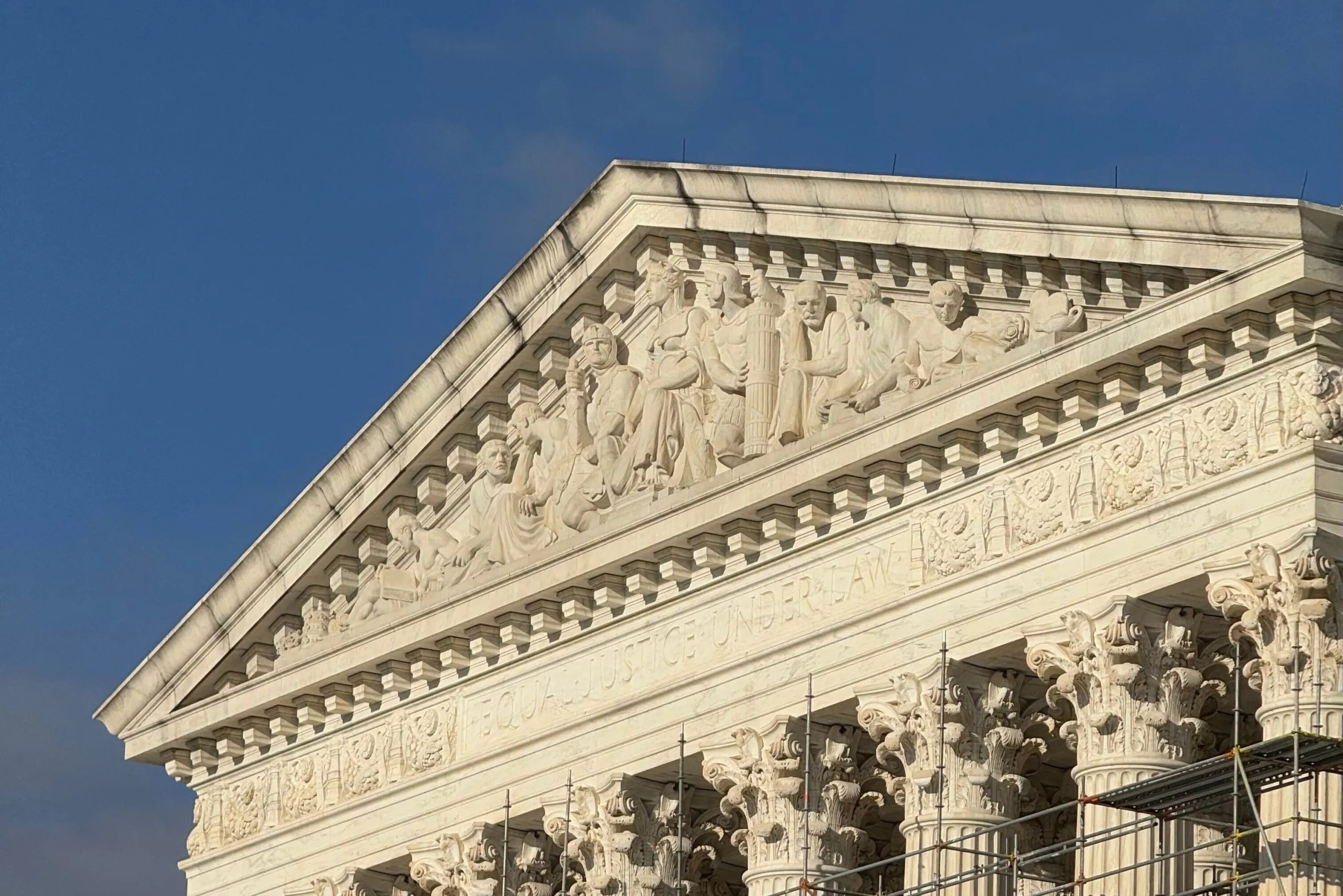


If you live in the Washington, D.C. area or plan on visiting for cherry blossom season, we’d recommend stopping by the Supreme Court to see its latest exhibitions.
Exhibitions are one of the four core programs put on by the Curator’s Office. This also includes collections (such as caring for historic objects), court photography, and visitor programs. Exhibitions began with the very first curator, Cathy Skefos, who “started the Curator’s Office pretty much from scratch” in 1973. Chief Justice Warren Burger summed up the concept in this way: “[The Court’s exhibit program] communicates to all Americans a sense of the story of the Supreme Court as a living institution, and in that process to add warmth and humanity to the building itself.”
Current exhibitions include: Harlan Fiske Stone: A Man for All Seats, From Petition to Opinion: How the Supreme Court Works, Integration Must Proceed Forthwith, The Triumph of Justice: Adolph Weinman’s Courtroom Frieze, and In Re Lady Lawyers: The Rise of Women Attorneys and the Supreme Court. The Stone and Lady Lawyers exhibitions are viewable online, while the others (besides the images shown on the exhibition website) can only be seen at the court itself.
The Harlan Fiske Stone exhibit, which commemorates the court’s 12th chief justice, lands on “the 100th Anniversary of Stone joining the Court,” and looks “back at Stone’s life and service.” Fun fact: Stone was the first and, to date, only justice to sit in every seat on the bench, going from the most junior justice to chief throughout his tenure on the court.
As for the other exhibitions:
The From Petition to Opinion exhibit allows viewers to “[f]ollow the process of how a case comes before the Supreme Court, the procedures the Justices use to complete their work, and some of the constitutional questions the Court has faced over time.” (While admittedly nerdy, it’s also fascinating to see the old petitions with their respective filing colors.)
Integration Must Proceed Forthwith involves the legal story behind the post-Brown 1957 integration of Central High School in Little Rock, Arkansas. The temporary exhibit has the judge’s bench in which Judge Ronald Davies ordered the high school’s desegregation – and in doing so changed American history.
The Triumph of Justice: Adolph Weinman’s Courtroom Frieze exhibit explores how Weinman developed and designed the four sculptural panels inside the courtroom (which feature “historical lawgivers and allegories of law and justice”).
And to learn about the women who “carved a path for future female advocates, judges, and Supreme Court Justices,” you can visit the exhibit In Re Lady Lawyers: The Rise of Women Attorneys and the Supreme Court. “Notable objects include a judicial robe and jabot worn by Justice Sandra Day O’Connor, historic photographs, as well as memorabilia and personal effects from Justices Sandra Day O’Connor, Ruth Bader Ginsburg, Sonia Sotomayor, Elena Kagan, Amy Coney Barrett, and Ketanji Brown Jackson.”
Is much of this for Supreme Court obsessives? Sure. But if you’re reading this newsletter (and thanks for doing so!) you might just qualify as such.