Court turns down several cases, including on filing fees for indigent prisoners and ability of felons to possess guns

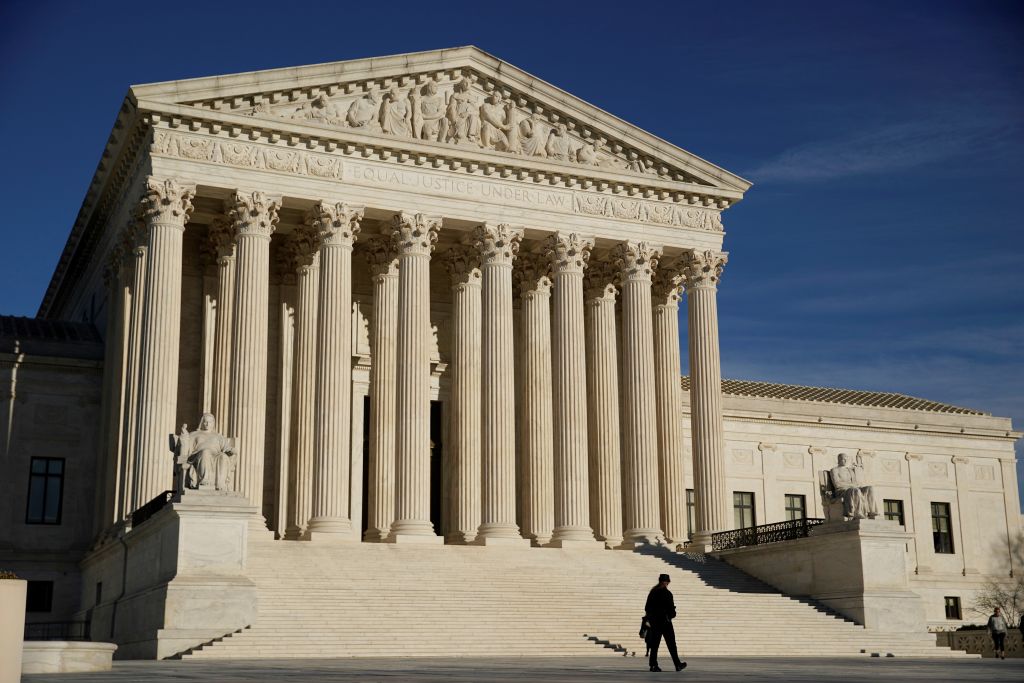
Over the objections of the court’s three Democratic appointees, the Supreme Court on Monday morning declined to hear a case involving the payment of filing fees by indigent prisoners. The announcement was part of a list of orders released on Monday from the justices’ private conference on Friday, Feb. 27. The justices did not add any new cases to their docket for the 2026-27 term.
In Johnson v. High Desert State Prison, the justices turned down a petition for review asking them to decide whether indigent prisoners who file joint lawsuits can share the amount of the filing fee, or whether each prisoner must instead pay the full fee – even if that is more than other litigants in a similar scenario would have to pay.
The issue arose from a federal civil rights lawsuit brought by three men who, while incarcerated at the High Desert State Prison in Susanville, California, were left standing in “dirty, urine-covered 2.5’x2.5’ holding cages with their arms handcuffed behind their backs.” They filed a motion for permission to proceed as indigent, which under the Prison Litigation Reform Act would allow them to pay the $350 filing fee in installments. The PLRA also provides that “[i]n no event shall the filing fee collected exceed the amount of fees permitted by statute for the commencement of a civil action.”
The lower courts ruled that the PLRA required each of the plaintiffs in the case to pay his own $350 filing fee. Two of the men –Topaz Johnson and Ian Henderson – came to the Supreme Court in October, asking the justices to weigh in. (The third plaintiff continued to litigate his case separately.) After considering the petition for review at five consecutive conferences, the justices rejected that request on Monday. Justice Elena Kagan indicated, without more explanation, that she would have granted review.
Calling the ruling by the U.S. Court of Appeals for the 9th Circuit “likely incorrect,” Justice Sonia Sotomayor, joined by Justice Ketanji Brown Jackson, dissented from the denial of review. She stressed that in normal circumstances, the default rule is that “when multiple prisoners file one lawsuit, the prisoners together must pay $350.” When it enacted the PLRA, Sotomayor wrote, Congress did not deviate from that default rule. “In fact,” she suggested, the law “says the exact opposite: ‘In no event shall the filing fee collected exceed the amount of fees permitted by statute for the commencement of a civil action.’” The lower court’s rule, she said, “also produces unfair results” because it requires poor prisoners to pay more.
The other factors that the Supreme Court often consider when deciding whether to grant review also militate in favor of the plaintiffs, Sotomayor wrote. The courts of appeals are squarely divided on this question, which is “an important, recurring” one. “The ability to split fees matters,” she said, “because $350 is a significant amount of money, particularly to indigent prisoners. … Paying the full $350 fee … requires prisoners to work for hundreds, if not thousands, of hours.”
In other orders, the Supreme Court turned down requests to weigh in on the constitutionality of a federal law that bans the possession of guns by people who have been convicted of felonies, after repeatedly considering petitions for review from a woman convicted of check fraud 17 years ago for passing a fake check for $498.12 at a grocery store and a man who had a gun with him when he was attempting to sell drugs. The court did not, however, rule on petitions seeking review of bans on assault rifles and large-capacity magazines.
The justices also turned down, after considering for the first time at last week’s conference, petitions for review involving a challenge to baseball’s antitrust exemption, a First Amendment challenge to Alabama’s ban on begging, and a dispute over whether Michigan failed to make sufficient efforts to remove dead voters from the voting rolls.
The justices will meet again for another private conference on Friday, March 6. Orders from that conference are expected on Monday, March 9 at 9:30 a.m. EST.
Posted in Court News, Featured
Cases: Vincent v. Bondi, Taylor v. Singleton, Cangrejeros de Santurce v. Liga de Béisbol, Public Interest Legal Foundation v. Benson, Johnson v. High Desert State Prison, Thompson v. United States