SCOTUStoday for Monday, January 26
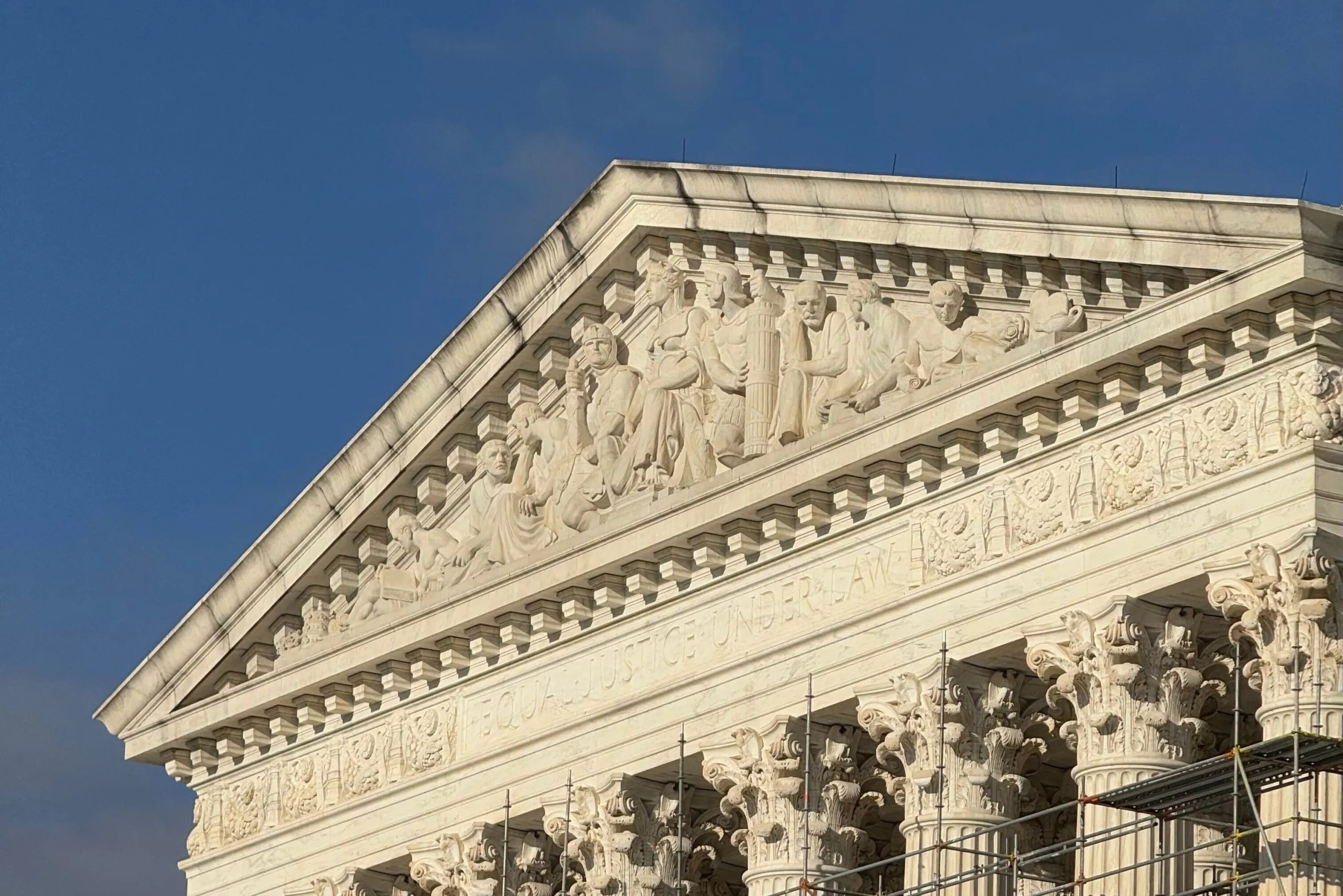
Former Supreme Court Justice Joseph McKenna was sworn in on this day in 1898. McKenna’s Oyez biography notes that, although he studied law before beginning a political career, he was thought by some to be too weak a jurist to deserve a spot on the court. “In fact, two federal trial judges took the unusual step of publicly expressing their view that McKenna was unfit for the office based on his performance as an appellate judge.” After his confirmation to the Supreme Court, he went to Columbia Law School for additional legal training, but (again, according to Oyez) “there is doubt that the last-minute tutoring had any measurable improvement on his ability as a justice.”
Plus, a reminder: Sarah Isgur is offering to send a signed bookplate to anyone who preorders her forthcoming book, Last Branch Standing, before Monday, Feb. 9. The book is a fun, myth-busting walk through the Supreme Court, showing how it is somehow both the Founding Fathers’ “third wheel” – and the only branch of government they would be likely to recognize today. To claim your bookplate, visit prh.com/lastbranchbookplate.
SCOTUS Quick Hits
- On Friday, the justices took part in a private conference to discuss cases and vote on petitions for review. The court is expected to release an order list from that conference this morning at 9:30 a.m. EST.
- The court has not yet indicated when it will next release opinions. If the court follows its typical pattern, the earliest the next opinion day may be is Friday, Feb. 20.
Morning Reads
- US judge blocks Trump administration’s push to end legal status of 8,400 migrants (Nate Raymond, Reuters)(Paywall) — On Saturday, U.S. District Judge Indira Talwani blocked the Trump administration “from ending the humanitarian parole granted to thousands of people from Cuba, Haiti, Colombia, Ecuador, El Salvador, Guatemala and Honduras,” according to Reuters. Talwani described the policy change as “arbitrary and capricious,” noting that the Department of Homeland Security “had provided no support for its fraud concerns” regarding the humanitarian parole program “or considered whether individuals could feasibly return to their home countries, where many had sold homes or left jobs.” Saturday’s ruling addressed one aspect of a broader class action lawsuit “challenging the administration’s broader rollback of temporary parole granted to hundreds of thousands of migrants.” Talwani previously “blocked the administration from ending grants of parole to about 430,000 Cubans, Haitians, Nicaraguans and Venezuelans, but the Supreme Court lifted her order, which an appeals court later overturned.”
- TikTok Strikes Deal for New U.S. Entity, Ending Long Legal Saga (David McCabe and Emmett Lindner, The New York Times)(Paywall) — On Thursday, TikTok announced “that its Chinese owner, ByteDance, had struck a deal with a group of non-Chinese investors to create a new U.S. TikTok, concluding a six-year legal saga that saw the app banned by Congress,” according to The New York Times. “Since 2019, universities, several branches of the U.S. military, the vast majority of the House of Representatives and both President Trump and President Joseph R. Biden Jr. had tried to ban or block TikTok, with unanimous support from the Supreme Court.” Since returning to office last year, Trump delayed the TikTok ban several times “as he pushed the company to reach a deal for new ownership.”
- Supreme Court draws who’s who of spectators during high-stakes term (Zach Schonfeld, The Hill) — Last week, several federal officials were in the courtroom as the justices heard argument on President Donald Trump’s effort to fire Federal Reserve Governor Lisa Cook, including Cook herself, Fed Chair Jerome Powell, and former Fed Chair Ben Bernanke. They continued a trend of high-profile attendees that emerged earlier in the term, when Treasury Secretary Scott Bessent and other administration officials attended argument in the tariffs case, according to The Hill, for which “[e]ven Trump himself had floated attending.”
- New Jersey fishermen challenge monitoring rule again (Nathan Strout, Seafood Source, National Fisherman) — One of the cases that led the Supreme Court in 2024 to overturn the Chevron doctrine and curtail the power of federal agencies was brought by a group of commercial fishermen who disagreed with a federal rule requiring them to pay for the at-sea monitors who were observing their work. But because the justices “only ruled on the legal question of whether the Chevron deference should continue,” the fishermen’s case was sent “back to the U.S. District Court for the District of Rhode Island to rule on the actual NOAA [National Oceanic and Atmospheric Administration] Fisheries rule,” according to Seafood Source. On remand, that court again ruled against the fishermen, who are now appealing to the U.S. Court of Appeals for the 1st Circuit.
- Can ICE Enter a Home to Make an Arrest With Only an Administrative Warrant? (Orin S. Kerr, The Volokh Conspiracy, Reason) — In a post for Reason’s Volokh Conspiracy blog, Orin S. Kerr analyzed a leaked Immigration and Customs Enforcement memo stating that federal immigration officers can enter homes with warrants “signed by immigration officials and not regular judges.” Although “the memo does not include any legal analysis,” Kerr analyzed the legal arguments that ICE officials may have relied on to craft the memo, concluding that these arguments likely mischaracterized or overlooked relevant Supreme Court precedent.
A Closer Look: The Shifting Size of the Supreme Court
Although the Supreme Court has consisted of nine justices since 1869, that wasn’t always the case.
The Judiciary Act of 1789 set the initial number of justices at six: one chief justice and five associate justices. This aligned with the early federal judicial system, which consisted of three circuits, thus allowing two justices to preside over each in terms of “riding circuit.”
Things changed with the Judiciary Act of 1801 (often called the Midnight Judges Act based on the quick appointments that it allowed for), which was passed by the outgoing Federalist-controlled Congress. Among other measures, this act reduced the court’s size from six to five justices, effective after the next vacancy, while also creating 16 new lower court judgeships for President John Adams to fill. The move was widely seen as an attempt to limit incoming President Thomas Jefferson’s influence on the Supreme Court, and, consequently, the new Democratic-Republican Congress repealed the five-justice limit in 1802, restoring the court to its original six justices before any vacancy occurred and increasing the amount of circuits to six.
In 1807, Congress increased the court’s size to seven justices to accommodate a new circuit covering the West. This pattern continued in 1837, when the court was expanded to nine justices amid rapid population growth and the addition of new states, ensuring better representation across a larger circuit system.
In 1863 Congress actually added a tenth justice with the creation of yet another circuit, allowing President Abraham Lincoln to appoint a pro-Union justice during the Civil War.
In 1866, amid conflicts between Congress and President Andrew Johnson (who faced impeachment proceedings by a hostile Congress), the Judicial Circuits Act reduced the court to seven justices (as vacancies arose) to prevent Johnson from filling them. Finally, in 1869, under President Ulysses S. Grant, the Judiciary Act of 1869 set the court’s size at nine justices, where it has remained to this day.
Which does not mean the story ends there. In 1937, President Franklin D. Roosevelt famously attempted to alter the court’s size. Frustrated by the court’s pushback against New Deal legislation, the president proposed the Judicial Procedures Reform Bill, which would have allowed him to appoint up to six additional justices. The act ultimately failed in the face of public backlash (and what impact it had on the justices themselves remains hotly debated).
Although more recent efforts have been made to change the court’s size, none have gained traction – which has not stopped some creative proposals from emerging.
SCOTUS Quote
CHIEF JUSTICE ROBERTS: “I — I hate to keep raising the point, but did you challenge the assertion that they said it was a bachelor party in your brief in opposition …”
MR. GARRETT: “No, it was — it was — we agree that they all said it was a bachelor party.”
CHIEF JUSTICE ROBERTS: “I’m sorry, what is –”
JUSTICE GINSBURG: “I thought some said it was a birthday party.”
MR. GARRETT: “No, Your Honor. That — that evidence — I mean, that evidence came out at a trial, at the trial after summary judgment. Officer Campanale changed his story –”
JUSTICE KENNEDY: “So Peaches is the host at a bachelor party. Is that it?” (Laughter.)
MR. GARRETT: “Yes.”
— District of Columbia v. Wesby
On Site
From the SCOTUSblog Team
Trump administration urges Supreme Court to find California’s redistricting map unconstitutional
The Trump administration on Thursday urged the court to block the new congressional map adopted by California voters in November. U.S. Solicitor General D. John Sauer told the justices that the map, which the state says was intended to create five new Democratic seats in the U.S. House of Representatives in response to the creation of five new Republican seats in Texas, “is tainted by an unconstitutional racial gerrymander.”

Contributor Corner
Closing out the cases to be heard this term
In his latest Nuts and Bolts column, Stephen Wermiel explained why a case typically needs to be taken up by the court by the end of January to be argued within the current term.

The Ten Commandments return to federal court
In her first Ratio Decidendi column, Stephanie Barclay reflected on the ongoing legal battle over laws requiring public schools to display the Ten Commandments in classrooms, contending that “there are strong reasons to uphold these laws” based on the Supreme Court’s establishment clause precedent.

Posted in Featured, Newsletters