SCOTUStoday for Friday, January 23

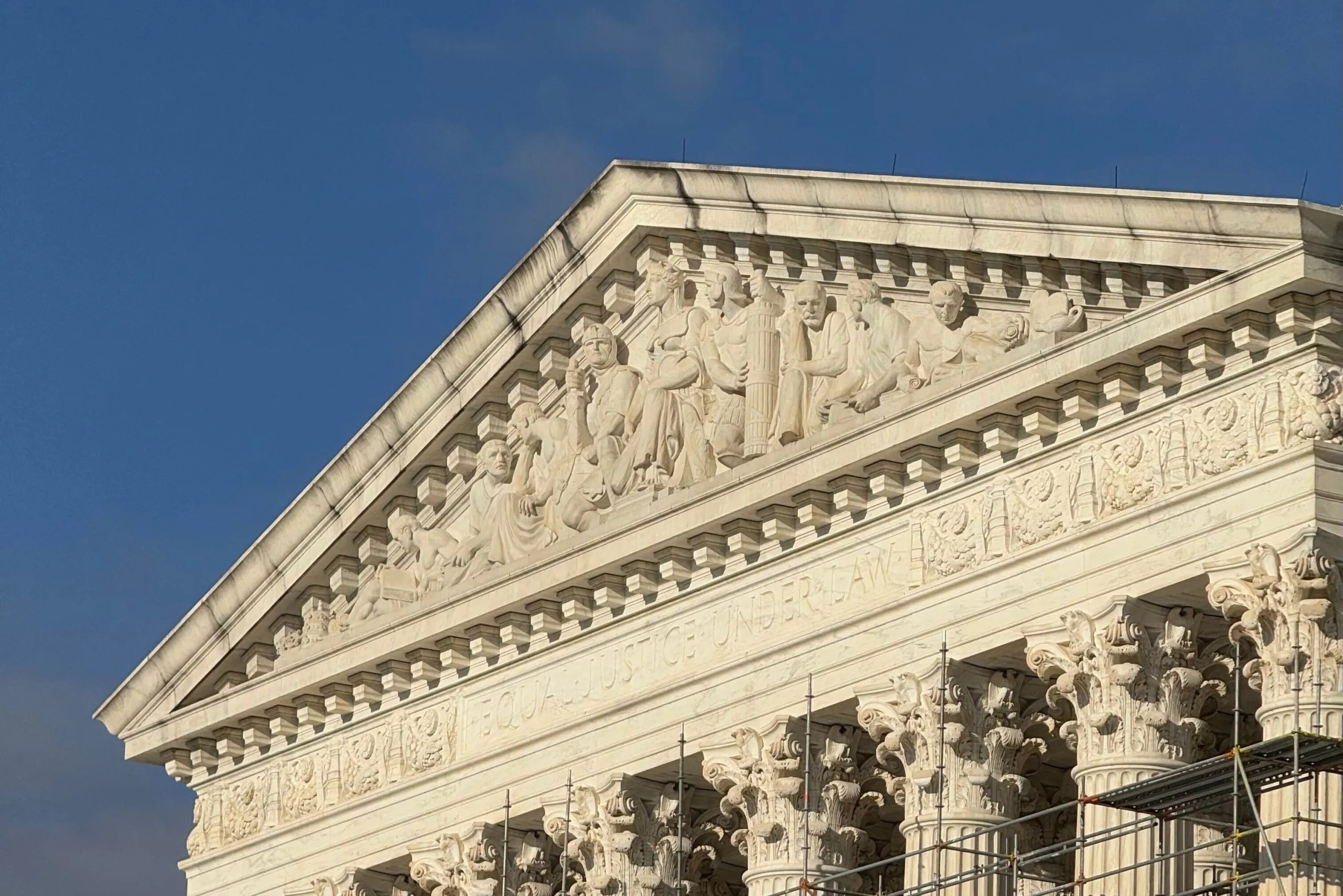
Former Supreme Court Justice Potter Stewart was born on this day in 1915. Although a distinguished jurist, he is perhaps best known for using the phrase “I know it when I see it” (see the fuller quote below) in describing how difficult it is to define “hard core pornography” for the purposes of policing the limits of the freedom of expression. He once joked that those words might end up on his tombstone. They did not.
Plus, Sarah Isgur is offering to send a signed bookplate to anyone who preorders her forthcoming book, Last Branch Standing, before Monday, Feb. 9. The book is a fun, myth-busting walk through the Supreme Court, showing how it is somehow both the Founding Fathers’ “third wheel” — and the only branch of government they would be likely to recognize today. To claim your bookplate, visit prh.com/lastbranchbookplate.
Week in Review
The court heard three arguments this week as it closed out the January sitting. Here are the links to SCOTUSblog’s coverage.
- Wolford v. Lopez: Case Preview and Argument Analysis
- M&K Employee Solutions, LLC v. Trustees of the IAM Pension Fund: Case Preview and Argument Analysis
- Trump v. Cook: Case Preview and Argument Analysis
And on Tuesday, the court released opinions in three argued cases: Berk v. Choy, Ellingburg v. United States, and Coney Island Auto Parts Unlimited, Inc. v. Burton.
- In Berk, the court held that a Delaware law requiring a plaintiff suing for medical malpractice to provide an affidavit from a medical professional attesting to the suit’s merit does not apply in federal court. Ronald Mann analyzed the opinion.
- In Ellingburg, the court held that restitution imposed under the Mandatory Victims Restitution Act of 1996 is criminal punishment for the purposes of the Constitution’s ex post facto clause. Ronald Mann analyzed the opinion.
- In Coney Island, the court held that the reasonable-time limit outlined in Federal Rule of Civil Procedure 60(c)(1) applies to a motion alleging that a judgment is void. Kelsey analyzed the opinion.
SCOTUS Quick Hits
- Today, the justices will take part in a private conference to discuss cases and vote on petitions for review. We may know as soon as this afternoon if the court has added any additional cases to the oral argument docket.
- The court is expected to release an order list on Monday at 9:30 a.m. EST.
- The court has not yet indicated when it will next release opinions. If the court follows its typical pattern, the earliest the next opinion day may be is Friday, Feb. 20.
Morning Reads
- What Does It Mean That SCOTUS Hasn’t Ruled on IEEPA Tariffs? Nothing, Experts Said (Layla A. Jones, Talking Points Memo) — So far this month, three opinion days have come and gone without the release of the Supreme Court’s highly anticipated ruling on tariffs. Talking Points Memo spoke with four constitutional lawyers about this state of affairs, asking if it is significant or just par for the course for the court. The scholars all adopted the latter view, contending that, in terms of the typical pace of the justices’ work, it actually hasn’t been that long since the November argument. “If this was a normal case, I’d say there’s nothing to see here,” said Michael C. Dorf, a professor at Cornell University. “So I suspect that they’re treating it as not presenting a kind of emergency.”
- Supreme Court Gets Last-Minute $30M Boost for Justices’ Security (Zach C. Cohen and Suzanne Monyak, Bloomberg Law) — Funding legislation released on Tuesday showed that the Supreme Court is getting “an extra $30 million for security … following a last-minute request from court officials,” according to Bloomberg Law. The new money “bumped up the judiciary’s appropriations for the fiscal year to $9.2 billion” and is expected to help “cover round-the-clock protection of the Supreme Court justices.” House Appropriations Chair Tom Cole confirmed that lawmakers had the justices’ safety in mind when they agreed to the last-minute budget adjustment. “We just want to make sure nothing happens to any of our justices,” he said.
- Immigration officers assert sweeping power to enter homes without a judge’s warrant, memo says (Rebecca Santana, Associated Press) — An internal Immigration and Customs Enforcement memo obtained by the Associated Press “authorizes ICE officers to use force to enter a residence based solely on a more narrow administrative warrant to arrest someone with a final order of removal,” instead of waiting for a warrant from a judge. “For years, immigrant advocates, legal aid groups and local governments” according to the AP, have advised people “not to open their doors to immigration agents unless they are shown a warrant signed by a judge” because they believed, based on Supreme Court precedent, that agents could not forcibly enter without such a warrant. The memo says that “the DHS Office of the General Counsel has recently determined that the U.S. Constitution, the Immigration and Nationality Act, and the immigration regulations do not prohibit relying on administrative warrants for this purpose.”
- Church says limits on bell tower are religious discrimination, sues town (Ben Brasch, The Washington Post)(Paywall) — A Ukrainian Catholic Church in a township near Pittsburgh is suing “local government leaders in federal court, claiming that religious discrimination is preventing the parish from properly honoring its dead,” according to The Washington Post. The dispute centers on the church’s effort to build a new chapel, retreat center, and bell tower, and its plan to use the bell to mark significant religious occasions. Collier Township leaders have pushed back against the proposal, and one official said “Please don’t tell me Jesus is going to pay for it” when asking how the church would fund the project. Sheldon Nahmod, a constitutional law expert, told The Washington Post that “the Supreme Court has looked unfavorably upon similar comments in the past” in its consideration of religious discrimination claims.
- The Full Taft (Josh Blackman, The Volokh Conspiracy, Reason) — In a post for Reason’s Volokh Conspiracy blog, Josh Blackman highlighted two memorable – and Supreme Court themed – phrases used by Paul Clement during Wednesday’s argument in Trump v. Cook. The first was “the full Taft,” which Clement repeatedly used to describe the process former President (and former Chief Justice) William Howard Taft used when seeking to remove federal officials from office. And the second was Clement’s reference to a guide to meeting procedure called Roberts Rules of Order. By saying “Roberts Rules,” Blackman noted, Clement appeared to be nodding to Chief Justice John Roberts.
A Closer Look: Stroble v. Oklahoma Tax Commission
In July 2020, the court issued a landmark ruling on American Indian rights, holding in McGirt v. Oklahoma that a substantial area of land in northeastern Oklahoma established as a Creek Nation reservation in the 19th century remains a reservation for the purposes of the Major Crimes Act, a federal statute giving the U.S. government sole jurisdiction over certain offenses committed by American Indians in “Indian country.” Now, the justices have been asked to revisit that decision by taking up a dispute over state income tax.
The petition for review in Stroble v. Oklahoma Tax Commission centers on Alicia Stroble, a Muscogee (Creek) Nation citizen who lives and works within the area that was at issue in McGirt. Stroble, who is represented by former U.S. Solicitor General Elizabeth Prelogar, contends that Oklahoma cannot tax her income, because McGirt made it clear that she lives in “Indian country” and because the Supreme Court has held “[i]n an unbroken line” of other cases that states cannot tax “Indians who live and work within their Tribes’ Indian country absent express authorization from Congress.”
In July 2025, the Oklahoma Supreme Court rejected this contention 6-3, explaining that “the United States Supreme Court has not extended its ruling in McGirt beyond the Major Crimes Act.” In her petition, Stroble described this conclusion as an “error,” asserting that “McGirt acknowledged that the” Supreme Court’s interpretation of “Indian country” “can matter in civil contexts as well as in criminal ones.”
In its reply brief, the Oklahoma Tax Commission noted that it “provid[es] a tax exemption for enrolled members of a federally recognized Indian tribe when they live and earn income from sources within ‘Indian country’ under the tribe’s jurisdiction,” but that its own definition of “Indian country” is different than the definition offered by the U.S. Supreme Court in McGirt. While Stroble works in “Indian country” under both the Supreme Court’s broad definition and Oklahoma’s narrower one, the commission contends that she “lives on unrestricted, non-trust, private fee land” that, while located “within the historical Creek territory,” does not qualify as “Indian country” for purposes of the tax law.
The definition of “Indian country” in McGirt, the commission asserted, does not apply across the board. Oklahoma remains free to use its own definition in “the taxation context,” and “[f]ederal law does not preempt Oklahoma’s authority to tax the income of a member of the Creek Nation who lives on unrestricted, non-trust, private fee land” where Congress has not said otherwise. Additionally, if the U.S. Supreme Court were to take up the case and conclude differently, the commission contended, it “would have a severely destabilizing effect” by, among other things, “depriv[ing] the State of much needed revenue to provide the myriad services that Oklahoma provides to all of its citizens, regardless of their tribal membership.”
Stroble characterizes the stakes of the case quite differently, contending that “[l]eft unreviewed,” the Oklahoma Supreme Court’s ruling “could have dramatic consequences. “Unless the Court intervenes,” she claimed, “Oklahoma will continue to levy tens of millions of dollars in income taxes on Indians working and living within their Tribes’ reservations—which, in turn, will limit Oklahoma-based Tribes’ ability to provide critical governmental services to Indians and non-Indians alike.” Several tribes filed friend-of-the-court briefs supporting Stroble’s position.
The petition in Stroble was first considered by the justices during the Jan. 9 conference. It was relisted for the Jan. 16 conference and will be considered again today.
SCOTUS Quote
“I have reached the conclusion … that, under the First and Fourteenth Amendments, criminal laws in this area are constitutionally limited to hard core pornography. I shall not today attempt further to define the kinds of material I understand to be embraced within that shorthand description, and perhaps I could never succeed in intelligibly doing so. But I know it when I see it, and the motion picture involved in this case is not that.”
— Justice Potter Stewart, Jacobellis v. Ohio
On Site
View from the Court
The full Fed battle
In his latest View from the Court column, Mark Walsh described the scene in the courtroom on Wednesday as the justices heard argument in Trump v. Cook. He noted that Lisa Cook, the Federal Reserve governor at the center of the case, was in attendance and appeared to be “hanging on every word without showing any reaction.”

Argument Analysis
Justices dubious about forcing actuaries to use out-of-date assumptions in assessing costs of leaving a multiemployer pension plan
Tuesday’s argument in M&K Employee Solutions v. Trustees of the IAM National Pension Fund showed a bench skeptical of forcing actuaries to use out-of-date assumptions when they work on pension plans, according to Ronald Mann, who is covering the case for SCOTUSblog.

Contributor Corner
Saints, statues, and church-state separation
In his latest Rights and Responsibilities column, Richard Garnett highlighted a dispute in Massachusetts over a mayor’s plan to place two large statues of the patron saints of police officers and firefighters outside a new public-safety building, reflecting on why the Supreme Court’s recent efforts to clarify establishment clause doctrine have not reduced conflicts like this one.

Only electoral reform, not the Supreme Court, can protect against an American Caesar
In his latest Justice, Democracy, and Law column, Edward Foley responded to a critique that’s been leveled at the court repeatedly over the past year: the idea that the Supreme Court has not done enough to constrain President Donald Trump. According to Foley, the real restraint on the presidency can only come from electoral reform, not the justices.

Posted in Featured, Newsletters