Court finds police properly entered man’s home despite absence of a warrant

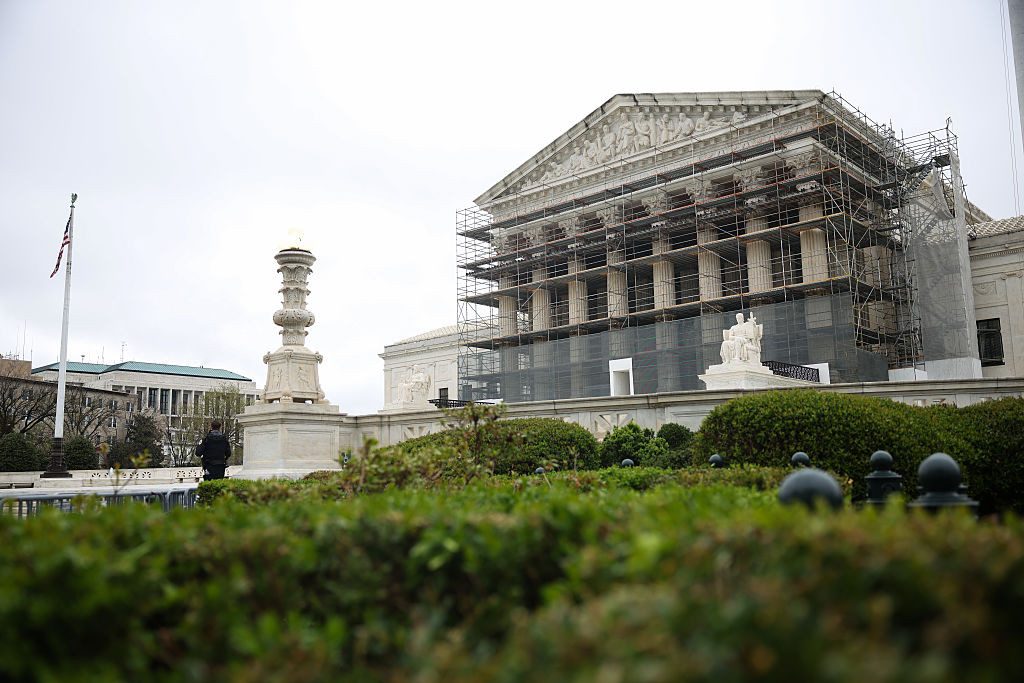
The Supreme Court on Wednesday upheld the conviction of a Montana man who was convicted of assaulting a police officer. In a unanimous decision written by Justice Elena Kagan, the court ruled in Case v. Montana that police officers in Anaconda, Montana, did not violate the Fourth Amendment when they entered William Case’s home without a warrant, rejecting Case’s contention that the police officers needed “probable cause” to go into his house. Under the Supreme Court’s earlier cases, Kagan wrote, it was enough that the police officers reasonably believed that Case – whose former girlfriend had called them to tell them that Case had threatened to commit suicide – needed emergency assistance.
The case began in 2021, when Case told his former girlfriend, identified in court papers as J.H., that he “was going to kill himself” and would also shoot any police officers who came to his house. J.H. called 9-1-1, which sent three police officers to the scene for a “welfare check on a suicidal male.”
Although Case did not answer when police officers knocked on the door or yelled into an open window, the police officers saw empty beer cans, an empty handgun holster, and what they believed to be a suicide note in the house. The police officers were also aware that Case had threatened to commit suicide before; on another occasion, police officers believed that Case was trying to goad them into shooting him.
Roughly 40 minutes after they arrived, the police officers entered the home. Case was hiding in a closet in an upstairs bedroom, where he was holding a black object that officers believed was a gun. One officer shot Case in the abdomen; another officer discovered a handgun in a laundry hamper near Case.
Case asked the trial court to exclude the evidence that law enforcement officials obtained after they entered his house, arguing that police officers should have had a warrant. But the state courts rejected that argument, prompting Case to come to the Supreme Court.
Case contended that if police officers enter a home without a warrant to provide emergency assistance, they must have probable cause “to believe someone is in urgent need of help.” On Wednesday the Supreme Court disagreed. In an 11-page opinion, Kagan acknowledged that the sanctity of the home is at the core of the Fourth Amendment, which protects the people from “unreasonable searches and seizures.” As a general rule, she explained, “[w]hen the intrusion is into that most private place, ‘reasonableness’ usually means having a warrant.” But there are exceptions to that general rule, she continued, including “the need to provide an occupant with emergency aid.”
Two decades ago, in Brigham City v. Stuart, the Supreme Court upheld an entry into a home without a warrant by police officers who were responding to a noise complaint. When they arrived, they saw – through a kitchen window – a fight between a teenager and several adults. The court ruled that the warrantless entry was “reasonable under the circumstances,” Kagan explained, because “[t]he officers had ‘an objectively reasonable basis for believing that an occupant [was] seriously injured or imminently threatened with such injury.’”
The justices, Kagan stressed, “decline[d] Case’s invitation to put a new probable-cause spin onto Brigham City.” The probable-cause standard, she reasoned, applies only in criminal settings, and “would fit awkwardly, if at all, in the non-criminal, non-investigatory setting at issue” in the current case. Having said that, Kagan cautioned that the “emergency aid” exception to the warrant requirement does not give police officers free rein “to search the premises beyond what is reasonably needed to deal with the emergency while maintaining the officers’ safety.”
When the Brigham City test is applied to this case, Kagan concluded, Case’s conviction can stand. When they entered Case’s home, she said, the police officers had “an ‘objectively reasonable basis for believing’ that their intervention was needed to prevent serious harm.” And although Case argued that “the police entry itself created a ‘likely danger’” because of “the prospect of suicide-by-cop,” Kagan continued, that contention “much oversimplifies a complex situation”: “The circumstances making their entry reasonable … were those suggesting that Case may have already shot himself or would do so absent intervention.”
Justice Sonia Sotomayor penned a concurring opinion in which she emphasized that “individuals with serious mental-health conditions are disproportionately likely to be injured and seven times more likely to be killed during police interactions compared to the general population.” Therefore, she said, “in some circumstances it may be more reasonable for officers to try different means of de-escalation before entering the home of a person experiencing a mental-health crisis.” But in this case, the facts, “[c]onsidered together,” “gave rise to an objectively reasonable basis for the officers to believe that Case was already injured and in need of emergency medical assistance, and was not necessarily waiting inside for the officers seeking to provoke an escalation leading to suicide-by-cop.”
Justice Neil Gorsuch also wrote a concurring opinion, in which he focused on the origins of the emergency-aid exception. He located the exception in judge-made law – which, he said, “has generally permitted a private citizen to enter another’s house and property in order to avert serious physical harm.” And under that law, he observed, law enforcement “officers generally enjoy the same legal privileges as private citizens.”
Posted in Court News, Merits Cases
Cases: Case v. Montana