When presidents attack the Supreme Court

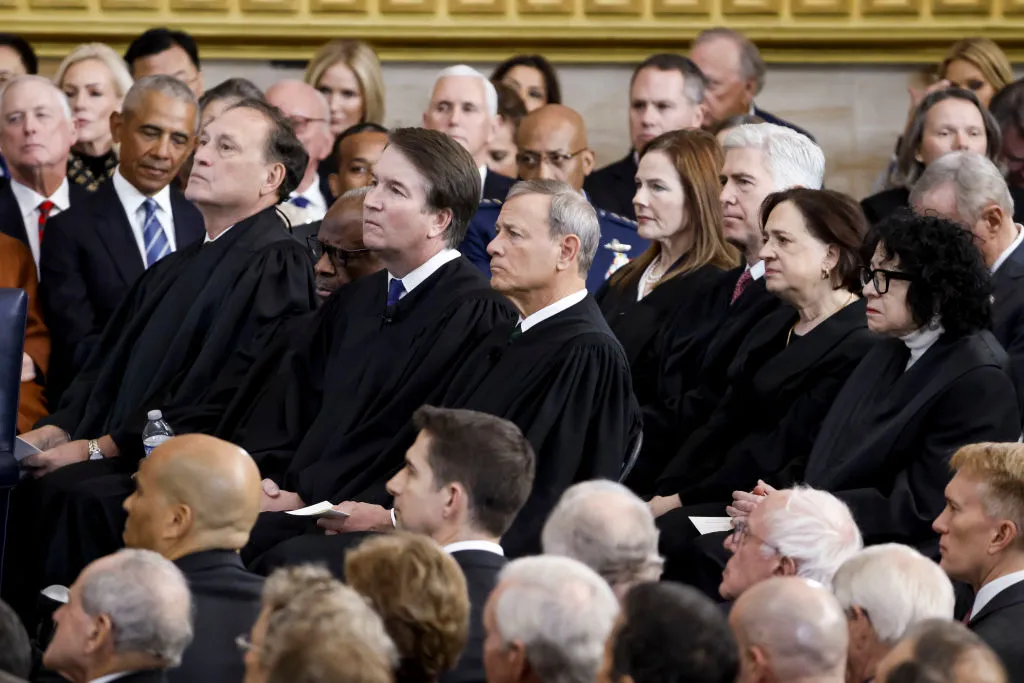
During a roundtable at the White House on Friday, March 6, President Donald Trump returned to what has become a familiar refrain in the weeks since the Supreme Court struck down his signature tariffs: He railed against the justices for interfering with his policy plans, accusing the court of harming the country. “I think the Supreme Court ought to be ashamed of itself for a lot of reasons, ok?,” the president said. “They have hurt this country so badly because they haven’t had the guts to do what’s right.”
With Friday’s comments, Trump furthered his reputation as a president comfortable complaining about the Supreme Court. But to be clear, he is not the first president – and he almost certainly won’t be the last – to do so. Several others have questioned the court’s authority to resolve a particular policy debate or expressed frustration with its rulings – and even criticized the justices themselves.
Here’s an overview of some of the most famous conflicts between presidents and the court.
President Thomas Jefferson
Presidential critiques of the court are not a modern phenomenon. Some early presidents lashed out at the justices, including President Thomas Jefferson, who repeatedly questioned the judicial branch’s authority and came into open conflict with Chief Justice John Marshall. (He also pushed for the removal of Justice Samuel Chase, who was impeached by the House in 1804 but then acquitted by the Senate.)
Jefferson complained not just about the effect of the court’s rulings, but about how they were written, arguing that Marshall was a master of “twistifications” and could make it sound like he supported your position even as he undermined it, as he did in Marbury v. Madison, when the court sided with the Jefferson administration in a dispute over President John Adam’s final judicial appointments yet, in doing so, established judicial review. (To Jefferson, had the Constitution wished to provide such an awesome power to the judiciary it would have said so explicitly.) Perhaps even more pointedly, Jefferson once wrote that Marshall holds “rancorous hatred” toward “the government of his country” but “enshround[s] himself” with “cunning and sophistry.”
In a letter written in 1820, more than a decade after he left the White House, Jefferson succinctly described his concerns with the judiciary, concerns that were likely solidified when the Marshall court limited states’ rights in 1819’s McCulloch v. Maryland, rejecting a vision of the balance between state and federal power that Jefferson’s had championed. While “[t]axes and short elections” keep the legislative branch in line, Jefferson wrote, judges and justices face no such limits. “The judiciary of the United States is the subtle corps of sappers and miners constantly working under ground to undermine the foundations of our confederated fabric,” he said.
Jefferson shared a similar thought in an earlier letter, writing that, “[t]he constitution … is a mere thing of wax in the hands of the judiciary, which they may twist, and shape into any form they please.”
President Andrew Jackson v. Chief Justice John Marshall
President Andrew Jackson, like Jefferson, is known for his “constitutional clashes” with Marshall. One of the sources of tension between them was Worcester v. Georgia, an 1832 case in which the court held that Native American tribes are sovereign nations and barred states from certain regulations of them. Jackson opposed the ruling because he supported “expanding American territory into Native American lands” and did not want to antagonize the state of Georgia as other southern states threatened secession. He has been said to have issued something of a dare to Marshall after it was handed down: “John Marshall has made his decision. Now let him enforce it!”
But Jackson likely didn’t actually say this famous line, according to the National Constitution Center. Instead, he described the ruling as “still born” in a letter to a friend and noted that the court “cannot coerce Georgia to yield to its mandate.”
Still, the pithier quote captures Jackson’s initial response to the ruling. While the federal government did not openly defy the decision, it also did not proactively enforce it. It did not, for example, “threaten Georgia with federal forces” when the state passed a law “declaring that anyone who came to Georgia to enforce the Supreme Court ruling would be hanged,” according to The Atlantic. Later, Jackson helped defuse the conflict by convincing Georgia’s governor to free the missionaries whose arrest on tribal land had led to the Supreme Court case in the first place.
President Abraham Lincoln questions the court’s power
In March 1857, the Supreme Court released one of its most notorious rulings, holding in Dred Scott v. Sandford that Scott, an enslaved man who had spent time in free territory, was not free; that Black Americans, whether enslaved or free, were not citizens and could not sue in federal courts; and that the Missouri Compromise, which banned slavery in certain territories, was unconstitutional. Abraham Lincoln, who was not yet president when the ruling was released, condemned it during his debates with Stephen Douglas and later said that he would not enforce it while he was campaigning for the presidency in 1860.
After winning the election, Lincoln briefly addressed his frustration with the Supreme Court during his inaugural address. While Supreme Court decisions are “entitled to very high respect and consideration” by the government, it is natural to be frustrated by the justices’ power, he said. “[T]he candid citizen must confess that if the policy of the Government upon vital questions affecting the whole people is to be irrevocably fixed by decisions of the Supreme Court, the instant they are made … the people will have ceased to be their own rulers, having to that extent practically resigned their Government into the hands of that eminent tribunal.” He added that this view is not an “assault upon the court or the judges,” and that it “is a duty from which they may not shrink to decide cases properly brought before them, and it is no fault of theirs if others seek to turn their decisions to political purposes.”
Around three months later, tension between Lincoln and the court came to a head in Ex Parte Merryman, which Chief Justice Roger Taney addressed in his capacity as circuit justice for the federal circuit that included Maryland. Taney held that Lincoln did not have the authority to suspend the writ of habeas corpus during the Civil War, because this power was reserved to Congress by the Constitution.
Lincoln publicly confronted Taney about the decision during an address to Congress on July 4, 1861, implying that Taney had put the country at risk. “Are all the laws but one to go unexecuted, and the Government itself go to pieces lest that one be violated? Even in such a case, would not the official oath be broken if the Government should be overthrown when it was believed that disregarding the single law would tend to preserve it?,” Lincoln said.
Lincoln went on to receive approval from Congress in March 1863 to suspend the writ for the duration of the conflict when “the public safety may require it.”
President Franklin Delano Roosevelt’s ‘no man’s land’
President Franklin Delano Roosevelt is better known for his efforts to change the court – by, for example, threatening to add justices – than his comments about it. But he publicly criticized the court on several occasions during his 12 years in office.
For example, in May 1935, Roosevelt accused the court of relegating the country “to the horse-and-buggy definition of interstate commerce” after it cited the Constitution’s commerce clause to strike down poultry industry regulations. A year later, after another high-profile loss, the president told reporters that the justices were creating “a ‘no man’s land’ where neither states nor the federal government had the right to legislate.”
Roosevelt summarized his frustration with the court during an address to Congress in 1937. “The Judicial branch also is asked by the people to do its part in making democracy successful,” he said. “We do not ask the Courts to call non-existent powers into being, but we have a right to expect that conceded powers or those legitimately implied shall be made effective instruments for the common good.”
President Barack Obama’s bully pulpit
President Barack Obama’s most memorable clash with the Supreme Court is more often discussed in terms of how one justice responded, rather than what Obama said.
The scene was the State of the Union address in 2010, which took place about a week after a divided court struck down restrictions on political spending by corporations and unions in Citizens United v. Federal Election Commission. Obama referenced the decision near the end of his remarks, contending that it threatened American elections and calling on Congress to pass a bill to address its potential harms. “With all due deference to separation of powers, last week the Supreme Court reversed a century of law that I believe will open the floodgates for special interests – including foreign corporations – to spend without limit in our elections,” he said in part.
While Obama spoke, the cameras panned to the six Supreme Court justices who attended the address and caught Justice Samuel Alito mouthing something while shaking his head, as SCOTUSblog reported at the time. Many observers concluded that Alito was saying, “Not true.” That moment is thought to be one of the only times – if not the only time – a justice has openly expressed frustration during a State of the Union address. Alito has not attended one since.
Obama’s relationship with the Supreme Court returned to the spotlight in 2012, as the justices considered the constitutionality of the Affordable Care Act’s “individual mandate” provision. During an April 2, 2012, news conference, Obama reflected on the case, sharing why he believed the health care law would survive the legal challenge. “Ultimately, I am confident that the Supreme Court will not take what would be an unprecedented, extraordinary step of overturning a law that was passed by a strong majority of a democratically elected Congress,” he said. “And I’d just remind conservative commentators that, for years, what we have heard is, the biggest problem on the bench was judicial activism, or a lack of judicial restraint, that an unelected group of people would somehow overturn a duly constituted and passed law. … Well, this is a good example.”
Obama faced pushback for the remarks from both conservative politicians and legal scholars, who argued that Obama’s comments were inaccurate and that presidents must avoid appearing to pressure the justices.
President Donald Trump’s tariffs talk
As these quotes from the past make clear, it’s not unusual for a president to criticize the court. But many commentators contend that Trump has done so in an unprecedented manner based on the nature of his complaints and the number of comments that he’s made.
The rise of social media may help explain the latter development. During his first term and now during his second, Trump has regularly taken to sites like Twitter/X to air his grievances about the Supreme Court and individual justices. In the first week after the court released its tariffs decision, he posted on Truth Social about it at least five times, calling the ruling “deeply disappointing” and stating that justices in the majority “should be ashamed of themselves.”
As those quotes make clear, Trump’s comments about the court are typically more personal than those of his predecessors, as Trump has not hesitated to criticize individual justices. For example, when Trump was asked during a Feb. 20 press conference about two of his appointees – Justices Neil Gorsuch and Amy Coney Barrett – voting to strike down his tariffs, he said that the decision is “an embarrassment to their families.” During the same press conference, he insulted Chief Justice John Roberts without naming him, saying, “It’s almost like [the decision was] not written by smart people.”
Although the court has not responded to these comments – just as it has generally maintained its silence in the past – the justices have likely seen them. Barrett appeared to reference Trump’s press conference (as well as certain criticisms from the other side of the aisle) during a book event on Sunday, March 8. After being asked if she dreamed of being a justice when she was growing up, Barrett responded that she had recently been asked that by “[o]ne of the law clerks of another justice.” She jokingly explained that she had told the clerk, “Do you mean when I was a little girl did I dream that people would call me a religious zealot, an embarrassment?”
Posted in Court Analysis, Featured
Cases: Learning Resources, Inc. v. Trump (Tariffs)