SCOTUStoday for Tuesday, February 10
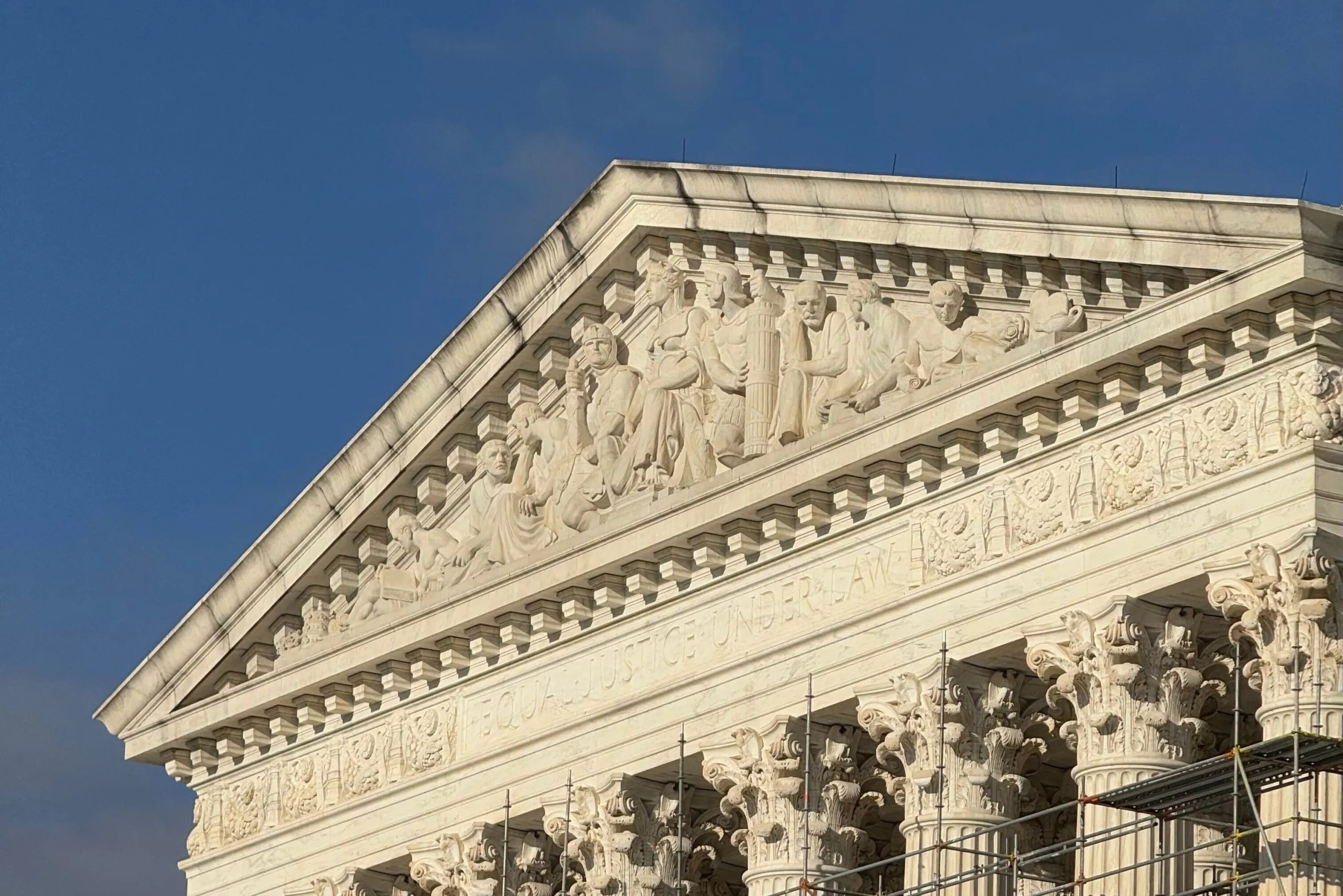
Ahead of Valentine’s Day, the Supreme Court is putting a spotlight on a “Match Made in Utah.” Its website currently features the marriage certificate for Justice George Sutherland and Rose Lee, which the couple received from Utah when it was still a territory, not a state. George and Rose “were married for 59 years and raised three children together.”
SCOTUS Quick Hits
- The court could rule at any time on an interim docket case on California’s policies for parental notification if a student chooses to use different names or pronouns.
- The court has not yet indicated when it will next release opinions. If the court follows its typical pattern, the earliest the next opinion day may be is Friday, Feb. 20, when the justices are next scheduled to take the bench.
- The court will next hear arguments on Monday, Feb. 23, the first day of its February sitting.
Morning Reads
- Small towns ask Supreme Court to freeze New Jersey rezoning for affordable housing (Kelsey Reichmann, Courthouse News Service) — A new application on the Supreme Court’s interim docket addresses an affordable housing dispute in New Jersey. Local officials in the state are challenging “a 2024 law signed by former Democratic Governor Phil Murphy creating a process for determining affordable housing quotas and reforming town zoning laws to expedite the construction of housing units,” according to Courthouse News Service. The “coalition of New Jersey towns and local elected leaders claim that the housing law violates the state constitution’s general welfare clause. They say small towns are being forced to take on more than their fair share of affordable housing units due to exemptions for fast-growing cities.” The court has asked the state “to respond to the application by Feb. 17.”
- US judiciary scraps climate chapter from scientific evidence manual (Nate Raymond, Reuters)(Paywall) — The federal judiciary has removed a controversial chapter on climate change “from the newest edition of its reference manual on scientific evidence,” after receiving complaints about it from Republican state attorneys general, according to Reuters. “The section at issue in the fourth edition of the FJC’s Reference Manual for Scientific Evidence was authored by Jessica Wentz and Radley Horton of Columbia Law School and was drafted to ‘help judges evaluate the admissibility and weight of expert testimony and documentary evidence involving climate science,'” but critics said it “places the judiciary firmly on one side of some of the most hotly disputed questions in current litigation: climate-related science and ‘attribution.'” “While the climate chapter was removed, a foreword to the manual authored by liberal U.S. Supreme Court Justice Elena Kagan appears to still nod to the now-excised section,” Reuters reported.
- Trump’s Midterm Redistricting Master Plan Is Falling Short (Aaron Zitner, Elizabeth Findell, and Olivia Beavers, The Wall Street Journal)(Paywall) — President Donald Trump’s plan to “create more GOP-leaning House districts” through mid-decade redistricting “is on track to yield far fewer gains than expected,” in part because of the Supreme Court, according to The Wall Street Journal. A Supreme Court decision from Feb. 4 will allow “California to hold its House elections this fall with a map that could flip as many as five seats from the GOP to the Democrats. Those expected Democratic gains would significantly trim the number of seats Republicans could pick up from newly redrawn maps in Texas, North Carolina, Missouri and Ohio. … Nonpartisan analysts say the California ruling will likely limit GOP gains from the redistricting push to three or four seats, or possibly none at all.”
- Proposed laws aim to test the Supreme Court’s ban on public school-sponsored prayer (Hannah Feuer, The Forward) — In the near future, the Supreme Court likely will be asked to revisit its 1962 ruling barring public schools from sponsoring prayers, as “lawmakers in several states are advancing measures” that aim to make “Christian prayer … a commonplace part of the school day,” according to The Forward. Some of the bills that have been passed or proposed in states such as Tennessee and Texas do not require students to participate in the prayers, but certain religious freedom scholars still see them as an effort to “undermine” Supreme Court precedent. “Teachers have a little bit more right to pray in public schools than they did last time. And then it just kind of slowly builds,” said Nik Nartowicz, lead policy counsel at Americans United for Separation of Church and State, to The Forward. “The very principles of religious freedom in public school are very clearly under attack.”
- Justice Department seeks to dismiss Steve Bannon’s Capitol riot contempt case (Devan Cole, CNN) — On Monday, the Trump administration “moved to drop a criminal case brought during the Biden administration against Steve Bannon, a former adviser to President Donald Trump who was convicted years ago” for refusing “to provide documents and testimony to the House select committee that investigated the Capitol attack” on Jan. 6, 2021, according to CNN. “Bannon already completed a four-month prison sentence in 2024, but he had continued to challenge his conviction, including by appealing to the Supreme Court, which hadn’t yet decided whether to review the case.” US Attorney Jeanine Pirro “asked US District Judge Carl Nichols, a Trump appointee, to dismiss the matter with prejudice, which, if granted, would mean prosecutors are barred from refiling the case.”
A Closer Look: The Cert Pool
To sift through the 7,000 to 8,000 certiorari (cert) petitions filed each year, seven of the nine current justices participate in what is known as the “cert pool,” which is, well, just what it sounds like. The seven justices – Chief Justice John Roberts and Justices Clarence Thomas, Sonia Sotomayor, Elena Kagan, Brett Kavanaugh, Amy Coney Barrett, and Ketanji Brown Jackson – “pool” their clerks together, and then these clerks are each tasked with reviewing a portion of the incoming petitions.
This means a cert petition is first reviewed by an individual law clerk from one of the seven chambers (the chief justice’s chambers assigns petitions to six of the other chambers). That clerk then prepares a memorandum about the case, which has a brief summary of each side’s arguments and includes an initial recommendation on whether the court should review the case.
There is an approved abbreviation system for drafting the “pool memos” – words like “in light of” become “i/l/o.” Previous Thomas clerk Kenton Skarin said “[t]his leads to sentences like ‘I recommend CVSG i/l/o federalism concerns the QP raises.’ (Which translates to, ‘I recommend call for the views of the Solicitor General in light of federalism concerns the Question Presented raises.’).”
The memo is then circulated across all seven chambers, where it is reviewed by (other) clerks and perhaps their justices.
Based on these reviews, the cases are added to one of two lists – the “dead list” (just what it sounds like – cert is denied without the justices having ever voted on or discussed the case), or the “discuss list,” a short(er) list of cases they plan to, well, discuss at their next conference. Any justice can place a case on the “discuss list.” At least four of the justices must vote to grant cert, and if this happens, a full review on the merits begins.
Established in 1972 after a suggestion by Justice Lewis Powell, Jr., the cert pool is a relatively recent development – before this, each of the justices’ chambers independently reviewed the cert petitions filed.
As you’ve probably figured out, Justices Samuel Alito and Neil Gorsuch are the two cert pool “opt outs.” Instead of dividing and conquering cert review, Alito and Gorsuch’s clerks review every incoming cert petition on their own and then make recommendations or give their views directly to each justice. Combined with the cert pool, this provides a second (and third) eye for all petitions. (Alito was initially part of the cert pool, but exited it in 2008. He did not explain his reasoning.)
The time- and labor-saving system has both supporters and critics. Those who support the process says it avoids redundant work and makes sure at least one clerk will look at each petition, while other individuals have qualified that the pool system puts ”enormous influence and power” in the hands of one clerk.
For this reason, Justice Ruth Bader Ginsburg once said, “[w]henever I think a case may be cert. worthy, I will do the homework required and will not rely solely on a pool memorandum.”
SCOTUS Quote
“Minimalism is an admirable judicial trait, but not when it comes at the cost of meaningless and disingenuous distinctions that hold the sure promise of engendering further meaningless and disingenuous distinctions in the future.”
— Justice Antonin Scalia in Hein v. Freedom from Religion Foundation
On Site
From the SCOTUSblog Team
The Second Amendment landscape
Although the 2025-26 oral argument docket includes two Second Amendment cases, the court’s eventual rulings are not expected to resolve several other gun rights disputes cropping up across the country, including battles over semiautomatic rifles, large-capacity magazines, sensitive places protections, or firearm possession by 18- to 20-year-olds or nonviolent felons.

Contributor Corner
Charging Homeland Security bosses: obstruction of justice and the Supreme Court
In his latest ScotusCrim column, Rory Little explored what relevant statutes and Supreme Court precedent have to say about the potential for federal charges for the Department of Homeland Security decisionmakers involved in the department’s response to Alex Pretti’s death in Minneapolis.

Posted in Featured, Newsletters