Court debates asylum determinations

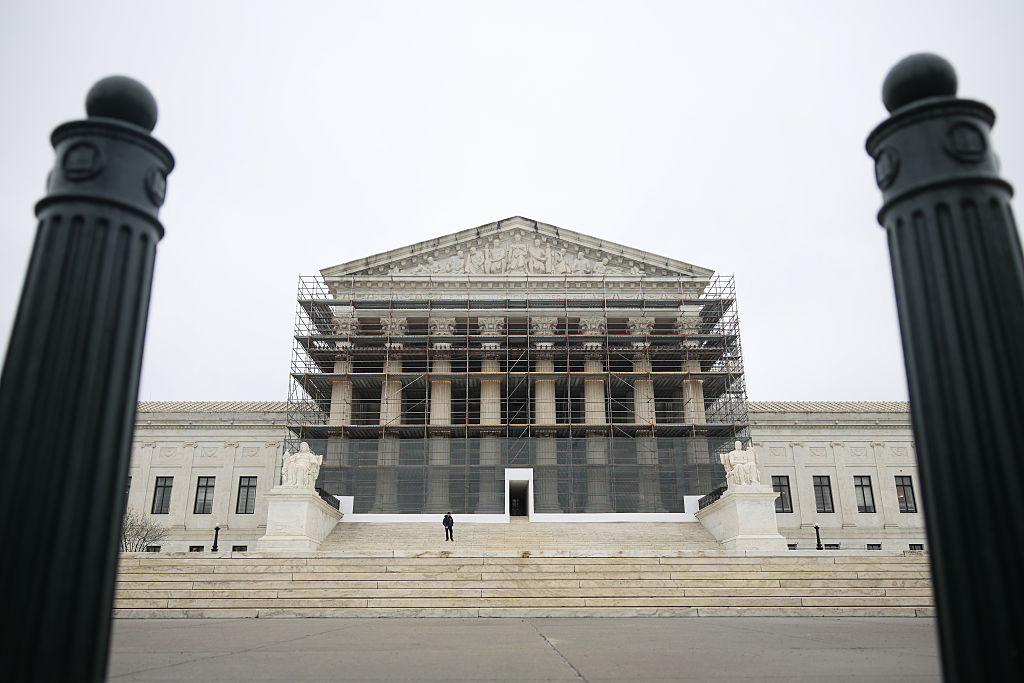
In Urias-Orellana v. Bondi, the Supreme Court on Monday considered whether federal courts of appeals should make their own determination on whether an asylum seeker experienced persecution, or leave it to the Board of Immigration Appeals, in a case that will clarify the circuit courts’ roles in the immigration system.
The dispute began soon after Douglas Humberto Urias-Orellana, Sayra Iliana Gamez-Mejia, and their child arrived in the United States in 2021 and requested asylum, citing repeated threats of violence from a hit man, or sicario, working for a drug lord in their home country of El Salvador. Urias-Orellana contended that after his half-brother, Juan, and the sicario got into an argument over a romantic relationship between their parents, the sicario shot Juan and another of his half-brothers, and then tracked Urias-Orellana across the country, repeatedly demanding money and once hitting him three times in the chest.
Under the Immigration and Nationality Act, individuals qualify for asylum if they have fled a country “because of persecution or a well-founded fear of persecution on account of race, religion, nationality, membership in a particular social group, or political opinion.” Urias-Orellana’s legal team argued that his family’s experiences met that standard because they had been persecuted due to their association with Juan, who is part of their social group.
An immigration judge denied the family’s request for asylum in 2022, holding “that the sum of the threats and the one time where [Urias-Orellana] was hit three times on the chest does not rise to the level of past persecution,” in part because “similarly situated” members of Urias-Orellana’s family “live in El Salvador without [facing] further harm and mistreatment.” In 2023, the Board of Immigration Appeals upheld the judge’s persecution determination and removal order.
Under the Immigration and Nationality Act, asylum seekers can ask a federal court of appeals to review their case if the Board of Immigration Appeals denies their asylum claim. These courts, however, do not agree on whether they can review de novo, or from scratch, the board’s decision about whether an asylum seeker’s experience meets the INA’s persecution standard, or if, instead, they must defer to the board’s determination unless “any reasonable adjudicator” would “be compelled to conclude to the contrary,” as the relevant statute states with regard to “administrative findings of fact” and the U.S. Court of Appeals for the 1st Circuit explained when it upheld the board’s decision in Urias-Orellana’s case. In June, after both the family and the federal government called on the justices to weigh in, the Supreme Court agreed to clarify what type of review federal courts of appeals should undertake.
During just under an hour of arguments on Monday, it appeared that the court’s decision will hinge on whether the justices believe persecution determinations are primarily the result of a factual inquiry or a legal one, since multiple justices said it would be out of step with Supreme Court precedent to hold that the federal courts of appeals should take a fresh look at the work of fact finders, rather than deferring to them.
It also appeared that Nicholas Rosellini, who represented Urias-Orellana and his family, was fighting an uphill battle as he worked to convince a majority of justices that “[d]eciding whether undisputed facts qualify as persecution under the law involves legal interpretation, not fact finding.” Several justices said it seemed to them to be a factual inquiry, perhaps none more directly than Justice Elena Kagan. “[W]e have all these masses of evidence of what the threats were and who made them and, you know, how serious they were. I don’t mean to belittle that. That’s an important question,” she said. “But it’s a factual question.”
Rosellini pushed back by contending that it’s a mixed question of law and fact, which, yes, involves a fact-based analysis, but also “a slew of auxiliary legal principles related to threats” that courts must interpret and apply as they determine whether someone’s experience qualifies as persecution. He added that the BIA itself treats the analysis as a legal inquiry and reviews persecution determinations from the beginning when it considers appeals in asylum cases and “that should not change when a case reaches federal court.”
Justice Brett Kavanaugh described that latter observation as “a good point” for Rosellini’s side, but he noted that the BIA’s approach to such appeals is not binding on the federal judiciary. Rosellini agreed that what matters for the courts of appeals is the text of the INA, adding that its text regarding the scope and standard for the court of appeals’ review “uses the exact same words” as BIA’s regulations.
Although Joshua Dos Santos, an assistant to the U.S. solicitor general, generally had an easier go of it while making his case (in part because he faced notably fewer questions), the justices were also dissatisfied with some of his arguments, particularly his contention that the text of the INA clearly limits the federal judiciary’s role in reviewing persecution determinations. “[Y]ou have some good arguments in this case, but, honestly, none of them come from the text,” Kagan said.
Kagan and others expressed concern that, under the federal government’s definition of a factual inquiry, nearly everything decided by immigration judges and the BIA would fit into that category. Dos Santos at first struggled to name exceptions, but he later clarified that courts of appeals can review the legal standards being used to make asylum decisions, even if they can’t conduct a de novo review of whether a specific set of facts satisfies one of those standards. He also drew a distinction between deferring to the BIA’s persecution determination and always siding with the BIA, noting that asylum seekers in some cases will be able to show that the “fact finder” in their case has not acted reasonably and that “no reasonable fact finder could have found that there was no persecution.”
By the end of Monday’s arguments, it appeared likely that a majority of justices will side with the government and hold that federal courts of appeals should undertake a deferential review of the BIA’s persecution determinations for asylum seekers.
Posted in Court News, Merits Cases
Cases: Urias-Orellana v. Bondi