


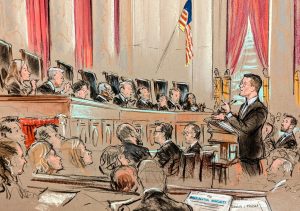
Analysis: Is Melendez-Diaz already endangered?

(NOTE: This post is an updated and modified version of a post that appeared here earlier this afternoon about the new Briscoe case.)

 Analysis

A fascinating possibility emerged Monday afternoon as the Supreme Court closed its Term: Judge Sonia Sotomayor, if confirmed as a Justice, may hold the deciding vote on the future of a controversial ruling that the present Court issued just last Thursday: the ruling in  Melendez-Diaz v. Massachusetts (07-591).  A strongly worded dissent in that case made it clear that four Justices would not soon be reconciled to that decision — a ruling that they argued would result in “a distortion of the criminal justice system.”

The ruling, made under the Constitution’s Confrontation Clause, requires the prosecution, if it plans to present a lab report as evidence in a criminal trial, to make the analyst who prepared it available for on-demand cross-examination by defense counsel. The decision came on a 5-4 vote.

If it were possible to pick up a fifth vote, could the dissenters from that case then lead the Court to reconsider — or least narrow considerably – the decision in Melendez-Diaz?  Perhaps; one of the five in the majority was Justice David H. Souter, who retired on Monday.  There is, it would seem, at least a chance that his designated successor, Judge Sotomayor, would not be prepared to embrace Melendez-Diaz, at least without some restriction on its scope; she has a record on criminal law issues that appears to be somewhat more prosecution-oriented than Justice Souter’s has been.

This is speculation, of course, but there is little else to suggest why the Court announced Monday that, next Term, it will review the case of Briscoe, et al., v. Virginia (07-11191).  Here is the question raised in the Briscoe petition, filed in May of last year by University of Michigan law professor Richard D. Friedman:

“If a state allows a prosecutor to introduce a certificate of a forensic laboratory analysis, without presenting the testimony of the analyst who prepared the certificate, does the state avoid violating the Confrontation Clause of the Sixth Amendment by providing that the accused has a right to call the analyst as his own witness?”

Read the rest of this entry »


What Ricci says about the Supreme Court’s views of Judge Sotomayor

Justice Kennedy’s opinion in Ricci will inevitably be put under the microscope for what it tells us about the Justices’ views of how the Second Circuit panel that included Judge Sotomayor handled the case. The Justices themselves were certainly aware of the political context of Ricci in the days running up to the confirmation hearings.

I am struck by the extent to which the majority opinion largely treats the court of appeals’ ruling as a non-event. To the contrary, Justice Kennedy almost seemingly goes out of his way not to criticize the decision below, notwithstanding that the Supreme Court takes a dramatically different view of the legal question. The Court indicates that the state of the law before today’s ruling was “a difficult inquiry,” and that its “holding today clarifies how Title VII applies.” It rejects the plaintiffs’ outright attack on the Second Circuit’s decision as “overly simplistic and too restrictive.”

Justice Ginsburg’s dissent in passing takes the view that the panel’s opinion followed prior Second Circuit precedent. Then the dissenters (in a footnote noted by Jonathan Adler that cites the district court’s discussion of existing Second Circuit precedent) elect not to remand — which would have made the reversal 9-0 — and instead explain why the city should prevail, albeit on a slightly different ground. But they avoid making their disagreement with the court of appeals particularly explicit (the difference is the thin one between whether the city reasonably believed it would be engaging in disparate impact discrimination and whether a court would agree with that belief), and they clearly agree with the bottom line of the Second Circuit, though they disagree with the standard seemingly set by prior Second Circuit precedent.

By contrast, Judge Alito’s concurring opinion comes much closer to an overt criticism of the rulings of the district court and court of appeals. I found it notable that the Chief Justice - who seems to place a priority on not interjecting the Court into political disputes unnecessarily - does not join the concurrence.

In the end, it seems to me that the Supreme Court’s decision in Ricci is an outright rejection of the lower courts’ analysis of the case, including by Judge Sotomayor. But on the other hand, the Court recognizes that the issue was unsettled. The fact that the Court’s four more liberal members would affirm the Second Circuit shows that Judge Sotomayor’s views were far from outlandish and put her in line with Judge Souter, who she will replace.


Letters on Justice Souter’s retirement

Here is a copy of the Chief Justice’s letter from all of the current Justices and retired Justice Sandra Day O’Connor expressing their well wishes to retiring Justice David H. Souter.

Here is a copy of Justice David H. Souter’s replying letter.


Detainees’ case put off

Lawyers for 13 Guantanamo Bay prisoners learned Monday that the Supreme Court has put off any action on their case until its next Term.  After noticing that the Court had issued no order on the case of Kiyemba, et al., v. Obama, et al. (08-1234), the attorneys checked with Court aides and were told there would be no decision “until October at the earliest.” That apparently means that the Court will not consider granting or denying the case until it next assembles for a private Conference on Sept.  29.

Because the Court took no formal action on Kiyemba Monday, there was no explanation.  It is possible to speculate on the reasons.

Among them could be that the Court did not want to be seen to be interfering with diplomatic efforts to arrange the re-settlement of the 13 men in the case — Chinese Muslims who are members of the Uighur sect.  The U.S. Solicitor General had told the Court that four of 17 Uighurs originally involved in the case had been released, and that diplomatic efforts would go on to try to place the other 13.

Another possible reason was that the Court was unwilling, while the new Obama Administration was sorting out its overall detention policy, to engage in a confrontation over presidential or congressional war powers of the kind that had led to four earlier rulings limiting detention authority.  The prospect that the remaining 13 might yet be placed in another country perhaps made it seem that the case simply would become moot in a matter of weeks.

Still another factor in the postponement decision could have been Congress’ passage this month of new legislation that severely restricts the President’s power to order the release of any detainees at Guantanamo, to live in the U.S. or to be re-settled in any other country.  That legislation raises significant new constitutional questions, and the Court may have been reluctant to take them on if, in fact, they would not have to do so because the case might become moot.

Because the case had developed so late in the just-closed Term, the Court would not have heard it until the next Term even if it had opted to grant review now, unless the Court held a special summer session, which was unlikely.  That, too, may have contributed to the perception that there was no need to act on it Monday.

Read the rest of this entry »


Today’s Opinions

The Court has released the opinion  in Cuomo v. The Clearing House Ass’n, L.L.C. (08-453), holding that states have the power to police discrimination in mortgage lending. The decision below is affirmed in part and reversed and part in a 5-4 opinion by Justice Scalia. Justice Thomas filed an opinion concurring in part and dissenting in part, joined by Chief Justice Roberts and Justices Kennedy and Alito.  The opinion is available here.

The Court has released the opinion in Ricci, et al. v. DeStefano, et al. (07-1428 and 08-328), holding for the plaintiff firefighters that the City of New Haven cannot be sued for disparate liability. The decision below is reversed and remanded in a 5-4 opinion by Justice Kennedy. Justice Scalia filed a concurring opinion. Justice Alito filed a concurring opinion, in which Justices Scalia and Thomas joined. Justice Ginsburg filed a dissenting opinion, in which Justices Stevens, Souter, and Breyer joined.  The opinion is available here. 

The Court has held that  Citizens United v. Federal Election Commission (08-205) will be reargued on Wednesday, September 9 at 10 a.m.  The Court has issued the following written order: “The parties should address the following question: ‘For the disposition of this case, should the Court overrule either or both Austin v. Michigan Chamber of Commerce and the part of McConnell v. FEC which addresses the facial validity of Section 203 of the Bipartisan Campaign Reform Act of 2002?’” The order is available here

For more details of the Court’s closing public session, please see this morning’s LiveBlog.


LiveBlog: Opinions and Orders 6.29.09

Beginning at 10 a.m. Eastern, we will provide “live” coverage of the Court’s release of opinions and orders. In the “LiveBlog” below, we will relay all developments as quickly as possible. We will post links to the slip opinions as soon as they are available. Because the LiveBlog automatically updates, users do not need to refresh their browsers to receive the latest news.

In the event of technical difficulties on our home page, users can also follow the LiveBlog by clicking here. At the conclusion of the live coverage, we will post opinion links and short recaps as a regular blog post.


Today at the Court

At 10 a.m. EDT, the Court will release the orders from the Justices’ private conference last Thursday. The outstanding opinions in pending cases are expected to be released. We will LiveBlog the public session.


The Week Ahead

At 10 a.m. on Monday, the Court will release orders from the Justices’ private conference last Thursday. The final three opinions from pending cases are also expected to be released. We will provide instant coverage of all decisions via our LiveBlog.

It is possible that a final order list for this Term will be released after Monday morning.

No petitioners’ or respondents’ briefs on the merits are due this week.


Sotomayor 2d Am. case now at Court

UPDATE: The Maloney petition has now been docketed as 08-1592.

————–

A Port Washington, N.Y., lawyer and martial arts enthusiast asked the Supreme Court on Friday to use his case to expand the coverage of the Second Amendment’s “right to keep and bear arms” so that it applies to restrict or bar state and local laws, as well as those at the federal level.

James M. Maloney’s petition in Maloney v. Rice is the third case on that point to reach the Court in recent weeks.  This one, however, seeks to challenge a ruling that has gained a special prominence because one of the judges on the Second Circuit Court panel deciding against Maloney’s claim was Circuit Judge Sonia Sotomayor, President Obama’s choice for a soon-to-be-open Supreme Court vacancy.

The Maloney petition and the appendix (a lengthy file) are available for downloads. (It has not yet been assigned a docket number.) The already pending cases on the issue are National Rifle Association v. City of Chicago (08-1497) and McDoanld v. City of Chicago (08-1521).

Another novel feature of the Maloney case is that it is not a challenge to the constitutionality of a gun control law; rather, it targets a New York state law on weapons control, so far as that law applies to a “chuka stick” (or “nunchaku”).

That is a weapon often used in martial arts training, but also in increasing use as a police weapon to subdue and control suspects.  James Maloney wants the right to have the weapon in his home for self-defense, just as others might do with a handgun.  (The chuka weapon consists of two lengths of wood or other rigid material joined by a short strand of rope.)

Even so, the questions posed by the new position raise the constitutional issue in broad form, so that the outcome would apply to guns and other persoonal weapons, too. 

Read the rest of this entry »


New StatPack Available

A new StatPack of preliminary data from all released opinions is available here.  We now also have a visual representation of the Justices’ voting lineups. Our finalized data, additional charts, and Term summary memo will be issued early next week.


Opinion Recap Available: Boyle v. US

New to SCOTUSwiki, here, is Stanford student JP Schnapper-Casteras’ discussion of the Court’s recent decision in Boyle v. US. In an opinion by Justice Alito, the Court held that a criminal association-in-fact enterprise may exist if it has a purpose, sufficient longevity to accomplish that purpose, and relationships among associates – which can be inferred from the underlying acts and without a distinct structural hierarchy.


Today at the Court

Oral arguments have concluded for the term. No non-capital orders are expected, but if any orders are issued today in pending cases, we will post them promptly.


Analysis: Law need not bow to chemistry

Analysis

Expressing a heavy dose of skepticism that crime lab reports are so reliable as to be beyond question, the Supreme Court on Thursday cleared the way for chemists and other scientists who prepare such reports to be summoned to the witness stand in criminal trials to defend their analyses.  The 5-4 ruling in Melendez-Diaz v. Massachusetts (07-591) resulted from some unusual alliances among the Justices, and continued the deep division within the Court over how to interpret the Constitution’s guarantee that an individual on trial for a crime has a right to face and challenge the witnesses for the prosecution.

Justice Antonin Scalia, the Confrontation Clause’s most devoted defender on the Court, wrote for the majority: “There is little reason to believe that confrontation will be useless in testing analysts’ honesty, proficiency, and methodology — the features that are commonly the focus in the cross-examination of experts.”

The ruling will provide for an added layer of challenge by defense lawyers to such criminal evidence as illegal drugs, fingerprints, blood spatter patterns and blood chemistry, guns and bullets, and other forms of physical evidence subjected to lab analyses, at least when the resulting reports are prepared for use as evidence in criminal trials.

Now, if prosecutors want to offer a crime lab report as evidence, and the report was prepared with the aim that it would be used at trial, the prosecution has to bring along the author or scientist and make them available for questioining by the defense — if the defense insists on the right to confront the analyst.  It is not up to defense lawyers to summon them to the stand, but they must assert the right to confront the analyst, the Court indicated.

The opinion recited a good deal of information from published reports about how defective crime labs and their results are, and said that claims that lab reports are the product of “neutral scientific testing” are open to challenge because such reports are not “as neutral or as reliable” as advertised.  “Forensic evidence,” Scalia wrote, “is not uniquely immune from the risk of manipulation.”

He cited one report, for example, that said “there is wide variabiility across forensic science disciplines with regard to techniques, methodologies, reliability, types and numbers of potential errors, research, general acceptability, and published material.”

Putting the chemist or lab technician on the stand to be tested by cross-examination, the majority said, will help “weed out not only the fraudulent analyst, but the incompetent one as well.”

Still, Scalia said, the decision to compel the reports’ expert authors to testify is based ultimately on the right of confrontation, not the quality of the reports or the credibility of the chemist.   “We would reach the same conclusion,” he wrote in a footnote, “if all analysts possessed the scientific acumen of Mme. Curie and the veracity of Mother Theresa.”

Read the rest of this entry »


Opinions from this week

In case you haven’t followed our morning live blogs, here are summaries of and links to the slip opinions released this week. The Court’s final session will be next Monday, at which the three outstanding opinions will be released.

Coeur Alaska, Inc. v. Southeast Alaska Conservation Council, et al.  (07-984/07-990) : The decision below is reversed and remanded in a 6-3 opinion by Justice Kennedy. Justice Ginsburg filed a dissenting opinion joined by Justices Stevens and Souter. Justice Breyer and Justice Scalia filed concurring opinions. The Court held that the U.S. Army Corps of Engineers has the authority to issue permits for dumping dredge or fill dirt into a waterway, without satisfying all of the pollution limits that are enforced by the Environmental Protection Agency. The opinion is available here. 

Forest Grove School District v. T. A. (08-305): The decision below is affirmed in a 6-3 opinion by Justice Stevens. Justice Souter filed a dissenting opinion, joined by Justices Scalia and Thomas. The Court held that parents of a disabled child, who decide on their own to transfer the child to a private school, are entitled to tuition reimbursement from the local school district even if the child had never received any special education aid previously. The opinion is available here.

Northwest Austin Municipal Utility District Number One v. Eric Holder, Jr, Attorney General, et al. (08-322): The decision below is reversed and remanded in an 8-1 opinion by Chief Justice Roberts. Justice Thomas filed a partial dissent. The Court did not strike down the Voting Rights Act, but held that all local units of government must be given the option to bail out of the requirement that they get federal approval for any changes in their election laws or methods. The opinion is available here.

Horne v. Flores; Speaker of the Arizona House of Representatives v. Flores (08-289 and 08-294): The decision below is reversed and remanded in a 5-4 opinion by Justice Alito. Justice Breyer filed a dissenting opinion joined by Justices Stevens, Souter, and Ginsburg. The federal court must reexamine whether the Arizona school district has taken “appropriate action” to overcome learning barriers for English Language Learner students. The opinion is available here.

Atlantic Sounding Co., Inc., et al. v. Townsend (08-214):  The decision below is affirmed and remanded in a 5-4 opinion by Justice Thomas. Justice Alito filed a dissenting opinion, joined by Chief Justice Roberts and Justices Scalia and Kennedy. The Court held that the respondent is entitled to pursue punitive damages. The opinion is available here.

Melendez-Diaz v. Massachusetts (07-591): The decision below is reversed and remanded in a 5-4 opinion by Justice Scalia. Justice Kennedy filed a dissenting opinion joined by Chief Justice Roberts and Justices Breyer and Alito. The Court held that a lab chemist must be called to testify in order to admit the lab analysis as evidence in a trial. The opinion is available here.

Safford United School District #1 v. Redding (08-479): The decision below is affirmed in part, reversed in part, and remanded in an opinion by Justice Souter, with the Court dividing 8-1 on the Fourth Amendment question and 7-2 on the qualified immunity question. Justice Stevens filed a partial dissent joined by Justice Ginsburg. Justice Ginsburg filed an opinion concurring and dissenting in part. Justice Thomas filed an opinion concurring in part and dissenting in part.  The Court held that the strip search did violate the Constitution but it wasn’t clear that the violation was established at the time of this incident.  The opinion is available here.


Analysis: Some expansion of student privacy

Analysis

Sending new constitutional instructions to public school officials on how far they may go to search students for drugs or other harmful items, the Supreme Court has set two limits: one mostly unchanged from before, and one new.  The new rule is that searching students’ inner clothing, resulting in exposure of their bodies, will be extremely difficult — though not impossible — to justify under the Constitution.

That is the meaning of the somewhat opaque language that Justice David H. Souter, writing for an 8-1 majority, used to deal with the constitutionality of “strip searches” of students in public schools.  The ruling in Safford United School District v. Redding (08-479) made clear that, while the Court seriously frowns on strip searches of students, those have not been forbidden totally; it depends, in other words.

The other constitutional rule is that searches of public school students’ backpacks, notebooks, other belongings, outer clothing and pockets are generally allowed if they are based on “reasonable   suspicion.”  That remains as it has for a quarter-century, but with a small amount of refinement, the exact scope of which is not quite clear.

Justice Clarence Thomas, who cast the lone dissenting vote on the constitutional rules, denounced them as “vague and amorphous.”  Whether they actually lack specificity to that degree, school officials very likely will need some legal sophistication to know just what they mean in practice.

Another part of the ruling — disappointing to students who have already been subjected to strip searches — is that Thursday’s decision only applies to future searches, so the Constitution does not provide them a remedy.  By a vote of 7-2, the Court said there has been enough confusion about what the Constitution meant for strip searches that school officials could not have been expected to know that they were invalid, so they have immunity.  Justices Ruth Bader Ginsburg and John Paul Stevens dissented on that point, saying school officials have been on notice since 1985 (the Court’s decision in New Jersey v. T.L.O.) that they could not go as far as requiring a strip search.

Read the rest of this entry »
