


The President, on long-term detention

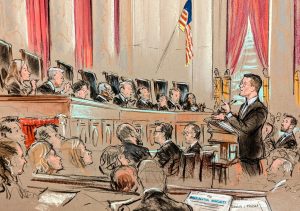
President Obama, in a press interview on Thursday, said it would give him “huge pause” to create a new system of long-term detention without trial of terrorism suspects.  After a flurry of news accounts, floating unattributed reports that the President would set up such a system by Executive Order, he told the Associated Press that “I am not comfortable with doing something this significant through executive order.”

Overall, he said, his administration was proceeding “very carefully on this front.”  He added that “it may turn out after looking at all the dimnsions of this, that I don’t feel comfortable with the proposals that surface in how to deal with this issue…”

The part of the interview dealing with this subject can be read here.


Hyperlinked Opinion: Ricci v. DeStefano

Courtesy of PARADOCS, a hyperlinked version of the decision in Ricci, et al., v. DeStefano, et al. (07-1428) is available here [Note: the document is hosted on an outside download site because of its large file size (25 MB)].  All references within the opinion are hyperlinked to the relevant documents.


Justices to London, change in calendar

The Supreme Court said Wednesday that a number of the Justices will go to London in October to attend opening ceremonies for the newly established Supreme Court of the United Kingdom.  (A Wikipedia entry on that new Court can be found here.) As a result of the Justices’ trip, the sitting calendar for October will be modified slightly.

The Justices’ private Conference that normally would have been held on Friday, Oct. 16, will be held instead on Monday, Oct. 19, the Court said.  Before the Conference that day, the Justices will be on the bench at 10 a.m. to admit lawyers to its Bar; no oral arguments will be scheduled that day.  Orders resulting from that Conference will be released on Tuesday, Oct. 20, at 10 a.m.; the Court will not be on the bench that day.

These changes are reflected in the Court’s color-coded calendar for the full Term that opens on Monday, Oct. 5, showing dates of its sittings and its Conferences.  It can be downloaded here.

The Court has not yet completed its calendar for oral arguments that it will hear in the first session, Oct 5-14.


The Sotomayor Confirmation Hearings as a Non-Event

A few days after the President nominated Sonia Sotomayor, I labeled the question of her confirmation “over.”  Along the same lines, I wanted to lay out why I think the hearings themselves will be a complete non-event.

Republicans have nothing significant to gain by making the hearing a media event, so they won’t.  For her part, Judge Sotomayor is likely to adhere to the modern tradition of saying as little as necessary.  The result is a conspiracy of convenience in which not much is likely to happen.

Start with the inevitable outcome.  Absent a bombshell development, she is going to be confirmed.  Democrats are about to have a 60-vote Senate majority.  Moderate Republican Senators – e.g., Collins and Snow – will make up for any (unlikely) Democratic defection.

Nor is there any prospect of an effort to mount a filibuster.  Opponents haven’t developed a narrative justifying that step.

The vote in the judiciary committee won’t be close either.  Democrats have a dramatic 12-7 advantage in membership.

There are political disadvantages to drawing attention to the hearings.  To the extent it has considered the question, the non-ideologically committed public – effectively, independents – seemingly likes her and thinks she should be confirmed. 

Judge Sotomayor is of course the first Latina nominee to the Court.  This is a historic moment for Hispanics.  The third appointment of a woman is also significant, though less profound.  Those are important electoral groups.

Beyond demographics, Judge Sotomayor has a compelling life story.  She not only came from a poor upbringing, but she continues to live very modestly after a career of almost exclusive public service.

She is objectively qualified.  She graduated at the top of her class at Princeton and did well at Yale.  She was a prosecutor, private practitioner, trial judge, and appellate judge. 

However positive the impression is now, it’s only going to gravitate further in that direction under what will presumably be a well-orchestrated White House roll out of her, the family, colleagues, and experts. 

Publicly attacking Judge Sotomayor in the general population puts a Senator on the wrong side of public opinion.

Given that there is no real prospect of derailing Judge Sotomayor confirmation, and the prospect of causing self-inflicted wounds by attacking her, I expect that conservative Senators will lower their profile.  They will note their opposition and state their principles, but limit their strong advocacy (that otherwise could come across publicly as badgering) to the already committed conservative community.

Contrast that with the array of “speakers” who have everything to gain with aggressive advocacy in support of Judge Sotomayor.  The Judge herself will speak, and by all accounts will present herself very well.  The Administration, liberal advocacy groups, supporting senators, and other varied supporters are all fully engaged. 

They have a significant audience, with much to gain beyond the votes of undecided Senators in this inevitable confirmation.  This will be a celebratory event for Hispanics, who will associate it with the President.  Women will appreciate the Court’s greater diversity. 

Read the rest of this entry »


Opinion Recap: Cuomo v. The Clearing House Ass’n, L.L.C.

Please note that Howe & Russell filed an amicus brief in this case on behalf of the Lawyers’ Committee for Civil Rights Under Law, National Fair Housing Alliance, and NAACP Legal Defense and Educational Fund, Inc. in support of the petitioner

In 2005, the New York Attorney General began an investigation into the lending practices of several national banks that he believed, based on publicly available data, had issued a disproportionate number of high-interest loans to minority borrowers.  The Office of the Comptroller of the Currency (OCC) and a banking trade group went to federal court to enjoin the Attorney General’s investigation, arguing that a 2004 regulation promulgated by the OCC prohibited states from enforcing their own fair lending laws.  Both the district court and the Second Circuit agreed with the OCC, and the New York Attorney General sought Supreme Court review. 

Yesterday the Supreme Court, by a vote of five to four, largely rejected the OCC’s argument.  At issue in the case is a provision of the National Bank Act which – as relevant here – provides that national banks shall not “be subject to any visitorial powers except as authorized by Federal law [or] vested in the courts of justice.”  In 2004, the OCC adopted a regulation to implement the National Bank Act that prohibited states from “exercis[ing] visitorial powers with respect to national banks, such as conducting examinations, inspecting or requiring the production of books or records of national banks, or prosecuting enforcement actions.”  However, the regulation did provide that “production of a bank’s records . . . may be required under normal judicial procedures.” 

Writing for an unusual line-up that included Justices Stevens, Souter, Ginsburg, and Breyer, Justice Scalia acknowledged “some ambiguity” in the meaning of “visitorial powers.”  But such uncertainty, he continued, “does not expand Chevron deference to cover virtually any interpretation of the National Bank Act.”  Surveying the Supreme Court’s jurisprudence, the Court deemed it clear that a state’s “‘visitorial powers’ and “its power to enforce the law are two different things,” and the National Bank Act “pre-empts only the former.”  The Court also questioned the consequences that would arise from the OCC’s interpretation of the NBA:  although some state laws regulating banks would remain in effect, states would be precluded from enforcing those laws.  By contrast, the Court noted, allowing state attorneys general to enforce state laws in court (but not exercise visitorial powers) “would preserve a regime of exclusive administrative oversight by the Comptroller while honoring in fact rather than merely in theory Congress’s decision not to pre-empt substantive state law.”  Moreover, the Court notes, judicial law-enforcement proceedings are subject to greater constraints and thus will limit the likelihood of “fishing expeditions” by state officials. 

Read the rest of this entry »


Akin Gump’s Supreme Court Summary Memo

As updated below in the Super StatPack, our annual summary memo of statistics from OT08 is available here. We welcome any citation, republishing, or repurposing of these facts and figures.  We ask that you acknowledge SCOTUSblog as the source.


UPDATE: Coleman concedes; no Bush v. Gore violation found

UPDATE 4:08 p.m.  Republican Norm Coleman on Tuesday afternoon ended his fight for reelection to the U.S. Senate, bowing to a decision of the Minnesota Supreme Court that his opponent, Democrat Al Franken, had won the most votes and was entitled to enter the Senate.  “The [state] Supreme Court has made its decision and I will abide by the results,” Coleman told reporters in St. Paul, the Associated Press reported. That, of course, eliminates any chance of a U.S. Supreme Court test on the constitutional issues Coleman had raised.

—————–

The Minnesota Supreme Court, ruling unanimously that Democrat Al Franken got the most votes and is entitled to be the state’s next U.S. Senator, turned aside a claim by Republican rival Norm Coleman that the Supreme Court’s decision in Bush v. Gore was violated in the way absentee votes were counted or rejected.  Whether that ruling will be tested before the Justices depends now on whether Coleman, who had held the seat, gives up the prolonged fight over the election conducted almost eight months ago.

The state Court’s 32-page ruling can be found here. (Thanks to Rick Hasen  on his election law blog for the usual promptness in posting a link to the opinion.)

Coleman and his supporters had challenged Franken’s 312-vote margin (out of more than 2.4 million total cast) on five specific points.  Three of those involved issues under state law, and would normally not be open to challenge in the federal courts, including the Supreme Court.  But two were claims under the U.S. Constitution and could be reviewed in the federal courts: the claim that Coleman’s right to an equal counting procedure in jurisdictions across the state — a right based on Bush v. Gore — had been violated, and a separate claim that his right to “substantive due process” had been violated by officials’ failure to count ten categories of absentee ballots by insisting that voters strictly comply with absentee voting rules.  The state supreme court rejected both of those challenges.

Read the rest of this entry »


Yesterday’s Grants in No. 08-645, Abbott v. Abbott, and No. 08-1200, Jerman v. Carlisle

We represent the petitioners in two cases that were granted yesterday, No. 08-645, Abbott v. Abbott, and No. 08-1200, Jerman v. Carlisle. 

In Abbott, the Court will construe the Hague Convention on the Civil Aspects of International Child Abduction, to which the United States is a party.  Under the Convention, a parent whose child has been abducted has the right to have his child returned to the child’s country of habitual residence if the child has been removed in violation of his rights of custody.  The Convention further defines “rights of custody” to include “the right to determine the child’s place of residence.”  At issue in this case is whether a ne exeat clause – which prohibits one parent from removing a child from the country without the other parent’s consent – confers a “right of custody” for purposes of the Hague Convention.  The Fifth Circuit joined the Second, Fourth, and Ninth Circuits in holding that the ne exeat clause does not constitute a right of custody; by contrast, the Eleventh Circuit and the majority of foreign courts which have considered the issue have held that it does.  Judge Sonia Sotomayor dissented from the Second Circuit’s decision on the issue in Croll v. Croll; she would also have held that the ne exeat clause does confer a right of custody.

We filed the petition for certiorari in November 2008; in January 2009, the Court invited the Solicitor General to file a brief expressing the views of the United States.  In late May, the Solicitor General filed a brief urging the Court to grant certiorari and reverse.  Our co-counsel in the case is Adair Dyer of Austin, Texas.  We received help along the way from five students from the Stanford Law School Supreme Court Litigation Clinic – David Schwartz, JP Schnapper-Casteras, Dan Matro, Rakesh Kilaru, and Martine Cicconi – as well as three students from our Supreme Court Litigation Class at Harvard Law School – Andrew Corkhill, Eric Nguyen, and Jane Wang.

In Jerman, the Court will consider whether a debt collector’s legal error qualifies for the bona fide error defense under the Fair Debt Collection Practices Act, which immunizes debt collectors from liability if they can prove that “the violation was not intentaional and resulted from a bona fide error notwithstanding the maintenance of procedures reasonably adapted to avoid any such error.”  Three circuits – the Second, Eighth, and Ninth Circuits – have held that the Fair Debt Collection Practices Act does not apply to violations that result from legal mistakes; in so holding, they relied on the similarity between the FDCPA’s bona fide error provision and a “nearly identical” provision of the Truth in Lending Act, which courts have consistently declined to construe as extending to legal errors.  In this case, the Sixth Circuit joined the Tenth Circuit in reaching the contrary result.  Our co-counsel in the case are Ed Icove of Cleveland and Steve Felson of Cincinnati.  Harvard’s Andrew Corkhill, Jane Wang, and Eric Nguyen worked on this case as well. 


Thoughts on this Term and the Next

It’s always perilous to try and generalize about a Supreme Court Term.  Roughly 80 cases on diverse topics decided by nine different people don’t collectively produce clear themes.  When they do appear to, it’s often a mirage that reflects the coincidence of cases that happen to fall together by chance within a single term.

But that never stopped me before.

Here is what strikes me most about this Term.  The Court is moving steadily in the direction of rolling back Warren Court-era precedents that conservatives view as significant overreaching of the judicial role.  To be clear, that isn’t the Court’s principal occupation.  Most of its docket is filled with important but ordinary questions of federal law.  But it is a significant trend.

I am struck in particular by the opinions of the Chief Justice that seem to lay down markers that will be followed in later generations of cases.  NAMUDNO details constitutional objections to Section 5 of the Voting Rights Act that seem ready-made for a later decision invalidating the statute if it is not amended.  Herring contains significant language that can later be cited in favor of a broad good-faith exception to the Fourth Amendment exclusionary rule that applies to individual police mistakes.

If I’m right about the direction of the case law, the Court’s methodology is striking.  It is reinforcing its own legitimacy with opinions that later can be cited to demonstrate that it is not rapidly or radically changing the law.  This approach may be in the starkest relief if next Term the Court cites its recent decision in Wisconsin Right to Life as precedent for concluding that McConnell v. FEC and Austin v. Michigan have been significantly undermined and should be overruled.  The plurality and concurrence in Wisconsin Right to Life famously debated how aggressively the Court should go in overruling prior campaign finance precedent.  The Chief Justice urged patience – not moving more quickly than required – and the wait may not have been long.

There is nothing illegitimate about that approach.  It’s easy to demonize decisions with which you disagree as either exercises in raw judicial power (the truth of the matter is that the principal difference between McConnell and Wisconsin Right to Life is that Justice O’Connor was replaced by Justice Alito) or outright sneakiness.  Neither is accurate or fair.  Just because one set of Justices gets to a constitutional question first does not give it a greater claim to “constitutional truth.”  I disagree (sometimes substantially) with the direction of the law, but this incrementalism is rooted in a consistent vision of the law and a deep concern for the Court as an institution. 

Overgeneralizing broadly, conservatives believe that doctrines like substantive due process, the exclusionary rule, and a high wall separating church and state aren’t merely wrong but overstep the limited role of judges and endanger the legitimacy of the Supreme Court.  Turning back those decisions, in turn, is thought to (among other things) enhance respect for the Court.  The Chief’s professional life is defined by the Court — as a clerk, Principal Deputy Solicitor General, private practitioner, and now the Chief Justice — and his institutional commitment to it, including ensuring that it is regarded as an institution of integrity rather than a political football (see my earlier post on the Ricci opinion) — is profound.

But that perspective – when taken by a thoughtful judge who has the long view – also counsels in favor of moving at a measured pace.  If the Court instead were to announce in rapid succession the overruling of its prior decisions permitting regulation of campaign contributions, guaranteeing a right to an abortion, and finding affirmative action consistent with the Fourteenth Amendment, then the public would likely be left with the impression that constitutional law is nothing more than a power play between competing ideologies that reflect nothing more than the happenstance of the most recent appointments.

For the moment, there is no reason to rush.  Time permits a jurisprudence of not just originalism, or textualism, but actuarialism.  The sand running through this hourglass will not expire for eight years. 

Later in his term, President Obama will likely replace Justice Stevens with someone else on the left.  If he is reelected in 2012, he will replace Justice Ginsburg with someone on the left.  Nothing changes.

Read the rest of this entry »


Exxon Valdez: One last fight

Exxon Mobil Corp. and its oil tanker subsidiary notified lawyers for fishermen and others harmed by the massive Alaska oil spill 20 years ago that on Wednesday it will pay them $470,268,908, but returned to a federal court to continue a fight over another $54.5 million.

The larger payment represents interest back to September 1996 on the punitive damages award that the company had already paid; the smaller figure represents 90 percent of what Exxon Mobil still owes to cover the $60.6 million it still owes in premiums on a “letter of credit” it obtained while it pursued appeals in the federal courts, up to and including the Supreme Court over the punitive damages award.  The Court ruled that the company could be assessed punitive damages for the incident involving the grounding of the supertanker Exxon Valdez, but said the punitive award could be no higher than the compensatory damages award of $507.5 million.

Two weeks ago, a three-judge panel of the Ninth Circuit Court ruled unanimously that Exxon Mobil must pay more than 12 years of interest on the punitive award — an issue the Supreme Court did not decide. But the panel divided, 2-1, in ruling that each side in the prolonged court battle must pay its own costs.

In a petition for en banc rehearing, filed Monday (available here), the company asked for reconsideration of the panel majority’s refusal to award Exxon any part of its court costs.

It made an argument based on simple arithmetic and on law. Its numbers argument said that the Supreme Court had reduced the punitive damages award from $5 billion to about $500 million — thus cutting it by 90 percent — so the fishermen and others who sued should have to pay 90 percent of Exxon’s credit premium costs of $60.6 million, or $54.5 million.

Its legal argument was that there is a “centuries-old principle that a successful litigating party should be compensated for the costs incurred to achieve its success.”  The company said it had to obtain a letter of credit to serve as financial security while it contested the punitive damages award in appeals, and that the premiums on that instrument “eventually exceeded $60.6 million.”  It asks that the full Circuit Court require it to pay only $6.1 million of that, as the amount spent to win a reduction of punitives, with the challengers required to pay the other $54.5 million.

Its filing made only one mention of the interest obligation, noting that it plans to pay that amount — minus enough to cover its court costs — on Wednesday.


Analysis: Ricci, without the rhetoric

Analysis

The cases of Frank Ricci and his 17 New Haven, Conn., firefighter colleagues — all whites except one Hispanic — now return from the Supreme Court to lower courts, with only one thing settled: their rights under a federal civil rights law were violated.

The Court’s ruling in Ricci, et al., v. DeStefano, et al. (07-1428) and a companion case with the same name (08-328) says nothing at all about a remedy for that violation, and leaves a host of questions to be answered.

Although the Court decided that city officials in New Haven violated Title VII of the federal civil rights law by failing to promote any firefighters to seven slots for captain and eight slots for lieutenant, it is not clear how many slots are open now — whether more or fewer — and it is uncertain whether the lists of promotions that were to be made from the results of the test in the fall of 2003 remain intact.

The decision does not guarantee an individual firefighter, by name, that he will become a captain or a lieutenant in New Haven.  And, while the winners of this lawsuit may very well claim that the denial of promotions entitles them to back pay, or even to money damages, the Court did not address any such claim, leaving it for further exploration by other judges.

While the Court seems to have said that, if an employer – public or private – conducts hiring or promotion tests that are legally sound, those who score highest and meet other selection factors cannot be denied a job or a promotion because of race, the decision does not say that the employer has any duty to avoid closing off jobs or the promotions so that no one is chosen (so long as it does not do so for racial reasons).

No duty, whatsoever, to keep slots open is imposed, although it may be doubted whether many employers would alter their payrolls to eliminate job opportunities just to keep from losing a lawsuit.

The decision did make some things clear, and that will influence what can happen next in the New Haven case, in particular.  And there are conclusions in the ruling that definitely will apply to other cases, in court now or in the future, involving claims of racial bias in job placement.

Read the rest of this entry »


Filings in today’s grants

Below the jump are petition filings in the seven cases granted certiorari today for OT09. Here is this morning’s order list and here is this afternoon’s order list.

Read the rest of this entry »


End of Term “Super Stat Pack” (Updated)

Here (as one file) are all of our stats, charts, lists, and observations about the just-concluded Term and here are visual representations of the voting lineups in each decision.  In addition to our regular inclusions, we have added an opinion tally, a chart of certiorari grants by conference, and a list of all OT08 cases with questions presented and results.  Here is our summary memo, condensing the most interesting trends and data of this Term.

We welcome any citation, republishing, or repurposing of these facts and figures.  We only ask that you acknowledge SCOTUSblog as the source.  You can download any individual data set below:


Briefing set on Citizens United rehearing

The Supreme Court on Monday afternoon ordered a schedule for filing new constitutional arguments when the case of Citizens United v. F.E.C. (08-205) is heard, before the opening of the new Term.  The rehearing itself will be at 10 a.m. on Sept. 9, nearly a month before the formal opening of the Term on Oct. 5.

Both sides are to file their opening briefs simultaneously by July 24, with amici briefs due by July 31. Reply briefs are due by Aug. 19.

These are to be supplemental briefs — that is, confined to the new question the Court has raised, without repeating other arguments previously made in the case.  The new issue is whether the Court should overrule either or both of two prior rulings on campaign finance law — Austin v. Michigan Chamber of Commerce in 1990 and part of McConnell v. F.E.C. in 2003.

In the Austin decision, the Court upheld the power of government to bar corporations from using funds from their own treasuries to support or oppose candidates for elected state offices.  In the part of McConnell that the Court will reconsider, the Justices upheld a provision of the 2002 campaign finance law that bars corporations and labor unions from using their treasury funds to pay for radio or TV ads, during election season, that refer to a candidate for Congress or the Presidency, and appear to urge a vote for or against such a candidate.  The Citizens United case involves a non-profit group’s campaign-season film sharply attacking the presidential candidacy of Hillary Rodham Clinton.

By scheduling the new oral argument before the next Term opens formally, the Court will repeat its approach to the McConnell decision: the argument in that case occurred on Sept. 8, 2003, in advance of the opening.

If the U.S. Senate moves with some dispatch, and approves the nomination of Justice-candidate Sonia Sotomayor, she could be on the bench for the Sept. 9 argument.  Even if she is not, however, she could, if confirmed, participate in reviewing the case by reading the briefs and listening to the audiotape of the oral argument.  She would not have to be physically present for the Sept. 9 session.


Analysis: Is Melendez-Diaz already endangered?

(NOTE: This post is an updated and modified version of a post that appeared here earlier this afternoon about the new Briscoe case.)

 Analysis

A fascinating possibility emerged Monday afternoon as the Supreme Court closed its Term: Judge Sonia Sotomayor, if confirmed as a Justice, may hold the deciding vote on the future of a controversial ruling that the present Court issued just last Thursday: the ruling in  Melendez-Diaz v. Massachusetts (07-591).  A strongly worded dissent in that case made it clear that four Justices would not soon be reconciled to that decision — a ruling that they argued would result in “a distortion of the criminal justice system.”

The ruling, made under the Constitution’s Confrontation Clause, requires the prosecution, if it plans to present a lab report as evidence in a criminal trial, to make the analyst who prepared it available for on-demand cross-examination by defense counsel. The decision came on a 5-4 vote.

If it were possible to pick up a fifth vote, could the dissenters from that case then lead the Court to reconsider — or least narrow considerably – the decision in Melendez-Diaz?  Perhaps; one of the five in the majority was Justice David H. Souter, who retired on Monday.  There is, it would seem, at least a chance that his designated successor, Judge Sotomayor, would not be prepared to embrace Melendez-Diaz, at least without some restriction on its scope; she has a record on criminal law issues that appears to be somewhat more prosecution-oriented than Justice Souter’s has been.

This is speculation, of course, but there is little else to suggest why the Court announced Monday that, next Term, it will review the case of Briscoe, et al., v. Virginia (07-11191).  Here is the question raised in the Briscoe petition, filed in May of last year by University of Michigan law professor Richard D. Friedman:

“If a state allows a prosecutor to introduce a certificate of a forensic laboratory analysis, without presenting the testimony of the analyst who prepared the certificate, does the state avoid violating the Confrontation Clause of the Sixth Amendment by providing that the accused has a right to call the analyst as his own witness?”

Read the rest of this entry »
