


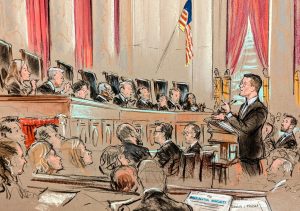
Although most petitioners face long odds of convincing the Court to grant review, there are exceptions. The Solicitor General’s petition seeking review of the D.C. Circuit’s decision restricting the President’s recess appointments power is one of those rare cases that is very likely to end up on the Court’s docket. The conventional wisdom is that the Court will agree to hear National Labor Relations Board v. Noel Canning to resolve the circuit split on the question and settle the status of a significant number of presidential recess appointees who are now in office. For readers wanting to get up to speed on recess appointments in anticipation of the likely cert. grant, I recommend several articles with divergent views on these questions.
We’ve prepared a survey about the blog that will take you two minutes to fill out (at most) and that will genuinely help us improve SCOTUSblog for you. We would really appreciate it if you would participate by clicking here.
We have changed our round-up format! In an effort to simplify the process for our round-up team, going forward we will only include in the round-up news articles and posts that are submitted to us. If you have (or know of) an article or post that you would like to have included in the round-up, please send a link to roundup [at] scotusblog.com so that we can consider it.
Briefly:
- Earlier this week the Republican National Committee filed its brief in McCutcheon v. Federal Election Commission, asking the Court to strike down limits on direct donations to political campaigns. Lyle reports on the brief (as well as that of Alabama businessman Shaun McCutcheon) for this blog, with further coverage coming from The Hill‘s Sam Baker. Continue reading »
The petition of the day is:
Issue: Whether Hildwin v. Florida, which upheld Florida's capital sentencing regime, remains good law after Ring v. Arizona, which held that “[c]apital defendants, no less than noncapital defendants . . . are entitled to a jury determination of any fact on which the legislature conditions an increase in their maximum punishment.”
The court case that the Obama administration has been pursuing in an attempt to gain added power for military commissions to try war crimes has grown a bit shaky, as the Guantanamo Bay detainee involved first said he wanted to withdraw the case and then his lawyers said he had changed his mind. It is unclear at this point whether that will make any difference as the D.C. Circuit Court moves toward a ruling in a potential prelude to Supreme Court action.
Alan B. Morrison is the Lerner Family Associate Dean for Public Interest & Public Service Law George Washington University Law School.
The Rules of the Supreme Court are changing, not in big ways, but in modest ways – some of which matter for practitioners, whether regulars or lawyers who have cases there only once in a while. Adopted on April 19, and effective July 1, 2013, the full text, with the helpful (albeit unofficial) Clerk’s Comments, is posted here. Here are the most significant changes, starting with those likely to affect most cases.
The Republican National Committee on Tuesday mounted a fervent new effort to get the Supreme Court to give those who contribute money to political campaigns as much freedom as those who spend money independently to promote candidates and causes. In a sixty-page brief in a case that the Court is to decide at its next Term, the GOP’s national organization argued that the time has come to give donors wider First Amendment freedom to make contributions to parties and candidates.
On April 19, the Supreme Court issued orders adopting amendments to the Federal Rules of Civil Procedure, Criminal Procedure, Bankruptcy Procedure, and Appellate Procedure. A few of the changes may be of interest to our readers.
First, an amendment to the Rules of Appellate Procedure eliminated the requirement that a brief separately provide a statement of the case (which focused on the procedural history) and a statement of the facts. Rule 28(a)(6) now simply requires a “a concise statement of the case setting out the facts relevant to the issues submitted for review, describing the relevant procedural history, and identifying the rulings presented for review, with appropriate references to the record (see Rule 28(e)).” This brings the Appellate Rules into line with the Rules of the Supreme Court, which long ago abandoned the annoying requirement of having to separate the procedural and factual histories of the litigation.
We have changed our round-up format! In an effort to simplify the process for our round-up team, going forward we will only include in the round-up news articles and posts that are submitted to us. If you have (or know of) an article or post that you would like to have included in the round-up, please send a link to roundup [at] scotusblog.com so that we can consider it.
Briefly:
- Court watchers continue to comment on retired Justice Sandra Day O’Connor’s recent remarks to the Chicago Tribune in which she expressed doubts about the Court’s cert. grant in Bush v. Gore. At the New Yorker, Jeff Toobin observes that, although the Justice’s comments were “not a full-fledged denunciation” of the Court’s decision, they did constitute “a decided shift in O’Connor’s views.” What has changed, Toobin suggests, is “[t]he Republican Party – O’Connor’s Republican Party.” [Disclosure: The law firm of Thomas C. Goldstein, P.C., now known as Goldstein & Russell, P.C., whose attorneys work for or contribute to this blog in various capacities, was among the counsel to respondent Al Gore in that case.] Continue reading »
At its May 9, 2013 Conference, the Court will consider petitions seeking review of issues such as the constitutionality of legislative prayer practices, successive habeas motions under the Antiterrorism and Effective Death Penalty Act, review of withdrawal from a remedy imposed by the Federal Energy Regulatory Commission, and a suspect’s requests to contact an attorney.
This edition of “Petitions to watch” features petitions raising issues that Tom has determined to have a reasonable chance of being granted, although we post them here without consideration of whether they present appropriate vehicles in which to decide those issues. Our policy is to include and disclose all cases in which Goldstein & Russell, P.C., whose attorneys work for or contribute to this blog in various capacities, represents either a party or an amicus in the case, with the exception of the rare cases in which Goldstein & Russell represents the respondent(s) but does not appear on the briefs in the case.


