
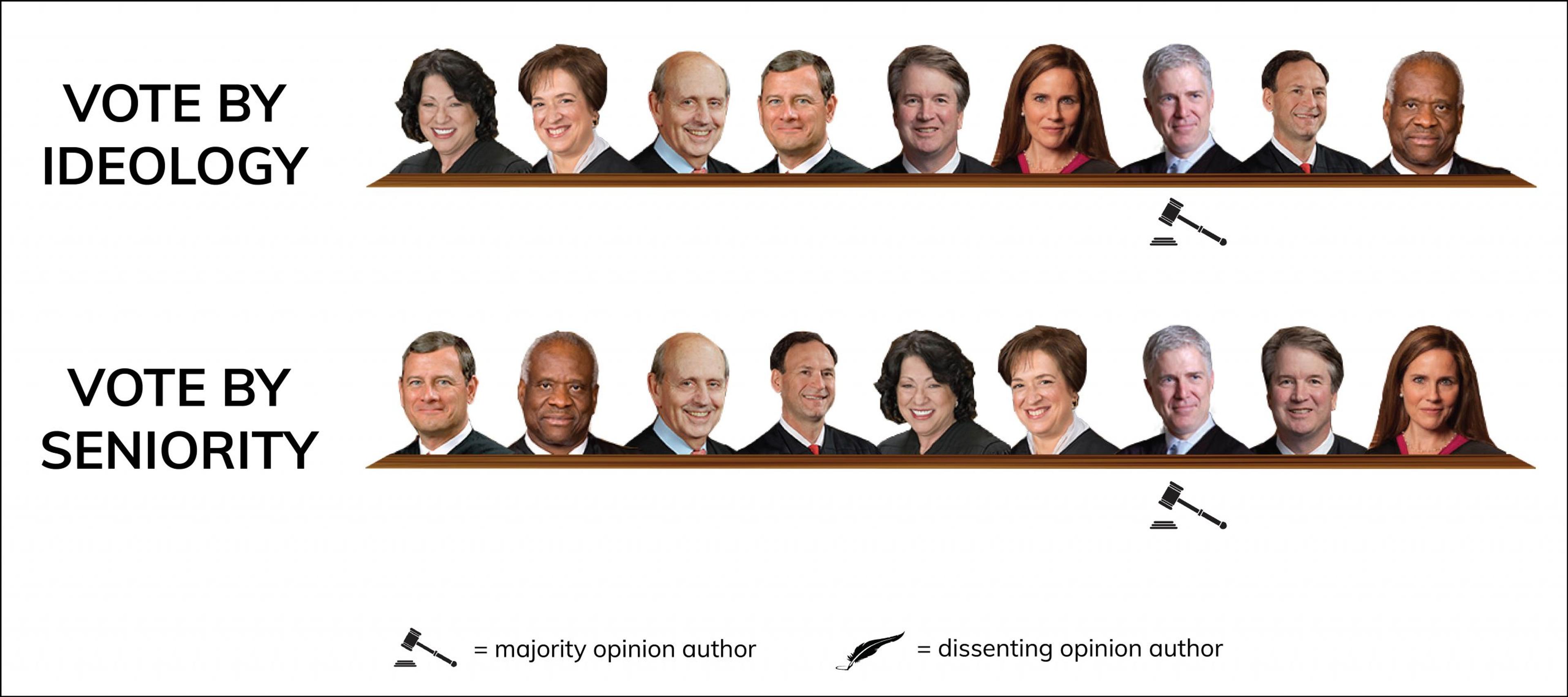
The Supreme Court on Monday reshaped the relationship between universities and the athletes who play college sports. In an opinion by Justice Neil Gorsuch, the justices unanimously ruled that the National Collegiate Athletic Association cannot prohibit its member schools from providing athletes with certain forms of education-related benefits, such as paid post-graduate internships, scholarships for graduate school, or free laptops or musical instruments.
Although the decision did not involve cash payments to college athletes, it may pave the way for a future Supreme Court ruling on whether college athletes should be able to earn money for playing sports – either directly from their universities or through lucrative endorsement deals. In a concurring opinion, Justice Brett Kavanaugh wrote that the NCAA’s policies banning those types of compensation “raise serious questions under the antitrust laws.”
Monday’s decision in NCAA v. Alston ended a dispute that began seven years ago as a class-action lawsuit filed against the NCAA and the major collegiate athletic conferences by athletes who played Division I football and basketball. Under the NCAA’s rules, universities generally are allowed to provide athletes with scholarships covering tuition while they are NCAA-eligible, and they are allowed to cover basic expenses like textbooks and room and board. But most other forms of compensation are banned.
The athletes contended in their lawsuit that the NCAA’s restrictions violate federal antitrust laws by barring the athletes from receiving fair-market compensation for their labor. A federal district court in California agreed in part: It ruled that the NCAA could restrict benefits that are unrelated to education (such as cash salaries), but it barred the NCAA from limiting education-related benefits. After the U.S. Court of Appeals for the 9th Circuit upheld that decision, the NCAA and the athletic conferences went to the Supreme Court, which late last year agreed to take up the case.
In a 35-page decision, Gorsuch first addressed which legal test should apply to the NCAA’s rules restricting athletes’ compensation. The district court applied the most common test in antitrust law, known as the “rule of reason.” The NCAA contended that a less stringent test should apply because the association and its members act as a “joint venture” and have to work together “to offer consumers the benefit of intercollegiate athletic competition.” But Gorsuch noted that less stringent tests apply only in extreme cases, when it is easy to determine what impact an agreement will have on competition. That is not the case here, Gorsuch stressed, because the NCAA and its members control the market for the services of college athletes. The potential anti-competitive effects of the NCAA’s restrictions, he concluded, demand a searching inquiry.

Recommended Citation: Amy Howe, NCAA athletes win 9-0 on educational perks as Kavanaugh calls out ban on direct payments, SCOTUSblog (Jun. 22, 2021, 12:00 AM), https://www.scotusblog.com/2021/06/ncaa-athletes-get-unanimous-win-on-educational-perks-as-kavanaugh-calls-out-limits-on-direct-payments/