Court ponders constitutionality of disparate fees in business bankruptcy cases

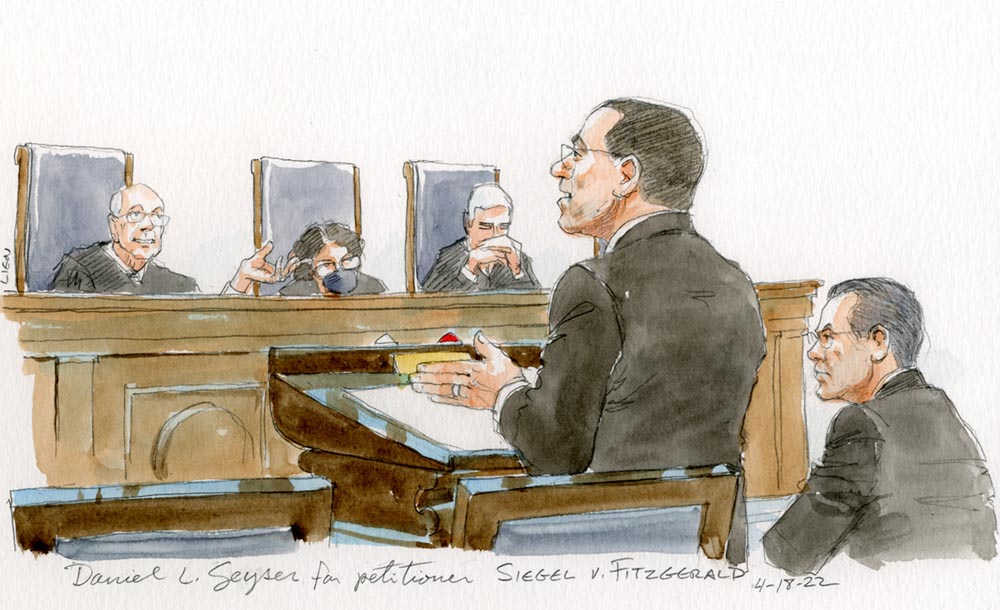
Monday’s argument in Siegel v. Fitzgerald was a meandering exercise that shed little direct light on how the justices will dispose of this matter. As I explain below, my best guess is that the protracted questioning about what the court should do if it holds the challenged provision unconstitutional suggests that most of the justices are seriously considering that outcome.
As my preview explains in more detail, Siegel is a rare case under the Constitution’s bankruptcy clause. The question is whether the system for administering business bankruptcy cases failed to provide “uniform Laws on the subject of Bankruptcies throughout the United States” – as the Constitution requires – during a period when a separate system for administering business bankruptcy cases imposed markedly lower fees in Alabama and North Carolina than in the remainder of the nation.
Daniel Geyser presented argument for the estate of failed retailer Circuit City, which paid about $600,000 more in fees while it was in bankruptcy than it would have had it filed in Alabama or North Carolina. Much of his argument was spent deflecting questions about minor administrative variations. Justice Stephen Breyer asked what would happen if “bankruptcy judges somewhere say we want to start court at 11,” but “other states say no, [we want to start at] 9.” Chief Justice John Roberts was preoccupied with what would happen under Geyser’s position if “one district decides they’re going to buy computers from computer company A and another says no, we’re going to buy them from B.”
Geyser maintained a steady position that the question was whether Congress established the disuniformity. So, under his argument, there would be no problem if Congress permitted all districts to pick their starting time or their computer supplier; it would start to be problematic, though, if Congress required some districts to start at 9 and permitted others to choose when they started. Even then, he emphasized, the court might hold that choosing the time when hearings begin is not a “Law[] on the subject of Bankruptcies.”
Several lines of questioning indicate a disparate group of justices reconciled to the idea that the differential system of administration cannot pass constitutional scrutiny. Justice Sonia Sotomayor, for example, suggested to Geyser a reluctance to “announce a rule that says your laws have to be uniform all the time,” paired with a “gut feeling” that Congress shouldn’t be able to say “this state is going to let the taxpayers pay for something, and the other 48 states don’t have that choice” because businesses must pay the costs themselves.
Justice Elena Kagan was even more pointed, describing the challenged arrangement as “a top-down imposition of a fee structure that predictably can’t help but disadvantage both debtors and creditors in 48 states as compared to two states.” When Curtis Gannon, arguing for the federal government, tried to defend it, she posed a hypothetical:
We’re going to pick four states and they just so happen to be the states of the chair and the ranking member of the relevant committees in the House and the Senate. We’re going to pick those four states and we’re going to give them a system in which fees are a tenth of what they are everywhere else. … Would that be appropriate?
For her, “the idea of Congress picking select states for any purpose becomes something that’s right in the heartland of what you’re worried about.”
The focus of Justice Clarence Thomas on the direct monetary effects of the policy also suggests a hesitation to accept it as permissible. When Gannon suggested that the arrangement was not sufficiently substantive to warrant treatment as a law on “Bankruptcies,” Thomas commented that “the fees – the amounts that are now going to pay fees – would have been distributed, to the extent there were distributions, to creditors.”
Even Roberts, for all the concerns about pointless uniformity expressed in his early colloquy with Geyser, seemed settled against the system by the end of the argument, characterizing the problem as one of “cold, hard cash, [which] is a big deal in bankruptcy.” It seemed obvious to him that “you’d want to file in a place that you’re not going to lose a lot of your [assets] paying fees,” which “makes a big difference if you’re running out of money, right?”
The final notable feature of the argument is how preoccupied several of the justices were with fashioning a remedy, a problem that would be relevant only if a majority of the justices found the arrangement unconstitutional. Justices Samuel Alito and Neil Gorsuch, for example, asked questions only about the remedy. Gorsuch was particularly pointed in his efforts to pin Gannon down on the topic. Gannon’s defense of the arrangement so frustrated Gorsuch at one point that he interjected: “Can you just answer my question, though, Mr. Gannon? … I’m going to keep repeating it until you answer it, okay? … And then you can say whatever the heck else you want to say.” Similarly, Kagan, Sotomayor, and Justice Amy Coney Barrett all spent a considerable amount of time asking questions about potential remedies. The broad-based give-and-take on that subject suggests that figuring out how to respond to the problem is much more challenging for the justices than deciding that the arrangement fails constitutional scrutiny.
Posted in Merits Cases
Cases: Siegel v. Fitzgerald